Newsletter
Newsletter Support JNS

Netanyahu says if he wins election, he can work with US to recognize settlements

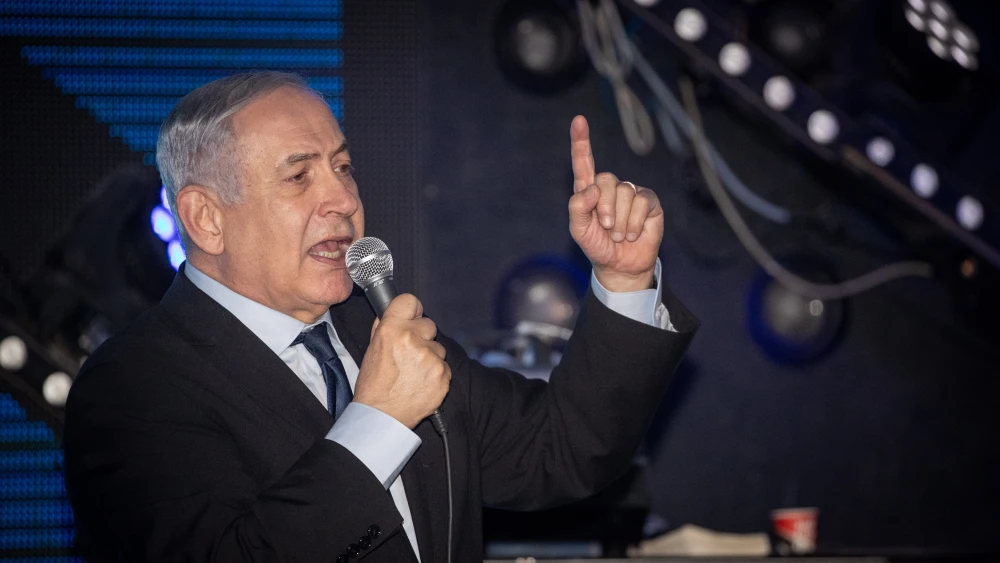
Israeli Prime Minister Benjamin Netanyahu addresses the media after his crushing victory over Likud rival Gideon Sa’ar.

Israeli Prime Minister Benjamin Netanyahu attends a rally in Jerusalem,ahead of the Likud Party primaries. Dec. 22, 2019. Photo by Yonatan Sindel/Flash90.

After crushing his Likud rival Gideon Sa’ar in the Likud primary elections on Thursday, Israeli Prime Minister Benjamin Netanyahu spoke at a meeting of Likud activists at Airport City outside Tel Aviv on Friday morning and expressed his deep thanks to his supporters.

“Yesterday, I received a new, enormous mandate from the Likud,” he said.

Netanyahu pointed out that in 2017 the U.S. administration had recognized Jerusalem as the capital of Israel, and in 2018 had relocated the U.S. embassy in Israel to the city, not to mention leaving the 2015 Iran deal. “And this year, we annexed the Golan Heights, and [the U.S.] stated that settlements are legal,” he said.

“Our rivals would not have achieved that—not only because they aren’t capable of it, but because that is not their path. In the next few years, we will decide on our borders. We will get the Americans to recognize the application of Israeli sovereignty to the Jordan Valley, and all the settlements in Judea and Samaria, and we will make peace deals with Arab states,” declared Netanyahu.

The prime minister thanked everyone who had worked on his campaign to be re-elected.

“I thank all the campaign workers, Foreign Minister Israel Katz, and Culture and Sport Minister Miri Regev. I thank all [Likud] ministers, deputy ministers, MKs, mayors, heads of local campaign offices, volunteers and activists—I thank the Likud!” he said.

Katz and Regev spearheaded Netanyahu’s campaign.

“For 11 years, I had to battle American policy that demanded concessions that would have endangered our security. I stood up to them, and I stood alone against the [Iran] nuclear deal,” he added.

This article first appeared in Israel Hayom.

“Anti-Zionism can be a framework for justifying anti-Jewish hostility,” Rafaela Dancygier, of Princeton University, told the N.J. Advisory Committee to the U.S. Commission on Civil Rights.
A board member at the Orthodox synagogue told the FBI that members began attending services less frequently after Kevin Charles Pyles allegedly targeted the synagogue in separate July and August 2025 incidents.
The Senate rejected a resolution calling for the removal of U.S. forces from the war against Iran after U.S. President Donald Trump hammered Senate Republicans for approving a similar measure the day before.
“When someone uses the N-word on campus, no one thinks about free speech. No one talks about, ‘Let’s understand what they’re thinking. Let’s have a discussion,’” Rep. Randy Fine said. “But somehow when it came to Jews, everyone wanted to rediscover the idea of free speech.”
“Leadership should be responding with moral clarity, not suggesting that the act of teaching about the Holocaust has somehow ‘missed the mark,’” said Kurt Schwartz, CEO of CAMERA.
The judges said the sanctions, which the United States imposed in response to the Hague-based court’s targeting of Israel, are unlawful.
Benny Gantz, JNS editor-in-chief Jonathan S. Tobin, Gilad Erdan, Mosab Hassan Yousef, Nissim Black and leading voices in security, diplomacy, media, law and Jewish communal affairs headline the summit’s third day in Jerusalem.