Newsletter
Newsletter Support JNS

Report: Sudan to hold talks with Israel on trade, migration

Sudanese Prime Minister Abdalla Hamdok wants the parliament in Khartoum, which has not yet been formed, to approve normalization with Jerusalem, meaning the process may take time.

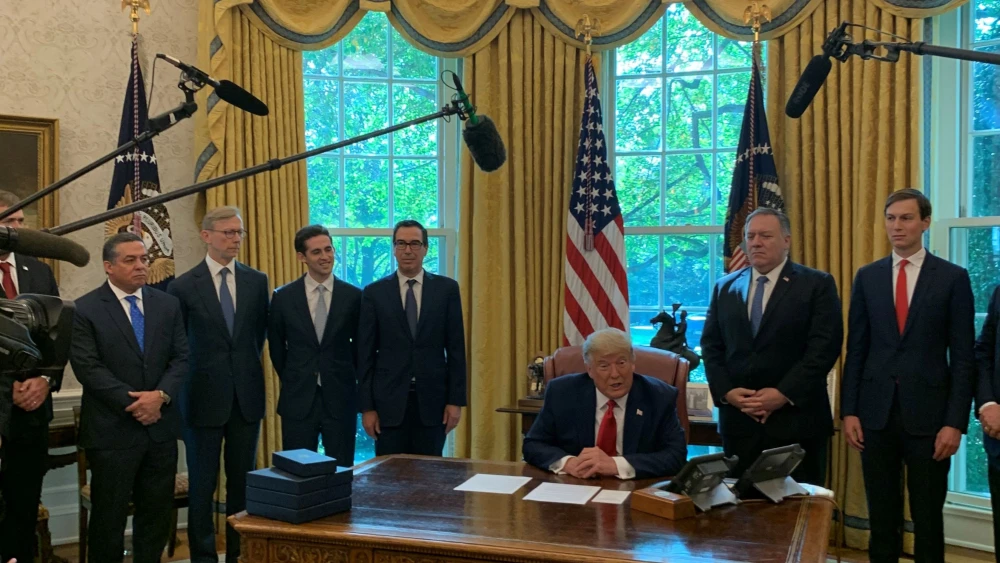
U.S. President Donald Trump and senior members of his administration in the Oval Office of the White House as Sudan agrees to normalize relations with Israel. Credit: Michael Crowley/The New York Times for White House/POOL.

Sudan announced on Sunday that it will hold talks with Israel in the coming weeks on a number of issues.

The Sudanese Foreign Ministry said that delegations from each country would negotiate deals for agriculture, aviation, trade and migration, Reuters reported.

According to the report, Sudanese Prime Minister Abdalla Hamdok wants the parliament in Khartoum, which has not yet been formed, to approve formal normalization with Israel, meaning the process may not be a quick one.

Meanwhile, Israeli Prime Minister Benjamin Netanyahu tweeted on Sunday that Israel will be “sending $5 million worth of wheat immediately to our new friends in Sudan.”

Major oppositionist factions in Sudan have rejected the peace deal between Israel and the transitional government in Khartoum, announced on Friday by U.S. President Donald Trump, who helped broker the agreement.

“If necessary, we will strike with even greater force,” said Israel’s defense minister.
Fifteen people were wounded Sunday when fragments from intercepted Iranian missiles fell across Tel Aviv as rescue crews and police secured impact sites.
Fighter jets hit multiple military targets in Tehran and across the country to weaken the regime’s ability to produce and launch ballistic missiles.
“The Iranian terrorist regime poses a global threat. Now, with missiles that can reach London, Paris or Berlin,” the military said.
IAEA Director-General Rafael Grossi says “maximum military restraint should be observed, in particular in the vicinity of nuclear facilities.”
The initiation of the joint U.S.-Israel military campaign against Iran has precipitated a fundamental refocusing of regional priorities. This unprecedented military undertaking has forcefully shifted the geopolitical center of gravity toward the Persian Gulf, rapidly relegating the Gaza Strip to a secondary theater of operations.