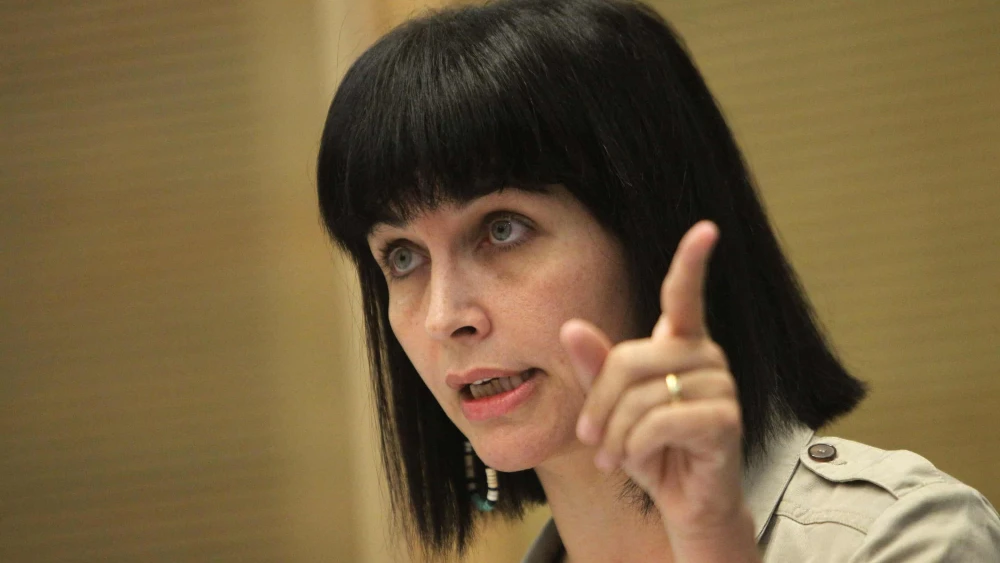
“My hope is to achieve as much political power as possible to shape the future of the country,” Einat Wilf, founder of Israel’s newest political party, Oz, told JNS on Thursday. She began considering establishing the Oz Party as an independent movement after the Oct. 7, 2023, Hamas onslaught on Israel, she said.
“I realized two things: first, that there was a massive gap between Israelis and their government, and second, that the ideas I was discussing were not only central to Israel’s key challenges, but were also original and didn’t fit into any existing political party,” she said.
“I thought that only by establishing a new party could I find out whether there was interest and whether it could translate into political support,” she added. Wilf previously served as a member of the Knesset for the Labor Party and Ehud Barak’s Independence Party.
Oz, she told JNS, is built on three guiding principles.
The first is to “pursue peace based on Arab and Palestinian embrace of Zionism. The conflict has always been about Arab—and especially Palestinian—rejection of the Jewish right to self-determination in any part of the land. As such, the vision we should put forward is one in which the Arab world and the Palestinians abandon their obsession with the nonexistence of the Jewish state and adopt the constructive vision of living alongside a Jewish state, not on its ruins,” she said.
The second principle is “social services for those who serve the public.” Wilf argues that a welfare state cannot function based on an abstract notion of rights.
“In Israel, this is best expressed through military service and the willingness to defend the country, which means universal conscription of women and men, Jews and Arabs. Those who reject the opportunity to defend the country are effectively saying they want nothing to do with the state and will not be recipients of social services,” she said.
The third principle, she said, is completing the “Zionist revolution—from a diaspora mindset to sovereign conduct. This guides many of my positions on the relationship between the religious establishment and the state, as well as long-term planning for borders and Israeli governance,” she added.
On borders, Wilf said that the conflict has never been about “settlements” or “occupation"—and that it will only be resolved once the other side no longer seeks the destruction of the State of Israel.
“I believe Israel should determine its borders even without peace. Our enemies try to prevent us from doing so because they want us to remain temporary, and I don’t think we need to accept that,” she said.
Regarding the relationship between state and religion, Wilf said rabbis should not have state authority and the state should not fund religious services. For her, there is no connection between state-funded religious services and Israel’s status as the national home of the Jewish people.
On governance, Wilf argues that in the struggle between the Supreme Court and the government, power should be returned to the Knesset—the only sovereign body that represents the people. “The main idea is that the Knesset should be the strongest body and the place where decisions are made. The Supreme Court and the government should be subservient to the Knesset,” she said.