


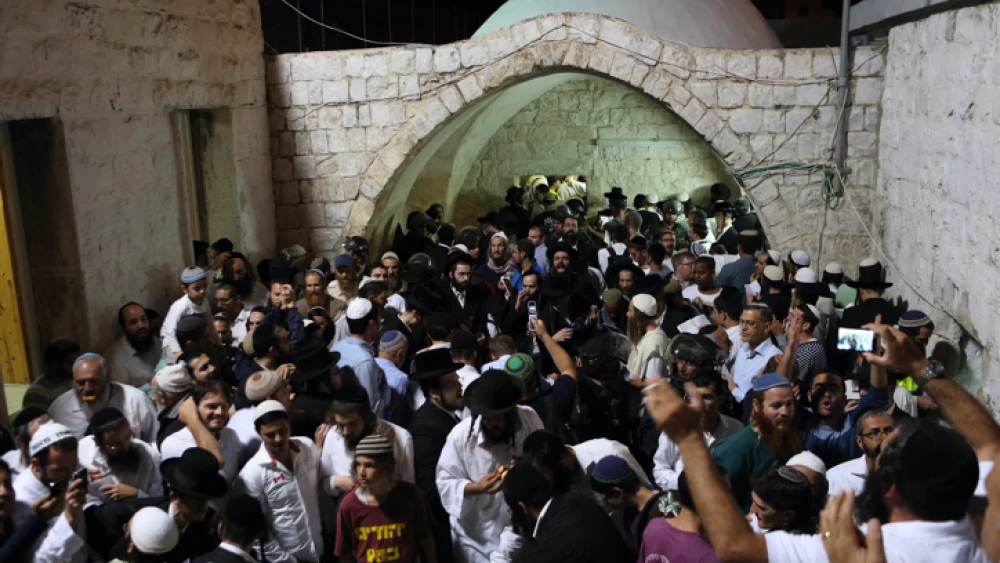
Thousands of Jewish worshippers took part in the monthly pilgrimage to Joseph’s Tomb in the Palestinian Authority-controlled town of Nablus (Shechem) on Tuesday night, making it the largest delegation to the holy site since the onset of the pandemic.
Among those in attendance were Shas Party Knesset members Erez Malul and Avraham Betzalel and Shomron Regional Council head Yossi Dagan, as well as several prominent rabbis, mayors and security officials.
The visit came just over a year after Arab vandals set fire to the structure, smashing parts of the tomb itself and causing other damage.
During Tuesday’s visit, local Arabs fired on Israeli troops guarding the delegation, in addition to throwing rocks and firebombs at them. The Israeli forces returned fire, and a number of hits were reported, according to the Israeli military. Several arrests were also made, and weapons seized. There were no reports of injuries to Israeli forces.
Elliott Cahan, director of development North America for the Elon Moreh Hesder Yeshiva, which overlooks Shechem, told JNS that some of his students participated in Tuesday’s delegation.
“It’s absurd that shooting in or near the Joseph’s Tomb compound has become the new normal,” said Cahan. “In the past, this would not have happened. In the eight years that I have worked here in Elon Moreh, I don’t recall this much shooting,” he added.
“It’s extremely important that we continue to exercise our right for freedom of worship at Joseph’s Tomb, which was explicitly agreed to under the Oslo Accords. We have to continue to visit and can’t be afraid,” he said.
Palestinian Arabs have desecrated the site numerous times over the years, with perhaps the worst damage taking place during the Second Intifada in 2000, after Israel pulled out of the area following a deadly terrorist attack there in October of that year.
Israelis started visiting again in 2004 following the IDF’s “Operation Defensive Shield,” albeit on a limited basis. Visits, typically on or near the beginning of the new Hebrew month, or during Jewish holidays, take place in the middle of the night, with visitors arriving in bulletproof buses accompanied by full IDF escorts.
During Tuesday night’s visit, Shomron Regional Council head Dagan said that the current state of affairs at the site could not continue.
“We arrived here with the masses in order to pray at this holy site, but also to tell the government that the situation in which Jews are forced to arrive here in the middle of the night can’t continue. This is one of the holiest sites in all of Judaism, and even under the terrible Oslo Accords, Joseph’s Tomb, and the road to get here, is supposed to be under Israeli control,” he said.
“We, on behalf of the People of Israel, expect the Israeli government to act with strength and valor, and bring back the Od Yosef Chai Yeshiva [housed at Joseph’s Tomb from 1982-2000], bring back the army here full-time, and raise the Israeli flag to show everyone—ourselves and our enemies—that we are not afraid,” he continued.
“Precisely at this time when [hostile] forces are trying to create a division in our nation, we are choosing to connect to Joseph the Righteous, who was a unifier, who knew how to forgive and who knew how to unite the People of Israel, and the entire world,” he concluded.
MK Betzalel said, “We’re very happy to be here at this holy site ... We hope that everyone from the nation of Israel can come here, at any hour of any day, as he chooses, in an orderly fashion, in order to pray here at the tomb of Joseph the Righteous.”



