Newsletter
Newsletter Support JNS

Top Likud officials: ‘Positive’ campaign will win us the election

Israel Prime Minister Benjamin Netanyahu’s smash win in the primaries is giving the party a shot in the arm ahead of the battle leading up to March 2.

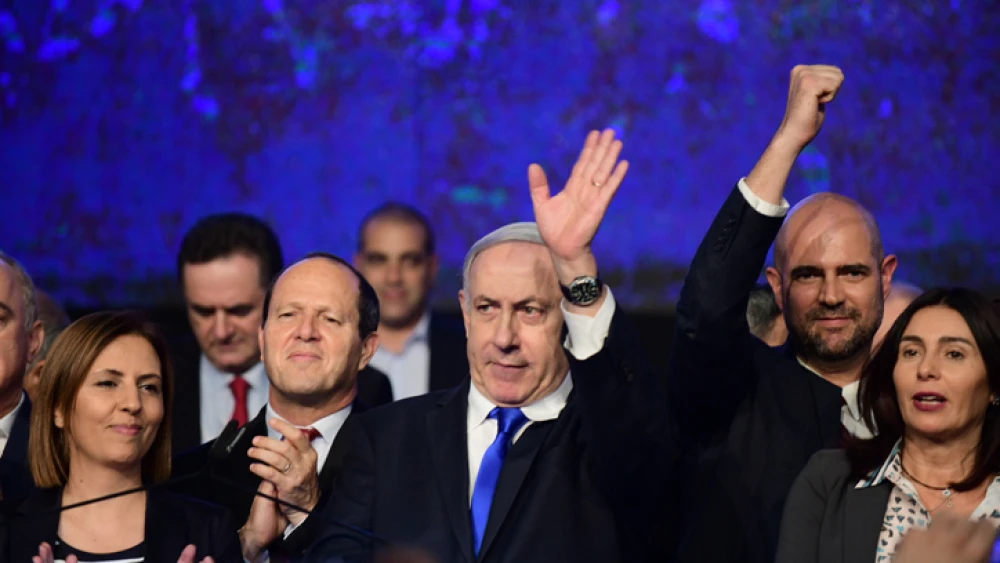
Israeli Prime Minister Benjamin Netanyahu speaks at a Likud Party rally in Tel Aviv, on Nov. 17, 2019. Photo by Tomer Neuberg/Flash90.

Israeli Prime Minister Benjamin Netanyahu’s decisive win in the Likud party primaries last week is an encouraging sign for the Likud as a whole and Netanyahu’s associates in particular.

Members of his inner circle believe that if Netanyahu wages a positive campaign leading up to the March 2 Knesset election, with plenty of time out in the field and without attacks on his political rivals, the party can win enough seats to enable it to form a governing coalition of 61 seats without Avigdor Lieberman’s Yisrael Beiteinu Party.

In another Likud development, party officials think that Netanyahu will appoint Foreign Minister Israel Katz as head of the Likud election committee after his success waging Netanyahu’s campaign in the primaries. As part of an attempt to bolster the party’s fieldwork, Likud ministers and Knesset members will be assigned specific areas of the country for which they will be responsible during the campaign.

Likud faction leader Miki Zohar told Israel Hayom that “the primaries were a great indication of how to win an election and how to get stronger ahead of the general election. We used two very clear strategies: A lot of time out in the field campaigning, which ‘woke up’ our side, as well as not attacking the opponent and nearly ignoring his existence. We saw in the primary results how that put a damper on the other side.”

According to Zohar, “Right now, the seat equation is difficult. There, voter turnout comes into play. We need to create a situation in which our bloc turns out to vote in very high numbers. … When it comes to the other side, we need to ignore his existence.”

This article first appeared in Israel Hayom.
“Anti-Zionism can be a framework for justifying anti-Jewish hostility,” Rafaela Dancygier, of Princeton University, told the N.J. Advisory Committee to the U.S. Commission on Civil Rights.
A board member at the Orthodox synagogue told the FBI that members began attending services less frequently after Kevin Charles Pyles allegedly targeted the synagogue in separate July and August 2025 incidents.
The Senate rejected a resolution calling for the removal of U.S. forces from the war against Iran after U.S. President Donald Trump hammered Senate Republicans for approving a similar measure the day before.
“When someone uses the N-word on campus, no one thinks about free speech. No one talks about, ‘Let’s understand what they’re thinking. Let’s have a discussion,’” Rep. Randy Fine said. “But somehow when it came to Jews, everyone wanted to rediscover the idea of free speech.”
“Leadership should be responding with moral clarity, not suggesting that the act of teaching about the Holocaust has somehow ‘missed the mark,’” said Kurt Schwartz, CEO of CAMERA.
The judges said the sanctions, which the United States imposed in response to the Hague-based court’s targeting of Israel, are unlawful.
Benny Gantz, JNS editor-in-chief Jonathan S. Tobin, Gilad Erdan, Mosab Hassan Yousef, Nissim Black and leading voices in security, diplomacy, media, law and Jewish communal affairs headline the summit’s third day in Jerusalem.