


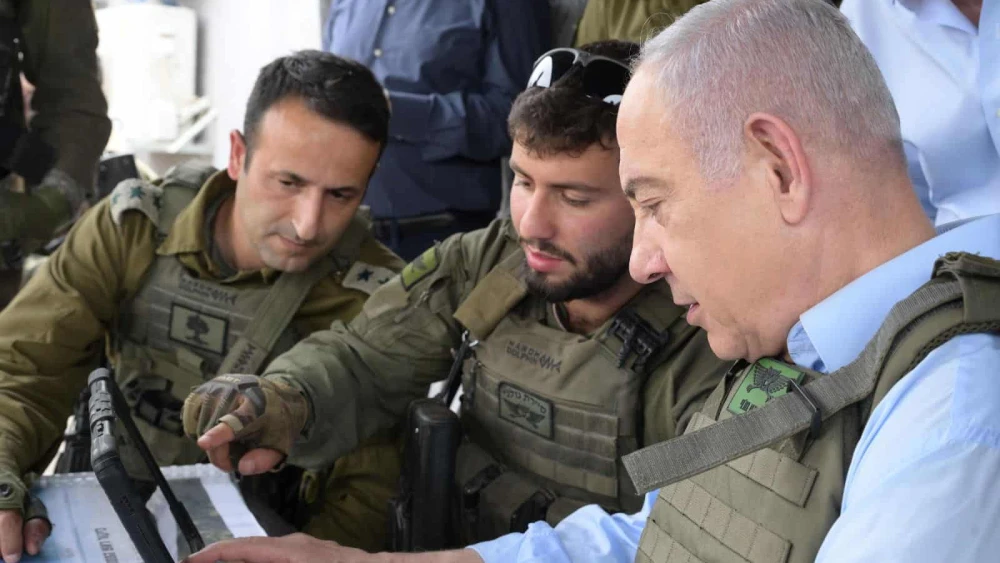
Prime Minister Benjamin Netanyahu told troops in the north on Tuesday that Israel was committed to safely returning tens of thousands of displaced residents to their homes near the Lebanon border.
“We are committed—in both the civilian and military spheres—to returning the residents safely to their communities and their homes. This is one of the objectives of the war and we are not conceding it,” said the premier during a visit to the IDF Northern District Intelligence Branch base.
Netanyahu received a situational briefing from Intelligence Branch head Maj.-Gen. Aharon Haliva and Unit 8200 signal intelligence unit commander Brig.-Gen. Y. He then went to a post on the Lebanese border, where he met with Golani Brigade Reconnaissance Battalion fighters. Golani Brigade commander Col. Adi Ganon and Reconnaissance Battalion head Lt.-Col. David Cohen briefed Netanyahu on their operational activity in the sector.
“I am here with the soldiers of the Golani Brigade and the Golani Brigade Reconnaissance unit, a splendid unit that is fighting in Gaza, in Judea and Samaria, and now here on the northern border,” said Netanyahu. “They have lost friends but have an exceptional fighting spirit and marvelous achievements, together with their fellow soldiers.”
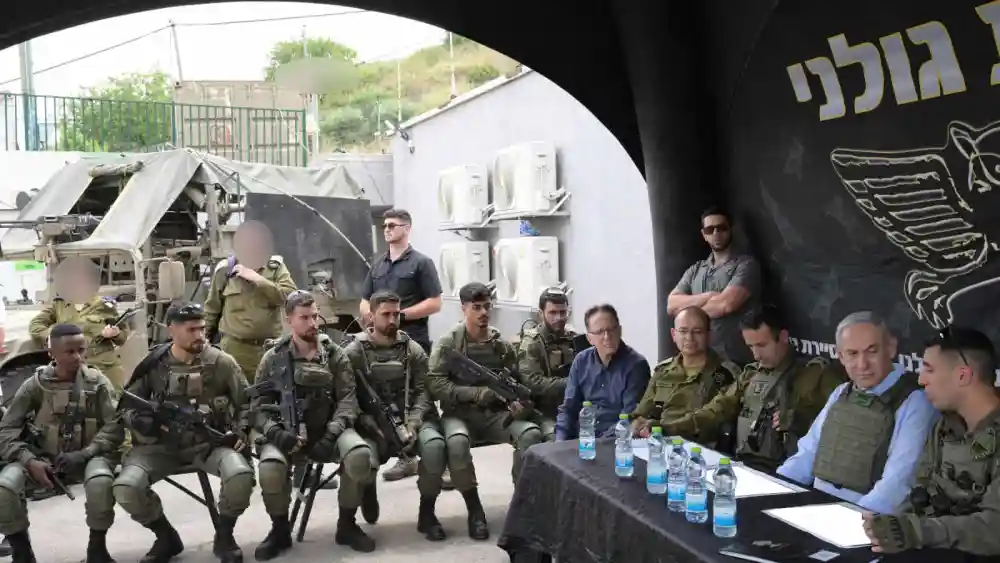
Netanyahu’s chief of staff and military secretary, Tzachi Braverman and Maj.-Gen. Roman Gofman, respectively, as well as National Security Council Director Tzachi Hanegbi accompanied him on the visit.
Israeli President Isaac Herzog also visited the north on Tuesday, meeting with Metula’s mayor, David Azoulay and others from the evacuated town on the Lebanese border.
Herzog also met with members of the civilian security squad and IDF reservists serving there, saying that despite the current war, Metula “will exist for hundreds and thousands of more years.”
באתי אמש לביקור במטולה כדי לחזק את ראש המועצה דוד אזולאי וכיתת הכוננות של היישוב. היה לי חשוב להעביר משם מסר מחזק ותומך לאלה שמגנים על הריבונות שלנו עד קו הגבול ושומרים על יישוב היסטורי שמתקרב לשנתו ה-130 ונמצא בתקופה הקשה ביותר בתולדותיו, ולומר לתושבות ותושבי מטולה המפוזרים בכל… pic.twitter.com/zPxllL8KVb
— יצחק הרצוג Isaac Herzog (@Isaac_Herzog) May 29, 2024
Their trips to the north came a day after the government unveiled a 3.5 billion shekel ($950 million) plan to rehabilitate the country’s north, which has suffered near-daily attacks by Hezbollah since Oct. 7. More than 60,000 area residents remain displaced nearly eight months into the war.
The immediate-term plan joins a multi-year plan dubbed “Northern Dawn” that offers specific proposals for rebuilding and developing the region.
The plan’s approval brings the overall budget for Israel’s north to 6.5 billion shekels, or roughly $1.8 billion.
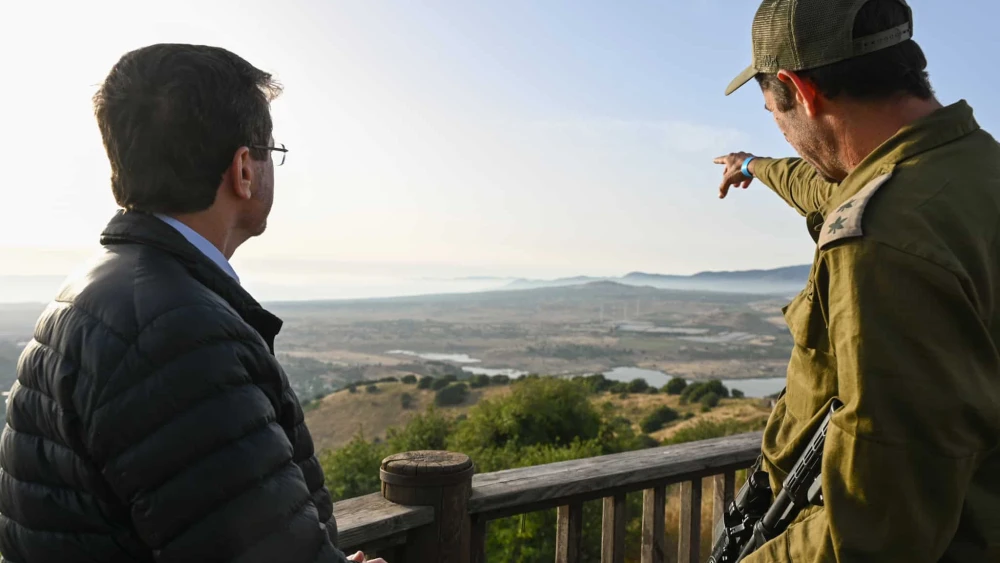
“Israel sovereignty extends until the border, most definitely. We simply care for the residents and therefore they’re not here. But this war will eventually end in one way or another,” Herzog said.
“I tell you with certainty, and I tell Metula residents: We will definitely return here,” the president added. “We will return calm to Metula and the entire north.”



