Newsletter
Newsletter Support JNS

Netanyahu vows to bring home Israeli woman imprisoned in Russia

“I’m not a magician, but I’ll bring Naama home,” Israeli Prime Minister Benjamin Netanyahu tells supporters • Israeli American Naama Issachar, 26, was sentenced to 7.5 years in prison on drug charges.

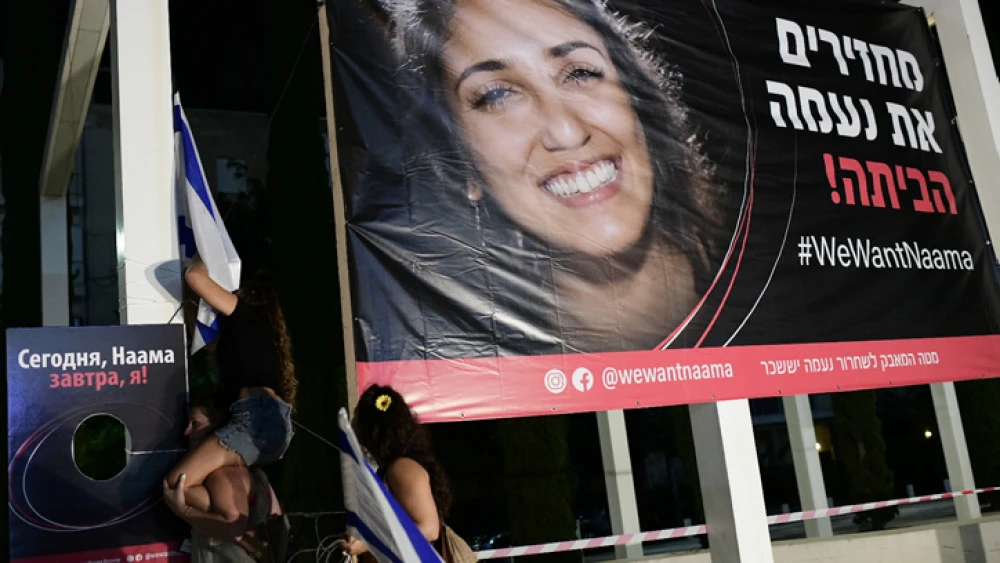
Protesters call for the release of Naama Issachar, an Israeli woman imprisoned in Russia for drug offenses, at Habima Square in Tel Aviv, on Oct. 19, 2019. Photo by Tomer Neuberg/Flash90.

Israeli Prime Minister Benjamin Netanyahu on Tuesday promised to personally ensure the release of an Israeli American woman being held in Russia on drug charges.

Naama Issachar was arrested in April while traveling via Moscow from India after Russian airport security discovered 9.5 grams of cannabis in her belongings. Two months ago, she was sentenced by a Russian court to seven-and-a-half years in prison.

Speaking at a Likud Party gathering in Haifa, where he was greeted by hundreds of enthused supporters, Netanyahu promised to use his close relationship with Russian President Vladimir Putin to see that the 26-year-old returns to Israel.

“I am not a magician, but I will bring Naama Issachar home,” he vowed.

Yaffa Issachar, Naama’s mother, sent a letter to Netanyahu on Tuesday requesting that he and the Israeli Foreign Ministry advocate for her daughter’s release before the first night of Hanukkah, which falls on Sunday, Dec. 22.

According to various reports, before Issachar was sentenced, Moscow pressured Jerusalem for a prisoner exchange with Russian hacker Alexei Burkov, who was incarcerated in Israel at the time. The government refused, later authorizing his extradition to the United States.

This article first appeared in Israel Hayom.

“Before the war, the public was divided,” the premier said. “I think that has changed.”
Prosecutors say defendants linked to the IRGC planned assassinations and arson against the Federal Republic’s top Jewish leader, a pro-Israel activist and Jewish businesses.
A change in Austrian law could allow survivors who remained in the country after World War II while searching for relatives or awaiting visas to receive long-denied benefits.
The facility, mainly used by budget airlines, had been shut for four months due to reduced traffic during the war with Iran.
“Peace is tied to freeing Lebanon from the de facto Iranian occupation,” said Gideon Sa’ar.
Jerusalem and Beirut recognized “that they are not at war w/ each other but with terror group Hezbollah,” the U.S. ambassador said.
Benny Gantz, JNS editor-in-chief Jonathan S. Tobin, Gilad Erdan, Mosab Hassan Yousef, Nissim Black and leading voices in security, diplomacy, media, law and Jewish communal affairs headline the summit’s third day in Jerusalem.