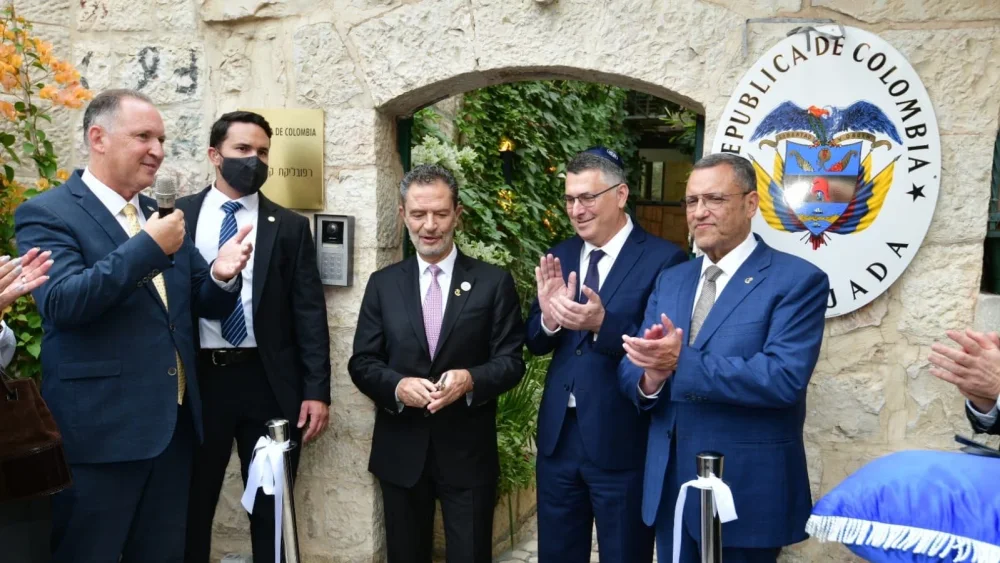
Colombia on Wednesday morning opened its embassy in Jerusalem, the 10th foreign diplomatic mission in the Israeli capital.
Israeli Foreign Minister Gideon Sa’ar, joined by Colombian Foreign Minister Omar Bula Escobar, Jerusalem Mayor Moshe Lion and Israel’s ambassador to Colombia, Vivian Aisen, said after signing the embassy’s guest book that it was a “historical day for the relations between Colombia and Israel, which is also an important day for Jerusalem, our capital.”
During the ceremony, the embassy sign was unveiled and Sa’ar affixed a mezuzah at the entrance.
Join us live now for the official opening ceremony of the Colombian Embassy in Jerusalem with FM @gidonsaar and Colombian FM Omar Bula Escobar! 🇮🇱🇨🇴https://t.co/qan75fjqUU
— Israel Foreign Ministry (@IsraelMFA) October 14, 2026
In a post on X shortly after the ceremony, Sa’ar said Colombian President Abelardo de la Espriella had pledged during a meeting in Buenos Aires, before his election, to move Colombia’s embassy to Jerusalem immediately upon becoming president.
“He promised—and fulfilled,” Sa’ar wrote, adding that the number of embassies in Jerusalem had doubled since he took office less than two years ago. “There will be more, God willing—and soon!”
יום חשוב והיסטורי ליחסי ישראל-קולומביה וגם לירושלים, בירתנו.
— Gideon Sa'ar | גדעון סער (@gidonsaar) October 14, 2026
הבוקר חנכתי, יחד עם חברי שר החוץ של קולומביה @omarbula, את שגרירות קולומביה בירושלים.
אני מודה לנשיא קולומביה חברי @ABDELAESPRIELLA, שאמר לי בבואנוס-איירס, הרבה לפני שנבחר: ״אם אבחר לנשיא הרפובליקה - אעביר מיד את… pic.twitter.com/cXPDjhQAAH
“Opening an embassy in Jerusalem is not only recognition of the simple political fact that Jerusalem is Israel’s capital,” Sa’ar said at the ceremony. “It is also recognition of a historical truth that no honest person can deny.”
“Today, we are taking a concrete step towards restoring diplomatic relations between our countries, relations that should never have been broken,” Escobar said at the ceremony, according to Israel’s Foreign Ministry. “Israel is a strategic partner. It always has been, and from now on, it will be an even stronger one.”
Aisen welcomed the opening in a post on X.
“May it be another step in strengthening the bonds of friendship between our nations!” she wrote.
Sa’ar was scheduled to host Escobar for bilateral talks at the Foreign Ministry in Jerusalem following the ceremony.
Escobar arrived in the Jewish state on Tuesday ahead of the inauguration.
The same day, Jerusalem and Bogotá restored their free trade agreement, in what the Israeli Foreign Ministry described as “a further significant step to strengthen diplomatic and economic ties.”
“I thank my friend, Colombian President Abelardo de la Espriella, for his determination to bring Israel-Colombia relations to an all-time high,” Sa’ar said. “I am confident that together we will achieve exactly that.”
The embassy opening marks a diplomatic reversal under Espriella, who took office in August and restored ties with Israel after his predecessor, Gustavo Petro, severed them over the Gaza war. Colombia also became the second country after the United States to recognize Israeli sovereignty over the Golan Heights.
Tuesday’s actions formally reverse Petro’s decision to terminate the free trade agreement with Israel. The completion of the exchange of diplomatic notes follows the understandings reached between Sa’ar and Escobar, during their meeting in Washington on July 15.
Colombia had long been considered one of Israel’s closest partners in Latin America, maintaining extensive cooperation in trade, agriculture and security before relations deteriorated under Petro.
“In just two months, we have reversed most of the negative consequences of the Petro era and opened new doors in Israel-Colombia relations,” said Sa’ar.
Nine other countries currently have embassies in Israel’s capital: the United States, Fiji, Guatemala, Honduras, Kosovo, Naoero (Nauru), Papua New Guinea, Paraguay and Somaliland.
All the other nations that have diplomatic relations with Israel maintain their embassies in Tel Aviv or its suburbs.
U.S. President Donald Trump’s decision to move the American embassy to Jerusalem during his first term set the stage for other countries to follow suit.
The Democratic Republic of Congo is expected to be the next country to move its embassy to Jerusalem.
Argentine President Javier Milei and Sen. Flávio Bolsonaro, the front-runner in the Brazilian presidential race, have both pledged to move their countries’ embassies to Israel’s capital.