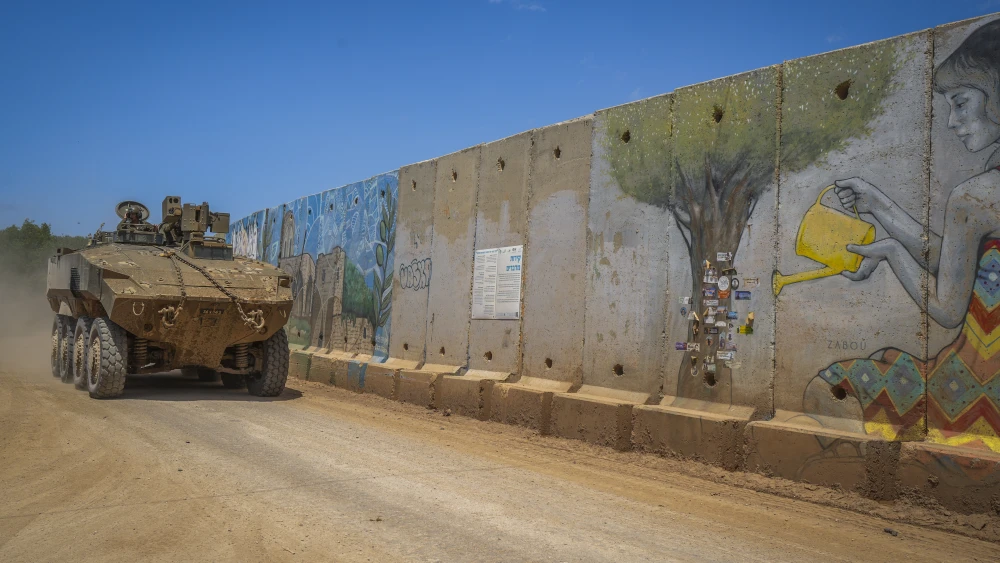
A Hezbollah suicide drone scored a direct hit in the northern Israeli border community of Shomera on Thursday morning, moderately injuring two Israel Defense Forces soldiers, the military confirmed to JNS.
Several other soldiers sustained light injuries, a military spokeswoman said, adding that troops of the ultra-Orthodox Hasmonean Brigade assisted in evacuating the wounded.
In an earlier statement, the IDF said that “following the sirens that sounded in the communities of northern Israel, impact from a UAV was identified in the area of Shomera.”
Alerts warning of incoming rockets sounded in the north due to concerns of falling debris from an interceptor missile launched at the UAV, the military added.
Throughout the day on Thursday, Hezbollah also targeted IDF soldiers operating south of the ceasefire line in Lebanon, with explosive drones.
“The Israeli Air Force successfully intercepted the majority of the targets. The interception results of several remaining targets are under review,” according to a statement.
In another attack, an unmanned IDF aircraft was shot down by Hezbollah with an surface-to-air missile, the IDF said, adding that the incident was under investigation.
תיעוד השניות הראשונות אחרי פיצוץ רחפן הנפץ הבוקר בשומרה. pic.twitter.com/ldDIeSlgbb
— זירת החדשות (@ZiratNews) April 30, 2026
“This isn’t a ceasefire—it’s nonstop fire,” Shimon Guetta, head of the Ma’ale Yosef Regional Council in the Western Galilee, which administers Shomera, told Ynet following Thursday morning’s drone strike.
“A difficult morning,” he said. “I was in another community and rushed toward the school to check on the children’s safety. I saw them trembling.”
Earlier this week, a projectile launched by Hezbollah impacted around 1,000 feet from a school, said Guetta, adding, “It’s impossible to go on like this. Not even half the students are attending school.”
Hezbollah began firing rockets and drones at Israel on March 2, after the Jewish state’s targeted killing of Iranian Supreme Leader Ali Khamenei on Feb. 28.
In response to the terrorist organization’s violation of the U.S.-brokered Nov. 27, 2024, truce agreement, Jerusalem launched an aerial campaign against Hezbollah and ordered the IDF to advance and take control of additional areas in Southern Lebanon to halt cross-border attacks.
Jerusalem and Beirut on April 16 agreed to a 10-day ceasefire following mediation by U.S. President Donald Trump. Last week, the two countries agreed to extend the truce for three more weeks following historic direct talks in Washington, D.C.

On Wednesday night, the IDF said it successfully intercepted a “suspicious aerial target that was launched from Lebanon toward Israeli territory.” The attack triggered air-raid sirens in the Upper Galilee village of Misgav Am.
The attack came just hours after Hezbollah terrorists launched rockets toward the Jewish state, setting off air-raid sirens in several Upper Galilee communities.
In addition, the Iranian-backed terrorist organization targeted IDF soldiers in Lebanon with explosive drones in several incidents on Wednesday.
The IDF in two days dismantled more than 30 terrorist infrastructures in aerial and ground operations throughout Southern Lebanon, the military said in a statement.
The Israeli Air Force, working together with the army’s 91st “Galilee” Division, struck some 20 Hezbollah sites in the areas of Baraashit and Shaqra on Wednesday, it stated. The strikes targeted weapons facilities, command centers and other “structures used by the terrorist organization for military purposes,” according to the IDF.
Also on Wednesday, IDF troops discovered a Hezbollah launch position inside a civilian structure in Southern Lebanon during a raid south of the truce line.
“The launcher was directed toward Israeli territory and IDF soldiers operating in Southern Lebanon, posing an imminent threat to them,” stated the military. “The soldiers struck and dismantled the launcher in order to remove the threat.”

In a separate statement on Wednesday, the IDF announced that soldiers had eliminated a Hezbollah terrorist who was operating in close proximity to them, in violation of the ceasefire.
The troops struck the terrorist with an armed drone “while he was attempting to flee on a motorcycle,” it added.
IDF Chief of Staff Lt. Gen. Eyal Zamir, during a visit to At-Taybeh in Southern Lebanon on Wednesday, instructed soldiers to “continue to operate, remove direct and indirect threats from the northern communities, dismantle terrorist infrastructure, locate and eliminate terrorists.”
“We continue operating and are working to deepen our operational achievements and protect our troops. On the front lines, we are not ceasing fire,” the military chief said during the visit.
“The mission assigned to us by the political echelon is to position ourselves along a line that prevents direct fire on the communities. We have achieved this—this is the line we are holding,” he continued, referencing the security zone created by the IDF inside Lebanese territory.
The IDF “may be required to remain” on the current truce line, Zamir said, adding: “We will not tolerate attacks and fire on our communities, and we will not leave until long-term security for the northern communities is ensured.”