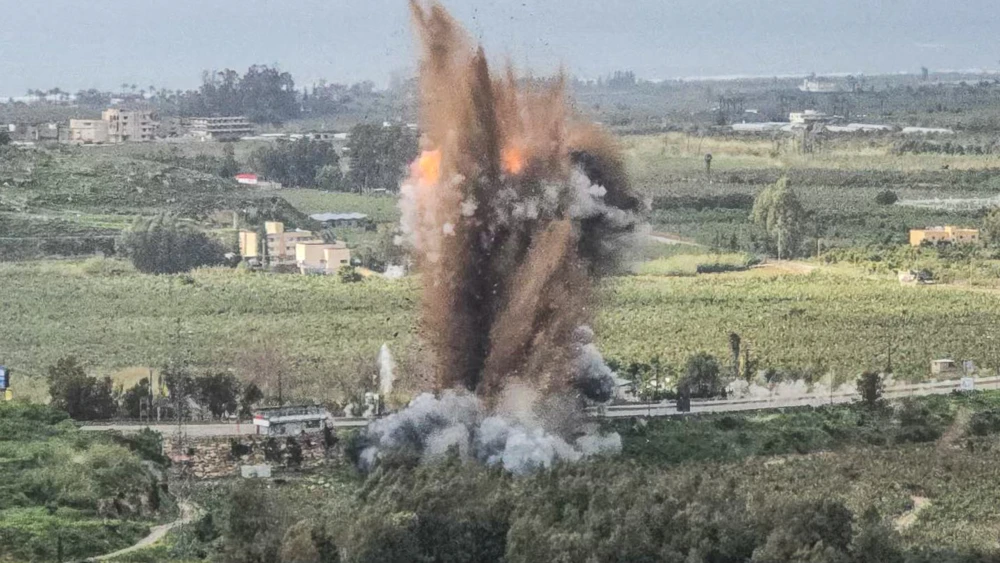
The Israel Defense Forces on Sunday struck a bridge in Southern Lebanon used by Iranian-backed Hezbollah to transfer thousands of weapons southwards, the military said.
The weapons that were transferred across the Litani River “were used to carry out terror attacks from the southern Litani area against IDF soldiers and Israeli civilians,” according to the statement.
The crossing was struck “to prevent harm to Israeli civilians, as well as to Lebanese civilians,” it added.
צה"ל השמיד מעבר מעל נהר הליטאני המשמש את מחבלי ארגון הטרור חיזבאללה לתנועה מצפון לדרום הליטאני בלבנון
— צבא ההגנה לישראל (@idfonline) March 22, 2026
צה"ל השמיד היום מעבר מרכזי ששימש את מחבלי ומפקדי ארגון הטרור חיזבאללה כמעבר מצפון לדרום הליטאני בלבנון.
ארגון הטרור חיזבאללה, משתמש במעבר זה להעברת אלפי אמצעי לחימה, רקטות… pic.twitter.com/2uxpkvCuEF
In a second wave of strikes in Southern Lebanon’s Nabatieh region on Sunday, around 15 command centers used by Hezbollah were targeted, the IDF stated.
“The IDF is operating decisively against the Hezbollah terrorist organization in response to its deliberate decision to attack Israel on behalf of the Iranian terror regime,” it said. “The IDF acts to remove threats to civilians of the State of Israel.”
Israeli Defense Minister Israel Katz, after an assessment of the situation in Lebanon with top-ranking IDF staff earlier on Sunday, said he and the prime minister had ordered the IDF to “immediately destroy all the bridges over the Litani River” to prevent the movement of Hezbollah terrorists and weapons to the south.
Katz also ordered the IDF to speed up the destruction of homes in southern Lebanese villages to eliminate terrorist infrastructure, following a similar model to that used by the Israeli army in Rafah and Beit Hanoun in the Gaza Strip.
“The IDF continues its ground maneuver in Lebanon to eliminate Hezbollah terrorists and reach the anti-tank [missile firing line] ... in order to protect the communities,” he added.
Hezbollah began firing rockets and drones at Israel on March 2, in retaliation for the Jewish state’s targeted killing of Iranian Supreme Leader Ali Khamenei on Feb. 28 in the opening strikes of “Operation Roaring Lion/Epic Fury.”
In response to the terrorist organization’s violation of the U.S.-brokered Nov. 27, 2024, truce agreement, Jerusalem launched an aerial campaign against Hezbollah and ordered IDF troops to advance and take control of additional areas in Southern Lebanon to halt cross-border attacks.
During operations in Southern Lebanon on Sunday, IDF soldiers discovered an anti-tank missile post and weapons, the military said on Monday.
🔍 DISCOVERED:IDF soldiers found an anti-tank missile post and weapons while operating in southern Lebanon. pic.twitter.com/MUzYfBWNBr
— Israel Defense Forces (@IDF) March 23, 2026
IDF Chief of Staff Lt. Gen. Eyal Zamir on Sunday approved plans to expand the ground maneuver in Lebanon.
“The campaign against Hezbollah has only just begun—by the end of the campaign in Iran, Hezbollah will remain alone and isolated. This is a prolonged campaign, and we are prepared for it,” Zamir said following a situational assessment in the northern sector.
“We will not stop until the threat is pushed away from the border and long-term security for residents of the north is ensured. Alongside the strikes, the IDF is reinforcing the front defensive line in order to protect northern residents,” continued the chief of staff.
“We are prepared for a long campaign and will continue to act as required, both offensively and defensively, to ensure the long-term security of northern residents,” he vowed.
Seven IDF soldiers were lightly injured on Sunday in three separate incidents in Lebanon and on the Jewish state’s northern border, the military confirmed in a statement to JNS on Monday.
“The soldiers were evacuated to receive medical treatment at the hospitals and their families were notified,” the IDF stated.