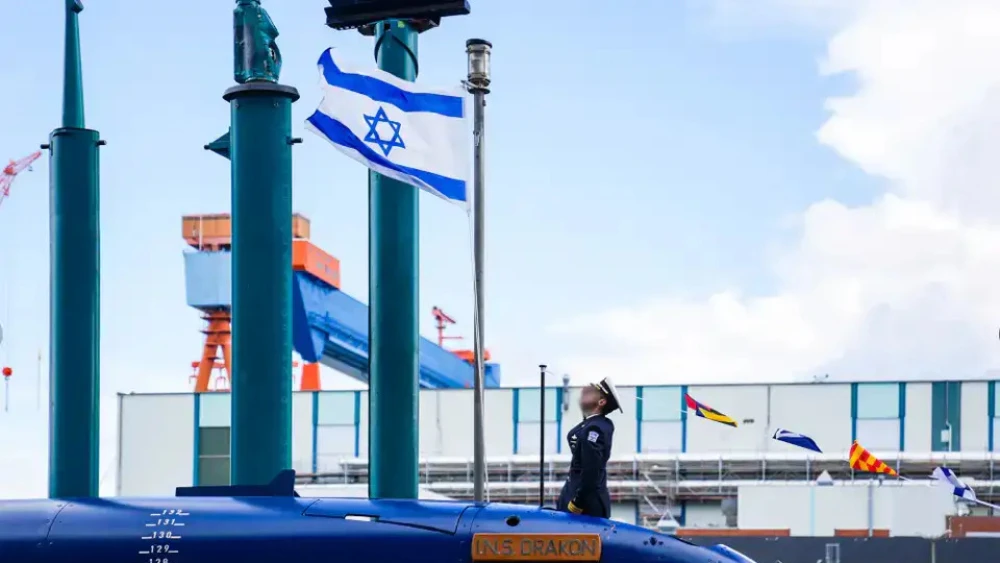
Israel’s newest submarine, INS Drakon, has entered Israeli territorial waters, 14 years after construction began. On Thursday, the submarine will be formally welcomed in a ceremony at the Haifa Naval Base.
The arrival of INS Drakon was delayed by several months after Norway and Denmark barred the submarine from entering their territorial waters during sea trials, despite the fact that it was sailing under a German rather than an Israeli flag.
It is the sixth submarine in the Dolphin AIP series to enter service. Israeli Navy officials say its classified capabilities are considered “game-changing,” and that following an approximately two-month process to make it fully operational, it will become the most advanced war machine in the Israel Defense Forces.
The Israeli Navy is now concerned that defense restrictions imposed by Canada, France, Denmark and Norway could also delay the arrival of the three future Dakar-class submarines currently under construction in Germany. Israel is closely monitoring Germany’s domestic political developments, concerned that they could impede the project’s progress.
Until the Dakar-class submarines arrive, beginning in 2033 according to current plans, Israel’s three older Dolphin-class submarines will remain in operational service to maintain the Navy’s force strength. Those submarines arrived in Israel between 1999 and 2001.
The submarine flotilla carries out approximately 10,000 hours of operations at sea each year, meaning that an average of two submarines are at sea at any given time. During the war, the submarines entered four new operational theaters and reached the farthest points west and south ever recorded by the flotilla.
Force buildup amid global naval arms race
Against the backdrop of a global naval arms race, the Israeli Navy is drawing up a new multiyear plan aimed at significantly expanding its force structure. The plan is expected to be presented to the IDF General Staff toward the end of the year.
The push for a larger fleet stems from serious concerns that hostile actors could attempt to impose a maritime blockade on Israel through the Mediterranean Sea. By comparison, Turkey currently operates the second-largest navy in NATO, with 14 submarines in service, four more under construction, and 17 frigates and corvettes.
As an interim measure, the Navy has decided not to decommission all of its aging Nirit-class Sa’ar 4.5 missile boats as originally planned. The newer vessels will remain in service alongside the introduction of five new Reshef-class ships. The Navy is also examining the purchase of commercially available autonomous vessels, which require fewer personnel.
Preparing for the threat from Yemen in the Red Sea
Meanwhile, the Israeli Navy is planning to expand its forces in the Red Sea, with a sixth Dvora-class patrol boat set to arrive in Eilat next month. The IDF is highly concerned about Jordanian weakness in this sector, and the growing threat posed by the Houthis.
The navy is also preparing to confront the Houthi threat on a far broader scale than in the past.
At the same time, in recent months an Israeli Navy missile boat completed the longest voyage ever undertaken by such a vessel from Israel’s shores. During the operation, the ship sailed to a location very close to the coast of Yemen.
This article was first published in Israel Hayom.