


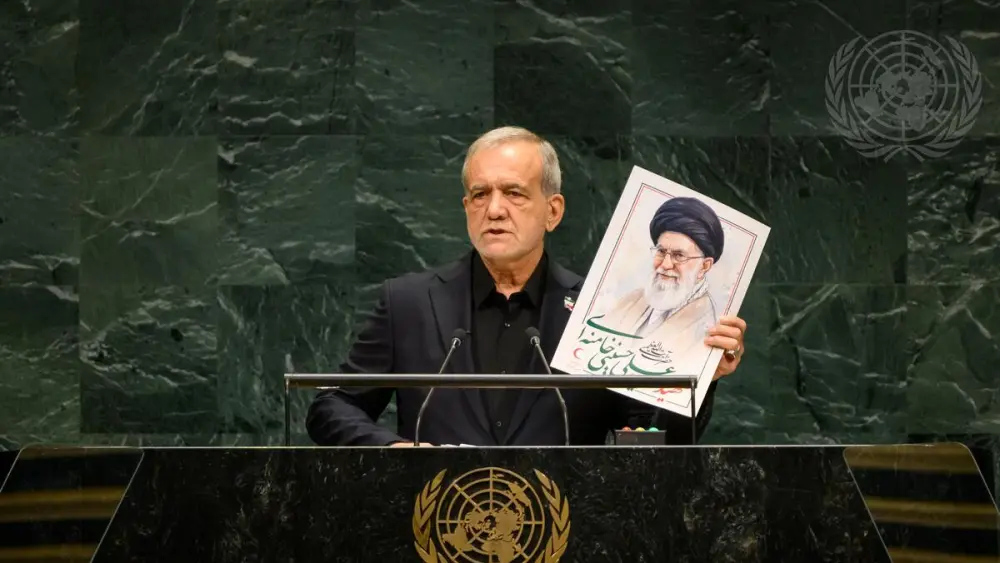
Iranian President Masoud Pezeshkian used his country’s annual address to the United Nations General Assembly to claim that Iran is a victim of terrorism rather than its sponsor. He pointed to Israel’s killing of a Hamas leader as apparent evidence that the Jewish state targets “civilians.”
“They assassinated Ismail Haniyeh in Iran on the day of my inauguration,” Pezeshkian said, referring to the Hamas political bureau chief, who was killed in Tehran in 2024.
“Israel targets any neighborhood, in any city, in any province,” the Iranian leader said.
The lone American delegate in attendance walked out of the General Assembly hall shortly after Pezeshkian began speaking and accused the United States of bombing children.
“We did not hit civilian populations,” Pezeshkian claimed.
Iran has fired thousands of ballistic missiles at countries across the region since the United States and Israel launched “Operation Epic Fury” in February.
Speaking to reporters at about the same time that Pezeshkian was addressing the assembly, U.S. Secretary of State Marco Rubio said that the scope of attacks on civilians from Iran and its proxies has been unprecedented.
“They attack, for example, diplomatic facilities,” Rubio said. “Unheard of that you would bomb or attack, for example, our embassy in Kuwait.”
Pezeshkian said Iran would not fold to economic or military pressure from the United States but that it was ready to negotiate.
“We will never bow our head or bend at the knee,” he said. “Iran must be understood by Mr. Trump and those who seek to bully us that we are ready for dialogue and diplomacy and negotiations, without accepting the language of force.”
Rubio said that if Iran continues to insist on having a path to acquire a nuclear weapon, it would face “big problems.”
He declined to characterize Tuesday’s talks “one way or the other.”
“The president has a number of options available to him, including the ones he’s already taken, which is to impose severe and growing economic costs,” Rubio said. “He also has some military options, upon which I won’t speculate.”


