
The Venice Film Festival recently awarded its Special Jury Prize to NAZA, an 80-minute documentary by Yuval Abraham and Rachel Szor. Its official synopsis promises to expose the machinery behind Israel’s “calculated mass killing” of Palestinian civilians. Such an accusation prompts a question the film reportedly neglects: Why, after constructing a subterranean fortress beneath Gaza, did Hamas provide virtually no underground protection for the civilians it governed?
This war did not begin with an Israeli target list. On Oct. 7, 2023, Hamas-led forces breached Israel’s border, attacked homes, kibbutzim and young people at an outdoor music festival, murdered civilians and carried hostages into Gaza. Civilians were not incidental casualties of attacks on military objectives. They were among the chosen targets. Any account that begins with Israel’s response removes cause from consequence.
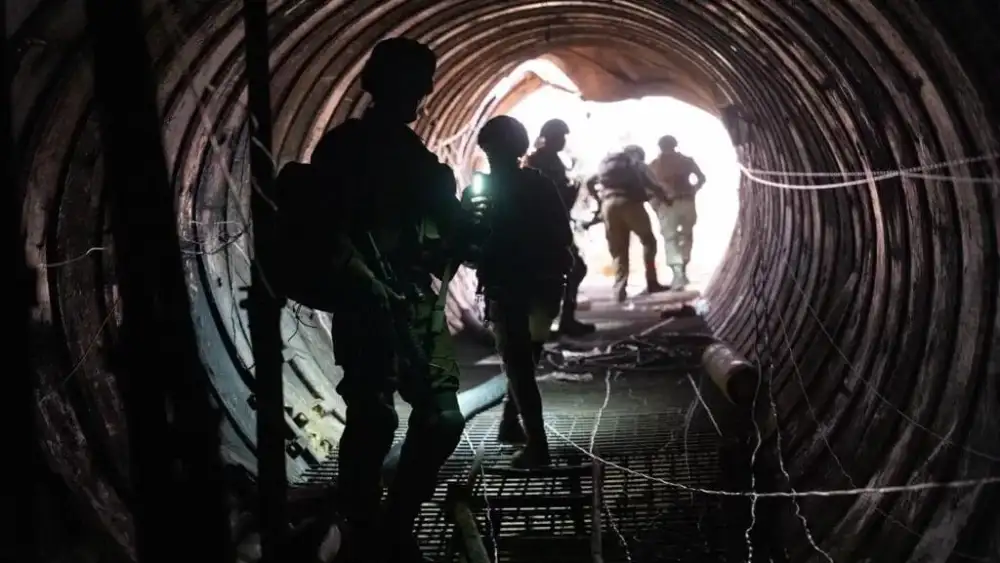
Beneath Gaza lay a second city containing fighters, weapons, command centers and hostages. Hamas once claimed that its tunnels extended roughly 500 kilometers. They were constructed to protect Hamas fighters; responsibility for Gaza’s civilians belonged to the United Nations and Israel.
Here lies the war’s defining moral inversion.
Israel is legally and morally obliged to distinguish civilians, take feasible precautions and avoid disproportionate harm. But Hamas’s obligations do not disappear because Israel has obligations of its own. Hamas initiated the war, embedded its military infrastructure within civilian areas and reserved its shelters for combatants. Then, Israel is commanded to protect Gazans from the battlefield Hamas constructed, while Hamas’s calculated exposure of those civilians to threat is treated as a natural condition for which nobody is responsible.
Where were the public entrances for families, the civil-defense shelters and protected chambers for children? Hamas’s fighters descended, its weapons disappeared, and its hostages were immured. Palestinian civilians remained above ground, surrounding the military infrastructure Israel would have to reach. The population became the exposed roof of Hamas’s fortress.
“NAZA” reportedly builds its indictment around 24 anonymous Israeli military and intelligence sources filmed in darkness. Anonymity can protect legitimate whistleblowers. It also prevents viewers from evaluating a source’s position, access, record, motive or representativeness. Darkness is a powerful cinematic device. It is not corroboration.
Israeli citizenship does not impose silence, and criticism of one’s government can be an act of patriotism. Nationality can nevertheless become part of a film’s salesmanship. Foreign audiences are invited to receive the accusation as a confession: Israelis themselves have said it; therefore the case is closed.
But a film need not be commissioned by Hamas to perform Hamas’s propaganda work. It need only erase Hamas’s decisions and attribute the resulting deaths exclusively to an Israeli desire to kill civilians.
The film’s title is derived from the Hebrew term nezek agavi, or “collateral damage,” and refers to estimates of anticipated incidental casualties. The use of that phrase as a title reveals another inversion. International humanitarian law requires commanders to distinguish civilians from combatants, identify military objectives, take feasible precautions and determine whether expected civilian harm would be excessive in relation to anticipated military advantage. Estimating potential casualties is part of the process intended to protect civilians. But the existence of an estimate cannot by itself prove that civilians were selected as targets.
Specific strikes may still be mistaken, disproportionate or unlawful, and serious allegations deserve serious investigation. But civilian deaths, however terrible, do not establish murderous intent without evidence concerning the target, anticipated military advantage and precautions taken.
Urban-warfare scholar John Spencer has documented Israel’s use of telephone calls, text messages, leaflets, broadcasts, evacuation maps and strategic pauses to move civilians away from combat. Such warnings also alert Hamas, surrender surprise and increase the danger to Israeli troops. Why would a policy of calculated extermination repeatedly compromise its own operations to reduce the number of civilians present?
The asymmetry becomes stark when intention requires no inference. Hamas gunmen attacked unarmed civilians—men, women and children. Hezbollah launched rockets at Israeli communities. Iran and the Houthis fired missiles and drones toward Israel. Terrorizing civilians was not collateral to those attacks; it was their purpose.
“NAZA” nevertheless infers criminal intention from Israel’s efforts to calculate incidental harm while avoiding enemies whose choice of targets was explicit.
A scientist who sets out to prove a theory by excluding every observation that might weaken it has not vindicated the theory. He has abandoned the scientific method. Evidence must test a conclusion, not merely decorate it.
A documentary about one military need not catalogue every offense committed by every belligerent. Once it alleges calculated mass killing, however, the battlefield’s structure becomes indispensable evidence, and the filmmakers must fairly address this issue. A film that removes Hamas’s tunnels, military embedding, civilian targeting and refusal to shelter its own population refuses to do so.
The objective method demands the opposite: state the theory, then search hardest for facts capable of disproving it. If the film’s thesis survives the tunnels, the hostage chambers and Hamas’s stated refusal to shelter civilians, it has earned consideration. If those facts are removed before the audience can weigh them, the verdict precedes the inquiry.
Venice has given “NAZA” prestige, not immunity from cross-examination. Who built the tunnels? Who occupied them? Who stored weapons and held hostages there? Who declared that the tunnels were for fighters rather than civilians? Until the film answers those questions, its darkness is not revelation; it is concealment.