


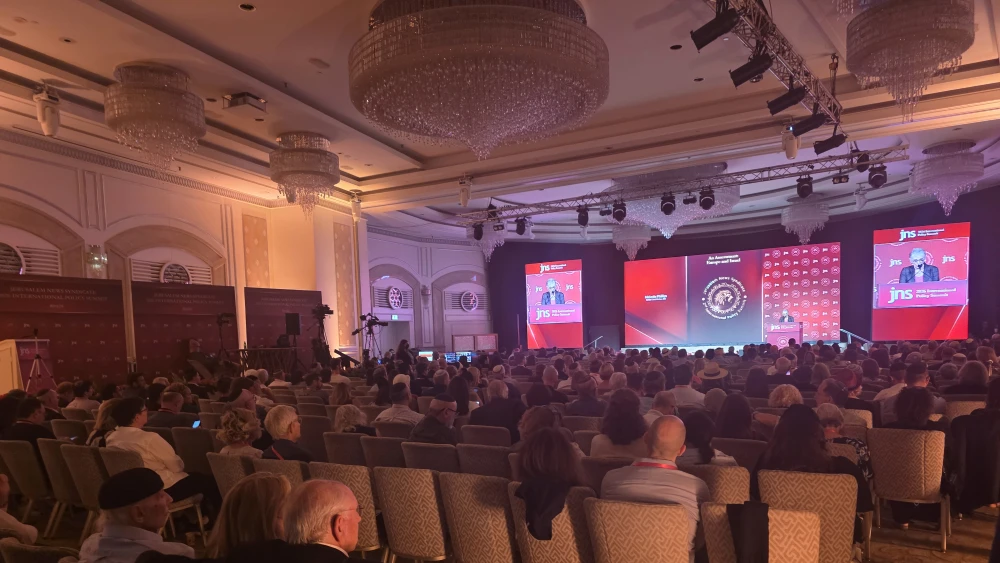
Amid great hopes and deep concern for the future of U.S.-Israeli relations, about a thousand people convened on Sunday in Jerusalem for the second annual JNS International Policy Summit, whose opening session spoke of “a new era” in that relationship.
U.S. Ambassador to Israel Mike Huckabee acknowledged the concerns in his address at the conference, following critical remarks by President Donald Trump and Vice President JD Vance on Israel’s handling of Lebanon’s Hezbollah terrorist organization and disagreements regarding the U.S.-Iran Memorandum of Understanding.
There is “a high level of anxiety about the relationship between the United States and Israel,” Huckabee said, but there is “an unbreakable bond” between the two nations, he added, noting that Trump has said this repeatedly.
Huckabee received two standing ovations from an audience that another panelist, Knesset member Ohad Tal of the Religious Zionism Party, said was “thirsty” for his words of deep friendship. Still, the conference also reflected the confusion and concerns that its participants felt, along with countless others who hold the U.S.-Israel alliance dear.
JNS Editor-in-Chief Jonathan Tobin opened the panels part of the three-day conference, which is scheduled to feature a speech by Israeli Prime Minister Benjamin Netanyahu, with a succinct question to three panelists specifically about the U.S.-Israeli partnership: “What is going on?”
The question reflected the confusion felt by many after Trump and Vance appeared to dismiss and disparage Israel, mere weeks after the countries’ joint military operation in Iran, which Trump halted last month, appeared to take the partnership to unprecedented heights.
Sylvan Adams, president of the World Jewish Congress-Israel, noted the contrast between Trump’s initial rhetoric about Iran and the U.S.-Israel partnership, and his dismissive language toward Israel in recent weeks.
Adams posited that the Memorandum of Understanding with Iran, which opens the door to releasing hundreds of billions of dollars to Iran in exchange for the opening of the Straits of Hormuz, is a “play for time,” which will end with the resumption of a U.S. attack on Iran with the goal of regime change.
“Despite the MoU, I trust the president. He didn’t lose his wits and courage to a bunch of Iranian pipsqueaks,” Adams said, adding, “President Trump is not a frayer,” Yiddish for “sucker.” Trump is merely “buying time ahead of the midterm elections” and the 250th anniversary celebrations, he said.
Adams related to the dismissive language that Trump and Vance used in reference to Israel, which Trump said may be replaced as the preferred partner for dealing with Hezbollah in Lebanon. With the midterms in sight, “Yelling and taunting Bibi may be popular in an increasingly isolationist America,” Adams, a dual citizen of Canada and Israel, said.
Malcolm Hoenlein, executive vice chairman emeritus of the Conference of Presidents of Major American Jewish Organizations, told JNS that, regardless of what becomes of the MoU, the enemies of Israel and the U.S. “see a breach right now.”
The U.S.-Israel relationship, he said, “will remain strong. But I worry about the perception of the leaders in the region who will look at this, and I don’t know if they would commit to the Abraham Accords today,” Hoenlein said. “My fear is that they won’t see the U.S.-Israel relationship as solid,” he said of Middle Eastern countries, “and that they won’t think they will get rewarded by coming closer to Israel in terms of American policy, and won’t view this as a priority.”
Hoenlein, a veteran Jewish community leader who speaks regularly with world leaders, including in the Middle East, said he does not believe that the Iranian opposition is in a position to stage a significant revolution. The Iranian regime is “remarkably resilient,” he said.
Forge new alliances
Panelist Amiad Cohen, founder and CEO of the Herut Center for Israeli Liberty, declared pessimistically that the Muslim Brotherhood is increasing its political clout in the U.S. in ways that will impact the alliance, and Israel needs to find new partnerships in response.
“We need to diversify our alliances if we want to act as an independent nation, and as an independent ally, if we want to really be independent, and to really be an ally,” he said.
Tal, the chair of the Knesset Israel-U.S. Relations Caucus, expressed gratitude to Trump, but expressed doubt that his successors will be as friendly to Israel, even considering the recent discord.
“No other president ever stood with Israel as Trump did. We need to remember that. But we need to prepare for a day that another president will most likely not be as friendly and supportive as Trump is, so we need to be much more independent, forge new alliances, and prepare for future alliances,” Tal said.
David Wurmser, an American foreign policy specialist and a fellow at the Jerusalem Center for Security and Foreign Affairs think tank, described changing attitudes toward Israel in the U.S. as a shift that is more connected to internal American processes than any actions undertaken by Israel. “This debate over Israel isn’t really about Israel, but about the soul of America as a civilization,” he said.
At the conference, the CEO and Jerusalem bureau chief of JNS, Alex Traiman, announced a rebrand and name change for the news site, which has been renamed the Jerusalem News Syndicate, with “Jerusalem” replacing “Jewish.”
Support for Israel among Christians in the U.S., in Latin America, and elsewhere around the world “is being undermined, in large part due to disinformation and misreporting in mainstream media,” Traiman said. “The word of God is truth. And among the vast sea of lies and disinformation, JNS strives to be a voice of truth.”
JNS Publisher Joshua Katzen jokingly thanked Trump’s unpredictable actions for increasing demand for JNS commentary. The American president “has been our No. 1 recruiter in the atmosphere of confusion and uncertainty. There are 1,000 people who have come here to make sense of it,” he said, triggering laughter.
Commenting on the MoU with Iran, he said that without good intentions, the agreements are not worth the paper they’re written on.
“This MoU was signed electronically,” Katzen noted.



