


The Jewish Federations of North America ended its relationship on Wednesday with a communications consultant, who told attendees at one of its conferences to avoid using the word “Zionism” to message effectively about Israel.
After JNS reported exclusively on how Matthew Berger, executive director of the Federation’s “Project Halo,” made the recommendation at an invite-only Federation event on Tuesday, the Federation told JNS that it was ending its work with him and his communications company.
“The presentation at our National Young Leadership Cabinet Retreat was not prepared by Jewish Federations of North America, but by a Project Halo consultant, and does not represent our approach to Zionism,” Niv Elis, the Federation’s associate vice president for external communications, told JNS.
“Project Halo was created to equip the Jewish community with research-based messaging and communications tools to combat antisemitism and strengthen support for Israel,” Elis said.
“At this time, we will be ending our engagement with that consultant and thank them for their work helping launch Project Halo,” the group said. “Jewish Federations of North America remain fully committed to Project Halo and to providing our communities with the strongest possible resources to advocate proudly and effectively for Israel and the Jewish people.”
Berger was executive director of the project and is also the president and CEO of Mashber Strategies, a communications firm that counts some of the largest American Jewish groups as current and former clients.
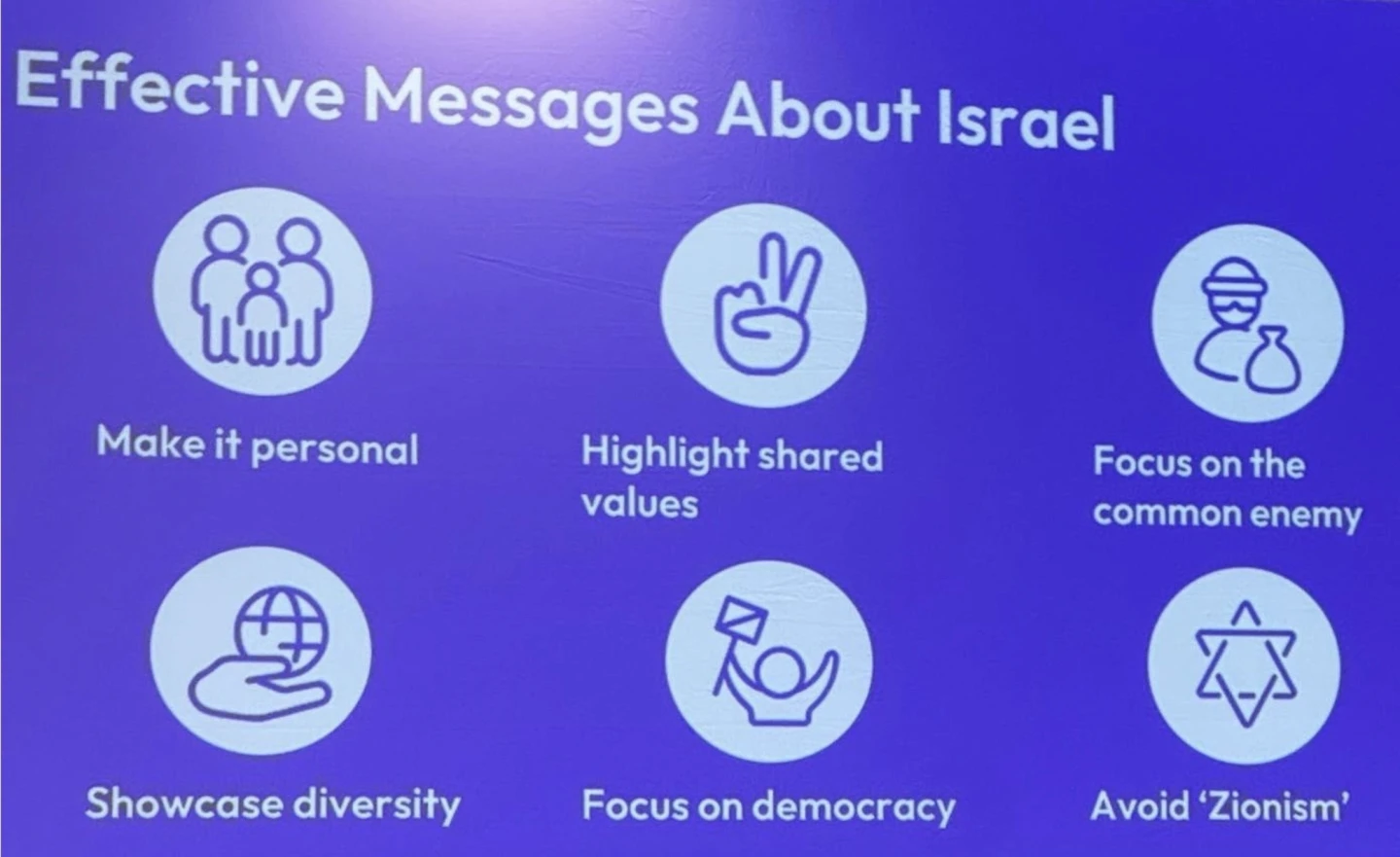
An attendee at the conference told JNS that “my jaw kind of hit the floor for a second” when Berger told the audience at the Federation’s youth retreat that it should “avoid ‘Zionism’” in a slide presentation about how to communicate about Israel.
The slide instead recommended that attendees should “showcase diversity” and “focus on the common enemy.”
Berger told JNS that the situation was a “misunderstanding of the presentation and my beliefs.”
“As a Zionist, I’m frustrated with how the word is being misused and often abused today by those attacking Israel,” Berger said.
“My goal is to guide people to use language that will open doors to conversations,” he told JNS. “By talking to people about Jewish self-determination and Israel as the Jewish homeland, rather than using the often-misconstrued term ‘Zionism,’ we are more likely to engage allies in the fight against antisemitism.”
A February briefing document from Project Halo that the Federation shared with JNS noted that the word “Zionism” is frequently misinterpreted and that a poll from the Federation found that a diminishing number of American Jews self-identify with the term.
The document encouraged supporters of Israel to define the term “Zionism” in response to those findings, not avoid using it.
“Jewish Federations are proudly and unapologetically Zionist,” Elis told JNS. “Since Oct. 7, we have raised more than $900 million to support Israel and its people, and we stand firmly behind both our commitment to Israel and the research we have produced to help our community better understand today’s communications challenges.”



