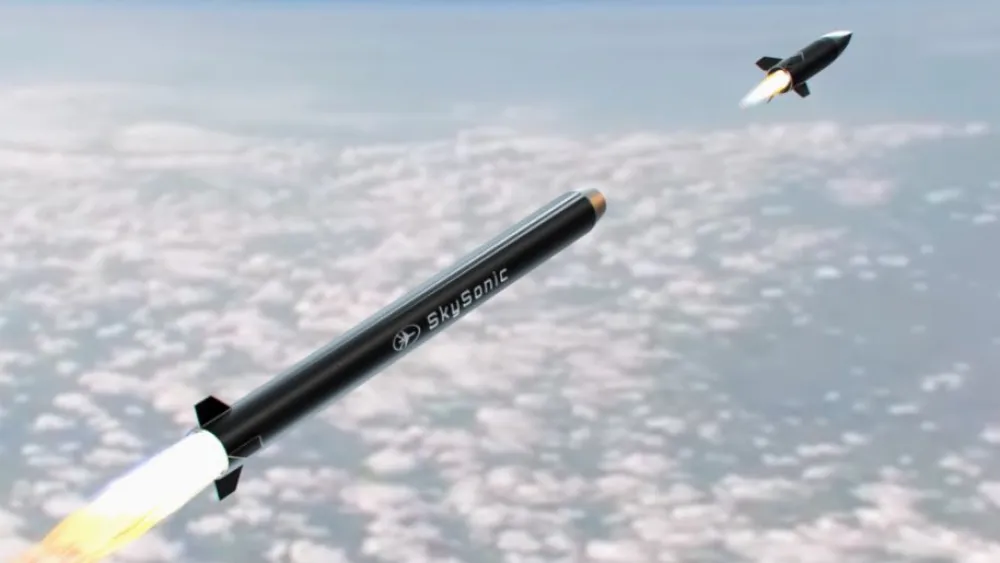
Rafael Advanced Defense Systems has unveiled a full-scale model of its Sky Sonic interceptor, designed to counter hypersonic missiles, offering a rare public look at a program whose testing progress and operational timeline remain undisclosed.
The model is on display at the Association of the United States Army (AUSA) exhibition, which opened Monday in Washington. Approximately 25 Israeli defense companies are attending the event as they seek to expand their presence in the American market.
Hypersonic missiles travel at more than five times the speed of sound, and some can maneuver in flight, making their trajectories difficult to predict. Their speed and maneuverability leave air-defense systems with little time to respond, increasing the risk that they could strike military installations and other strategic targets before defenses can intercept them.
Developing effective countermeasures has become a priority for several military powers. The United States and Japan are jointly developing the Glide Phase Interceptor, designed to destroy hypersonic weapons during atmospheric flight. However, dedicated interception technologies remain under development, and publicly available information has not established the existence of a comprehensive operational defense against maneuvering hypersonic missiles.
Rafael announced Sky Sonic in June 2023, amid growing international concern over Russia’s use of hypersonic missiles against Ukraine and Iran’s claims of advances in the field. Rafael Chairman Yuval Steinitz said development had begun earlier in the decade and was based on technology developed by the state-owned company.
Steinitz described the interceptor as being in advanced development and said initial flight tests were expected soon. Rafael has since disclosed little about the program, leaving unclear whether flight tests have taken place and when the system might become operational.
Expanding in the American market
The unveiling comes as Israeli defense manufacturers seek to expand their share of the American defense market. The AUSA exhibition provides a platform for companies to showcase both established weapons systems and technologies still in development.
Rafael is also showcasing developments in its SPIKE family of precision-guided anti-tank missiles, including a capability to launch SPIKE missiles from existing American TOW missile launchers mounted on Bradley infantry fighting vehicles.
Separately, upgraded Bradley vehicles recently delivered to U.S. forces incorporate Iron Fist, an active protection system developed by Israeli defense company Elbit Systems to counter incoming anti-tank weapons.
Israeli defense exports reached a record $19.2 billion in 2025, with the United States and North America accounting for 13% of the total. Expanding that share is a Defense Ministry priority for 2026.