
Call it Transjordan or the West Bank. Blame the awful “settlers” for the reasons the war does not end. But if you call it Judea and Samaria—its historic name—this land and its history offer a way of being and seeing that has nothing to do with colonialism, but rather with history and identity. It is like calling Italy the land of the Italians. Certainly, with all its mistakes and flaws.
Facing east are rocky and desolate mountains; those facing west bloom. For 3,000 years, they have been Judea and Samaria, even when Jordan occupied them from 1948 to 1967.
But it is forbidden to utter their name. Instead, people prefer to cite episodes of violence by a few hundred angry and violent youths, and the words of a cynical politician such as Itamar Ben-Gvir, to unleash fury against all of Israel.
Repeating the word “settlers,” as British Foreign Secretary David Miliband and French President Emmanuel Macron do, erases the many reasons why this area demonstrated to Yitzhak Rabin and Shimon Peres, and also to Ronald Reagan, that Israel must never again find itself in a narrow strip without the ability to defend its own survival.
The people who live here are religious and secular, right-wing and left-wing. They commute by bus across the Green Line. They are high-tech workers, students and doctors. They spend less here than they would in Tel Aviv and defend their country.
For them, “land” and “nation” are not negative concepts. They are the conditions for the survival of the multitude of children born here.
Sometimes, this story is incomprehensible to those who seek simplistic explanations while ignoring the murderous aggression of Iran, Hezbollah and Hamas, and who love to use one word: “colony.”
That word was not used when Jordan attacked Israel, which won the war and subsequently took control of a piece of land that no one at the time dreamed of defining as a Palestinian state. Then came the Oslo Accords. The United Nations has never determined that a Palestinian state must be established there; the issue was left to negotiations between the parties.
We venture into Samaria with Boaz Haetzni of Kiryat Arba and Yehuda Shalem of Ofra, two educated and passionate citizens who take me among the roughly 750,000 Israelis living beyond the Green Line, including some 230,000 residents of eastern Jerusalem.
Boaz is not religious; Yehuda wears a kippah. Neither has a beard or sidelocks. Neither shows fear on roads plagued by terrorist attacks, where fathers, wives, brothers, children and friends have been killed.
Living under fire
On May 14, 2025, terrorists opened fire on a car traveling between Bruchin and Peduel, killing Zeela Gez, who was nine months pregnant and on her way to the hospital to give birth.
Nearby, on April 12, 2024, 14-year-old Benjamin Achimeir was murdered while grazing sheep, a killing that sparked furious reactions in the Nablus area.
Near Eli, two Israelis were murdered on Feb. 29. On Jan. 6, 2025, three terrorists from the Jenin area murdered two women and a man and wounded eight others.
And nearby lies Awarta, home to the cousins who in 2011 entered Itamar and slaughtered the Fogel family: a father, a mother, two children aged 11 and 4, and a 3-month-old baby.
Every day and every night, people living in Judea and Samaria face attacks on their cars, fields and homes, as well as theft and the poisoning of livestock. European and American activists come to the area shouting, “From the river to the sea.”
According to the Institute for National Security Studies, considered left-of-center in Israel, there were 6,828 Palestinian attacks in Judea and Samaria in 2024, including 231 classified as significant, with 46 people killed and 337 wounded.
The United Nations, meanwhile, says there were some 1,400 settler attacks in the West Bank, with 10 Palestinians killed directly by settlers and 27 killed in total. The pro-Palestinian organization Yesh Din says that 90% of investigations into settler violence end without indictments.
But Israeli public opinion in Judea and Samaria condemns the violent offenders.
The ‘balcony of the country’
We catch up with Yossi Dagan, the energetic head of the Samaria Regional Council since 2015, at what is known as the “balcony of the country,” from which Israel beyond the Green Line spreads out below.
“If we abandon this, Israel becomes a target for missiles,” he says.
The mountains of Samaria in the north and Judea in the south overlook Israel’s coastal plain. The distance between the Mediterranean Sea and the Green Line is at points only about 15 kilometers, about nine miles.
Ben-Gurion Airport is there below, and beyond it, Tel Aviv. An aircraft can cross from the Jordan River to the Mediterranean in just minutes. An undefended Jordan Valley could provide an avenue of attack from Jordan and, beyond it, Iraq, Syria and Iran.
“We are the shield,” Dagan says.
He once lived in Sa-Nur, one of the four northern Samaria communities evacuated in 2005 alongside Israel’s disengagement from the Gaza Strip.
Today, new farms dot the hills. New roads and bus routes connect the communities to Tel Aviv and Jerusalem. Every morning, commuters in jackets and ties head to work.
“There, do you see?” Dagan says, pointing toward the industrial zones. “The industrial facilities are impressive—the real peace with the Arabs who work there and are well paid.”
For Dagan, the answer is hard work. Judea and Samaria, he says, are Jewish and help defend peace and democracy.
“War and normality go together. Here, a Jewish village or town; there, Palestinian houses and villas; here, a farm. We are scarred by ambushes, but 90% of the Bible takes place here, beginning when Abraham reached Shechem and built an altar to the one God to thank Him for the Promised Land.”
At Shiloh, the Jewish people arrived from Egypt with the Ark of the Covenant. Every stone is a sign of the covenant that changed the world and commanded: Love your neighbor as yourself.
Benny Katzover lives in Elon Moreh, where God promised Abraham the Land. He was among the founders of Gush Emunim. At Sebastia, he was evacuated seven times before eventually helping establish Kedumim with the approval of Rabin’s government.
He is one of the founding fathers of the modern settlement movement.
Standing on a mountaintop opposite Mount Ebal and Mount Gerizim, he quotes Deuteronomy 11:24: “Every place where the sole of your foot treads shall be yours.”
The biblical altar associated with the covenant on Mount Ebal seemed lost to history until archaeologist Adam Zertal, a secular Israeli, uncovered a structure there that he identified as Joshua’s altar.
Life on the hilltop farms
On the chavot, the rudimentary and extraordinary farms scattered across the hilltops, they plant grapevines and olive trees. They also stand in the path of Palestinian efforts to expand into Area C.
It resembles a Western. The word “heroic” seems indispensable when describing how these people sleep in caravans or huts, how they eat and how hard they work.
They explain that Israel is not only their country to save. They believe they are fighting a fanatical and authoritarian world that kills dissidents, women and gays.
They insist that when they face security threats, they do not take the law into their own hands but call the army and police.
Is that always true? Do they condemn the violent youths?
The judges deal with them, they tell me. We call the police.
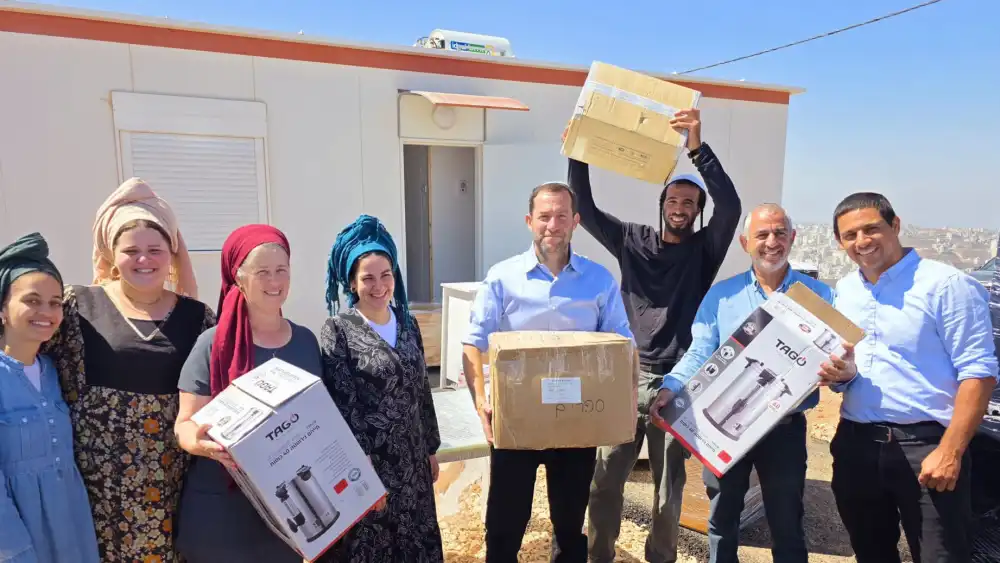
Adi is tall and thin. Nearby, her little blond daughter dangles from an embankment. Some 120 cows are grazing. Grapes are crushed in vats, and children press green olives in the small olive press as golden oil flows out.
Four young people sent by the army to help are Adi’s lifeline: Shimon, 20; Yossi, 16 and a half; Hillel, 24; and Rachel, 20. They make coffee and help with the cows and children, while keeping one eye on the valley.
From the Arab houses comes what the farmers see as the threat of a takeover of Area C. If that succeeds, Macron and others will simply call all of it “the Territories,” as though the entire area were already Palestinian.
Every hilltop has a flock to protect, an olive grove that can be destroyed or burned.
But without Samaria, Israel is exposed.
With sidelocks and a crooked kippah, Amishav is the young man on his extraordinary chava (“farm”) who was reprimanded by U.S. Ambassador Mike Huckabee, himself a staunch friend of Israel.
“He didn’t understand that we wanted to protect him from the provocations,” Amishav tells me.
A little higher up, Turmus Ayya looms over him. Wearing a worn T-shirt, alternately holding his youngest daughter and a kid goat in his arms, with his pregnant wife sitting quietly beneath a wooden shelter, he boasts: “There are four more houses. New families are coming.”
A determined goat wants her kid back. Amishav points to a walnut tree, kept high so the animals cannot eat from it.
“All I care about is making the land bloom. That’s all.”
And the Arabs?
“I called the farm ‘Havat Gilad.’ Gilad, my brother, was killed while trying to save hikers who had been caught in an ambush. They shot him. They are the violent ones.”
Havat Gilad lies partly in Area C and partly in Area B. Area A is under full Palestinian Authority civil and security control and is legally off-limits to Israeli citizens. By extending his grazing area, Amishav sees himself as preventing Palestinians from Turmus Ayya from expanding into Area C.
He grazes his flock with a rifle slung over his shoulder.
The settlers are not angels. But they are certainly not devils.
The past cannot be erased by closing the Bible and inventing a people called “colonists.” The battle that began 3,000 years ago continues.
And it is not only a battle for the Jews.