


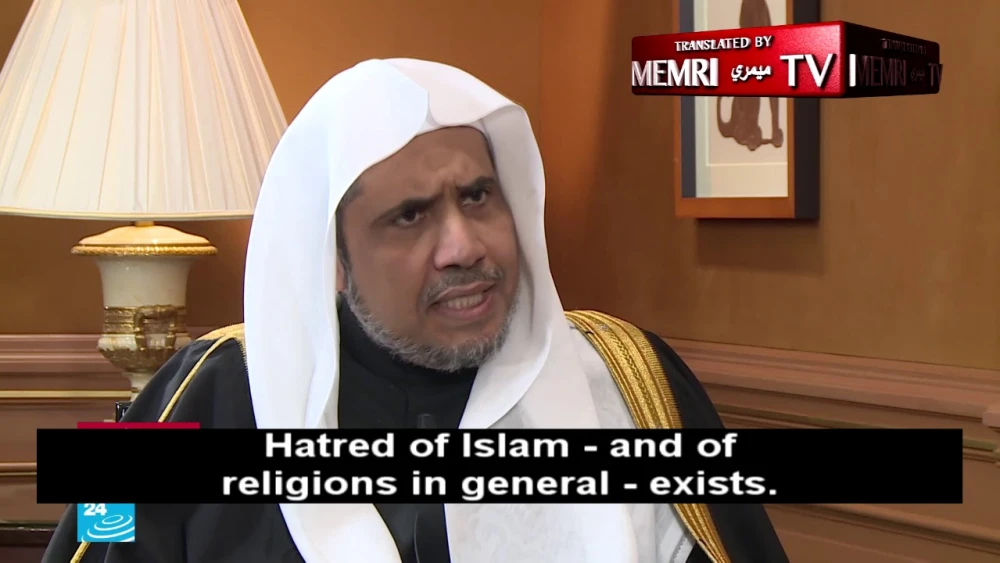
There is no place for political Islam in France or anywhere else, Saudi cleric and Muslim World League Secretary-General Muhammad bin Abdul Karim Issa said last week.
In an interview with France 24 TV’ Arabic-language channel on March 4, Muhammad bin Abdul Karim Issa said that political Islam is not in accord with Islamic values or the national values of any country. He added that all people must respect the constitution, laws and culture of the country they are living in, and that they should move somewhere else if they cannot.
Political Islam, said Issa, has a “political background, and it strives to accomplish a certain political agenda. Therefore, it does not represent Islam.”
He criticized Muslims who want to separate from the countries they are living in for wanting to destroy the social contract on the basis of which they entered those countries.
He also explained that his recent visit to Auschwitz with 60 other Islamic scholars was meant to deliver the message that there are no double standards in Islam when it comes to confronting all forms of injustice.
“What happened in Auschwitz was a genocide that shook human conscience. It was an atrocious genocide in the full sense of the word,” said Issa. “We came there to say that Islam does not uphold double standards. We denounce [the Holocaust]. Over 60 scholars and muftis from the various Muslim denominations went there with me, in order to say that Muslims are hurting for what happened there, and that Islam does not uphold double standards.”



