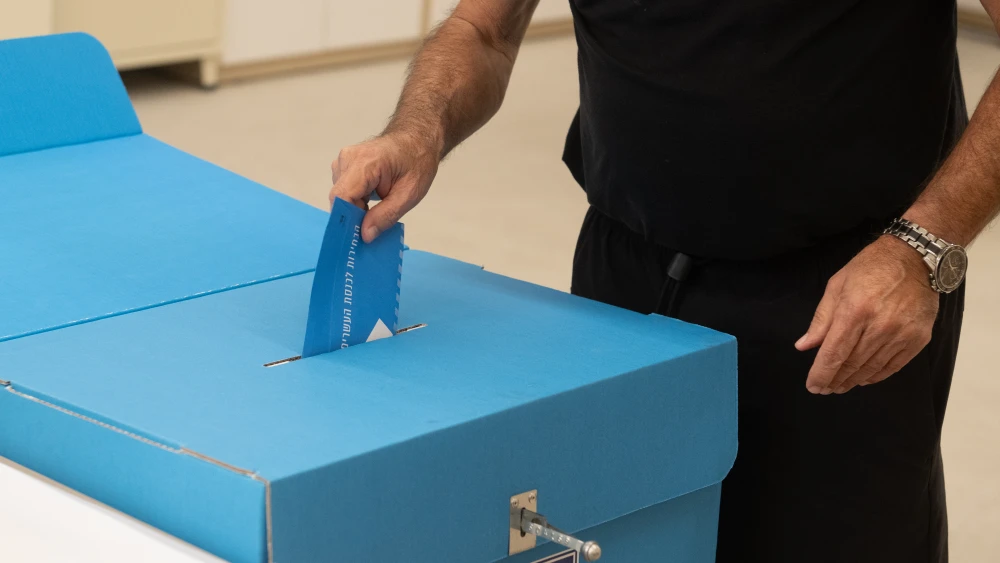
U.S. President Donald Trump chose an apt phrase early on Wednesday to describe what appears to have happened in Israel’s election, which he called a “big come-from-behind stalemate.”
Israeli Prime Minister Benjamin Netanyahu’s Likud Party seems likely to win the most seats, but neither the previous governing bloc nor the opposition has an obvious path to a 61-seat Knesset majority, teeing up either difficult coalition negotiations or the possibility of another election.
Shortly after the first exit polls were released on Tuesday, Herbert Block, executive director of the American Zionist Movement, told JNS that American Jews will be closely watching any outcome.
“American Jews follow what happens in Israel,” he said. “It impacts us personally in society.”
Block pointed to Oct. 7 and its aftermath as generating greater interest in the United States for what is happening in Israeli politics.
“I think since Oct. 7, unfortunately, everything that’s going on in Israel gets followed here in America more,” he told JNS.
William Daroff, CEO of the Conference of Presidents of Major American Jewish Organizations, said that the interest of American Jews in the Israeli election is in part a reaction to the domestic political climate towards Israel.
“There’s been intense interest in all things Israel, amplified by Oct. 7, and particularly by the response of so many, where we look to our left and our right, at our erstwhile allies, at the people that we had stood with, and they just weren’t with us on Oct. 8,” he said.
“I think that has brought us together as a people,” he told JNS.
Republicans and Democrats have expressed a rooting interest in Israel’s elections, with Israel, Gaza and the Iran War all significant issues in the American midterm elections on Nov. 3. Trump endorsed Netanyahu, while New York Gov. Kathleen Hochul, a Democrat, likely spoke for many pro-Israel Democrats when she told Politico on Tuesday that her job would be “a lot easier” if Netanyahu lost.
Daroff told JNS that whatever government forms in Israel needs to coordinate with the incoming Congress.
“The priority needs to be on ensuring that the bilateral relationship is grounded,” Daroff said. “Particularly with leadership in Congress, assuming that the House and/or the Senate shifts, the more communication, the more discussion, the more transparency, the fewer surprises, the better across the board.”
Both Daroff and Block, who lead non-partisan organizations, said that a political stalemate in the Knesset might create an opportunity for cooler rhetoric in the United States.
“If there is a second election and there is a caretaker government with Prime Minister Netanyahu at the helm, my hope would be that that government would be one that would engage more with the opposition, engage towards common goals and on behalf of the State of Israel, particularly as it relates to defense policy and foreign policy,” Daroff told JNS.
“People can be a proud American and wave our American flag regardless of who’s in the White House, and we should be able to do the same with Israel regardless of who’s sitting in the seat of the prime minister,” Block said. “We’d hope that people will be able to make those separations.”
Americans looking at what unfolds in Israel may be less familiar with some of the issues that Israelis said were most important to them heading into the polls and why forming a governing coalition could prove difficult.
In a September poll of Israeli Jews, the Israel Democracy Institute found that about a quarter of that population said that conscription of Haredi Jews into the Israel Defense Forces and the relationship between religion and state were the most important factors in determining which party they would support.
Among Israeli Arabs, who turned out in record numbers and whose parties are likely to garner about one-sixth of the Knesset seats, a plurality said that their most important issue was crime affecting Arab society.
None of those issues garner much media attention in the United States.
Daroff told JNS that that can create a disconnect between how Americans and Israelis look at Israel’s elections.
“We, in American Jewry, don’t always look through the lens that our Israeli brothers and sisters are looking at the candidates or the issues through,” he said. “They’re not voting on the issues that we tend to be most focused on, like issues relating to the Palestinians.”
“In Israel, to act Jewishly, you have to wake up in bed and breathe the air—I would say that is a Jewish act,” he said. “Here in the United States, it’s not as simple. We have to go to a synagogue. We have to go to a Jewish community center. We have to engage in politics with AIPAC or with the Jewish Federations on issues. It’s just a different phenomenon.”
American supporters of Israel applauded the high turnout among the Israeli electorate, both Jewish and Arab, after the election, even as the success of Arab parties might make it more difficult to form a coalition government.
“Israel’s Arab citizens, men and women, are turning out in historic numbers to vote,” Rep. Josh Gottheimer (D-N.J.) stated. “They can vote, run for office and serve in the Knesset, rights denied to many Arabs and women across much of the Middle East. Our critical ally in the fight against terror, Israel, is the only democracy in the region, and today shows it.”
The Jewish Federations of North America likewise called the high election turnout “historic.”
Netanyahu, by contrast, accused the Arab parties on Wednesday of having “stolen” the election in a statement attributed to the Likud Party.
“We demand from the police and the Shin Bet a thorough investigation into the election theft by the Arab parties,” he wrote.
A senior leader of an American Jewish group, who spoke anonymously and candidly with JNS, said on Tuesday that Avigdor Lieberman, leader of the opposition Yisrael Beiteinu party, was likely to be a sticking point in any coalition talks with Arab parties.
“Being the guy who helps make the corrupt bargain to bring in the Arabs, to bring in a ‘non-Zionist, illegitimate government,’ is not a legacy that helps Lieberman move forward,” the leader told JNS.
Without Yisrael Beiteinu’s seats, the math for the opposition parties becomes more difficult and the coalition-forming logic more twisted. The path for Netanyahu to form a bloc of 61 seats is at least as difficult, with opposition to Netanyahu being the raison d’être of many of the opposition parties.
Daroff told JNS that political stalemate was unlikely to benefit either Israel or the relationship between Jerusalem and Washington.
“Stability is good,” he said. “I think—I know—that the period of multiple elections from earlier in the decade did not serve Israel well, and my hope would be that as the party leaders look at these results, and as President Herzog decides who to give the first shot at building a government to, that they very much keep in mind that a wider, broader government will be beneficial to the Israeli people, will be beneficial to the cause of Israel around the world.”
“The next week and then weeks will be fraught with all sorts of intrigue, and I would encourage the Israeli political establishment and the American Jewish establishment to take a deep breath, to recognize that there is a long road here and that, God willing, there will be a new government to close from it,” he said.
“If there’s not, there’ll be another election,” Daroff said. “And we’ll be able to celebrate vibrant Israeli democracy yet again.”