An alleged commander of the Iraqi terrorist group Kata’ib Hezbollah facing federal criminal charges in New York has demanded that he be afforded prisoner-of-war status, according to a court filing his lawyers submitted on Tuesday.
Mohammad Al-Saadi, a dual citizen of Iraq and Iran, is accused of plotting to bomb synagogues in the United States and of carrying out terrorist attacks in Europe, but argues that his alleged service to the Iranian Islamic Revolutionary Guard Corps via its proxy Kata’ib Hezbollah means that he should be afforded protection under the Third Geneva Convention.
“Because the United States is involved in an international armed conflict in the Middle East, and because the pleadings drafted by the government allege that Mr. Al-Saadi is a commander in one of the adversary militias or militaries—and that his charged conduct was to coordinate responses to American and Israeli military attacks—he should be treated as a prisoner of war rather than as a common criminal in civilian court,” the filing says. “Any other conclusion would violate the United States’ obligations after it initiates a war, and it would forebode poorly for any of this country’s soldiers who face capture in the future by Kata’ib Hezbollah, the Islamic Revolutionary Guard Corps or their allies.”
Andrew Dalack, one of the attorneys for al-Saadi who filed the motion, told JNS that he is seeking an “improvement in his confinement conditions consistent with the minimum standards afforded to prisoners of war.”
“Article Five of the Third Geneva Convention sets forth that if there’s an ambiguity or a dispute over whether a person should be treated as a prisoner of war or otherwise entitled to combatant immunity, that they should be afforded prisoner of war status until their status has been fully adjudicated,” Dalack said. “Because there is a dispute, we think that he should at least be entitled to prisoner of war status until or unless a judge has determined that he’s not entitled to it.”
Dalack is an attorney with the Federal Defenders of New York, a non-profit that represents defendants who cannot afford a lawyer.
The government has not yet responded to the defense motion.
The question of what to do with alleged enemy combatants and members of foreign terrorist organizations arrested on foreign soil and held in U.S. custody has dogged successive administrations since the 9/11 attacks.
Charging detainees under military commissions at Guantanamo Bay, Cuba, has proven largely fruitless for more than two decades. According to a New York Times tracker, of the 780 detainees once held at Guantanamo, 756 have been released or transferred, 15 have died and just nine have been charged with crimes. Of those nine, only two have been convicted, and the remaining seven have yet to face trial.
Terrorists tried in civilian federal courts have sometimes claimed prisoner of war status, but those cases do not typically involve a defendant alleged to be in the chain of command of a state party to a conflict, like Al-Saadi. In 2018, for example, the U.S. Court of Appeals for the Fourth Circuit upheld a district court ruling that a member of the Taliban and the Haqqani Network was not entitled to POW status because those groups were not lawful combatants.
Dalack could not cite any examples of defendants successfully claiming prisoner-of-war status.
He told JNS that the motion is not an admission that Al-Saadi is a member of Kata’ib Hezbollah or the Islamic Revolutionary Guard Corps, but relies on the government’s own claims.
“There’s no concessions about the accuracy of the government’s charges,” Dalack said. “We’re basing it on what the government has alleged.”
Federal prosecutors have not said how Al-Saadi came to be in U.S. custody, but Al-Saadi’s lawyers say that he was “secretly detained in Turkey on May 1, 2026, at the direction of the United States, held underground for nearly two weeks without access to an attorney or a court,” including at one point in “the basement of the U.S. embassy in Ankara,” and was then “renditioned to the United States in violation of international law and presented” in the Southern District of New York on May 15.
Al-Saadi is charged with eight terrorism-related counts, including conspiracy to bomb a place of public use, conspiracy to provide material support to a foreign terrorist organization and destruction of property by means of fire or explosive.
The prosecutors allege that in service of Kata’ib Hezbollah and the IRGC, Al-Saadi orchestrated a campaign of violence against Jewish, American and Israeli targets in the United States, Canada and Europe.
In a recorded call, the complaint against Al-Saadi says that he claimed that “our people” were responsible for shootings at the U.S. consulate and a synagogue in Canada, that he was “running multiple teams” that carried out attacks in Europe and that he would provide targeting information for future attacks in the United States to the other person on the call, who was an FBI source.
“Al-Saadi stated that he would give” the source “the ‘targets,’ such as ‘Jewish synagogues[,] . . . Zionist headquarters,’ and that Al-Saadi ‘do[es] not have a problem with killing, neither do I have a problem with terrifying [the targets],’” the complaint says.
According to the complaint, the source asked Al-Saadi “[w]hat is it that you’d like to bomb?,” to which Al-Saadi responded, “I mean, we provide him with a Jewish temple, a Jewish center.”
Al-Saadi later allegedly sent an undercover law enforcement officer photographs and maps related to a synagogue in New York and Jewish institutions in Los Angeles and Scottsdale, Ariz.
Al-Saadi’s lawyers say in their filing that that the government has alleged that Al-Saadi’s actions were in “direct response to the United States’ and Israel’s Feb. 28, 2026, military strikes on Iran” and that the Jewish institutions in question are part of “Israel’s financing and foreign support” in the United States.
They quote documents that Al-Saadi sent to the undercover officer describing the New York synagogue and the two other Jewish institutions as “staunch supporters of Zionism outside Israel” and “beacon[s] for solidary and support for Israel and its Zionist objectives.”
JNS asked Dalack if the motion was suggesting that those might have been legitimate military targets in the conflict, rather than civilian objects.
“We’re just resting on what the government alleged in the complaint,” Dalack said.
The motion from Dalack and his co-counsel alleges that Al-Saadi’s “total solitary confinement with few opportunities for mental stimulation” violates his rights under the Geneva Convention, and demands that he given better and greater quantities of halal food, more contact with his family, and access to Arabic-language television and books.
The motion does not include a move for combatant immunity—a claim that al-Saadi might be immune from prosecution for acts that are legitimate participation in hostilities—but notes that Al-Saadi reserves the right to make such a claim.
“We think there are colorable arguments, that we intend on pressing more fully later, consistent with our Rule 12 motion schedule, as to whether or not he’s entitled to combatant immunity under Article Four of the Third Geneva Convention and the various descriptions of who is entitled to combatant immunity under Article Four,” Dalack told JNS.
“At present, we’re not asking the judge to resolve whether or not Mr. Al-Saadi is entitled to combatant immunity,” he said. “We’re simply saying that there’s a colorable basis to believe that he could be entitled to combatant immunity under any of those subsections of Article Four and, as a result, for the time being, he needs to be afforded prisoner of war status.
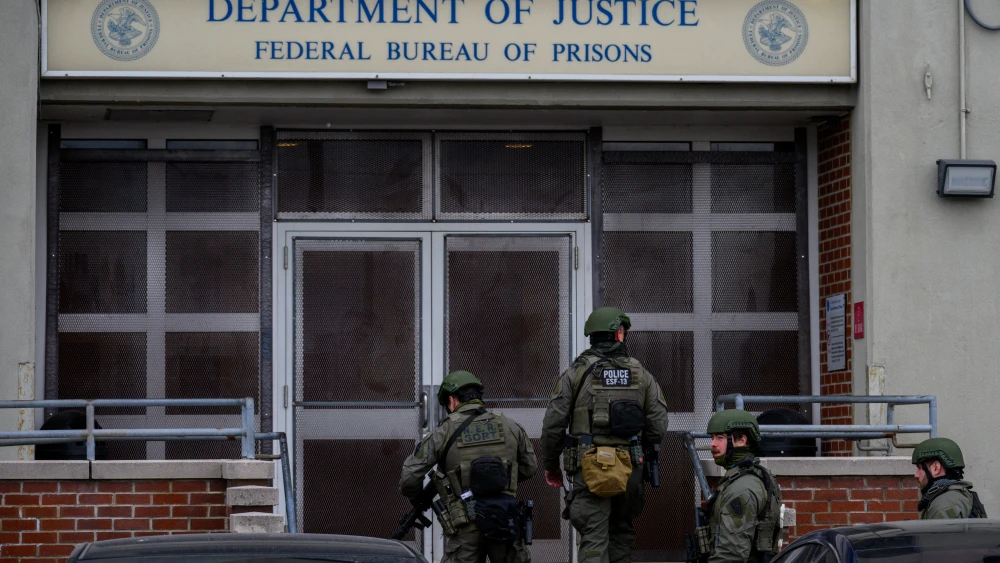
Al-Saadi is currently being held in the Metropolitan Detention Center in Brooklyn.
Dalack told JNS that the defense and prosecution teams will meet with the judge on the case for a status conference on Sept. 9, at which time he expects to ask the judge to set a trial date.
If convicted, Al-Saadi faces life in prison.