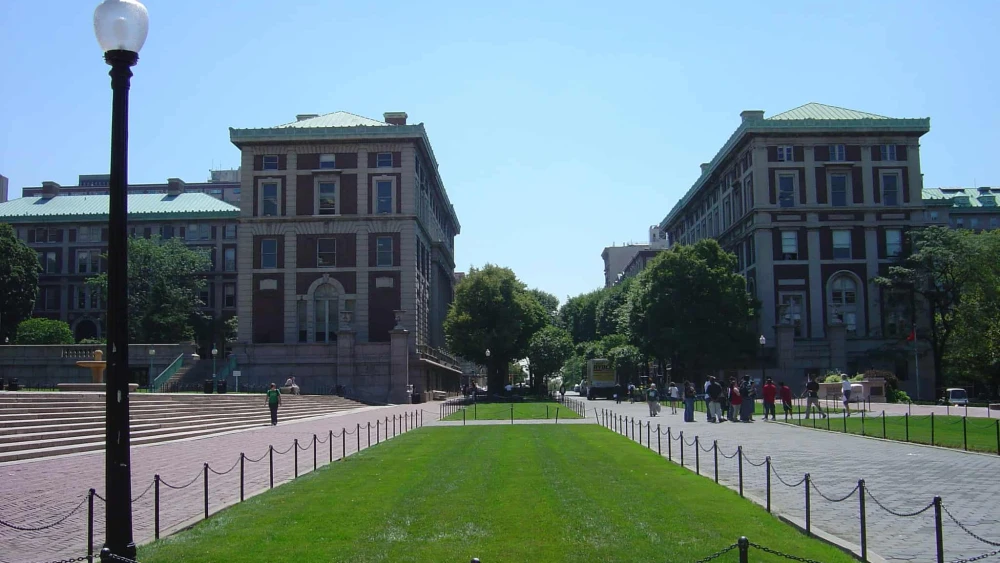
Columbia University, whose own antisemitism task force found that Jew-hatred on campus was “serious and pervasive,” has joined 35 other colleges and universities, including Brown University, in supporting Harvard College’s challenge to the Trump administration’s termination and withholding of federal research funding.
The universities filed an amicus brief on July 22 in the U.S. Court of Appeals for the First Circuit, urging the court to affirm a lower-court ruling in Harvard’s favor. The administration froze or terminated billions of dollars in federal grants and contracts after Harvard rejected demands that the administration said were intended, in part, to address antisemitism on campus.
The 29-page brief, filed by former U.S. Solicitor General Donald B. Verrilli Jr., focuses almost entirely on the importance of federal funding to academic scientific research. It does not mention antisemitism.
The brief specifically argues that the government cannot impose “sweeping terminations” based on an administration’s concern about “a single particular aspect” of a university’s conduct, “even if that concern is justified.”
‘Antisemitism concern may be justified’
Mark Goldfeder, director of the National Jewish Advocacy Center, told JNS that the wording allowed Brown and Columbia to sign the brief without contradicting agreements they reached with the Trump administration in 2025.
“Verrilli built a brief that Brown and Columbia could sign without contradicting agreements they inked with the same administration eleven months earlier, and he did it by never once naming the conduct that started the fight,” Goldfeder said.
“The closest the brief comes is a single subordinate clause: the government may not impose sweeping terminations ‘based on an administration’s concern about a single particular aspect of the university’s conduct—even if that concern is justified,’” he said. “Read that again. Thirty-six universities just told the First Circuit, in a signed filing, that the antisemitism concern may be justified. They simply want it to carry no funding consequences.”
“I think it’s crazy that they don’t mention antisemitism, and literally explain that instead of stopping, it’s fundamentally acceptable as part of a greater cause,” Goldfeder told JNS. “Antisemitism is the cost of doing research.”
“Run the substitution test,” he said. “Picture 36 universities filing a brief in 1965 arguing that federal funds must keep flowing to a segregated flagship ‘even if’ the finding of discrimination against black students is justified, because the physics department is doing marvelous work.”
Columbia’s antisemitism task force reported in August 2024 that Jewish and Israeli students had experienced harassment, verbal abuse, ostracism and, in some cases, physical violence. After the report and other concerns, the Trump administration terminated or paused about $400 million in federal funding to Columbia. The university reached a resolution with the government in July 2025 that restored most of the affected funding.
Under the agreement, Columbia agreed to pay the federal government $200 million over three years and established a separate $21 million settlement fund to resolve federal employment-discrimination claims involving Jewish employees. The university did not admit liability.
Brown reached its own agreement with the administration in July 2025 to restore federal funding for medical and health sciences research. The agreement included a commitment to support Jewish campus life and combat antisemitism, as well as a third-party campus climate survey focused in part on Jewish students.
Goldfeder told JNS that the brief essentially suggests that the enforcement rationale behind the Brown and Columbia settlements was “arbitrary.”
“If the findings that produced the settlements were substantial, the rationale is not arbitrary,” he said. “If the rationale is arbitrary, Columbia paid $221 million for nothing, and it owes its trustees an explanation before it owes Harvard an amicus.”
The brief calls the funding cuts “draconian,” arguing that they “ruin experiments and datasets, snuff out the careers of aspiring scientists” and threaten U.S. global leadership.
Universities, the brief states, would also be less likely to commit their own resources and faculty to federally supported projects if funding could be “yanked away from them without any meaningful procedural safeguards.”
Kimberly Winston, a spokeswoman for Columbia, told JNS that the university “isn’t going to comment beyond the brief we filed.”