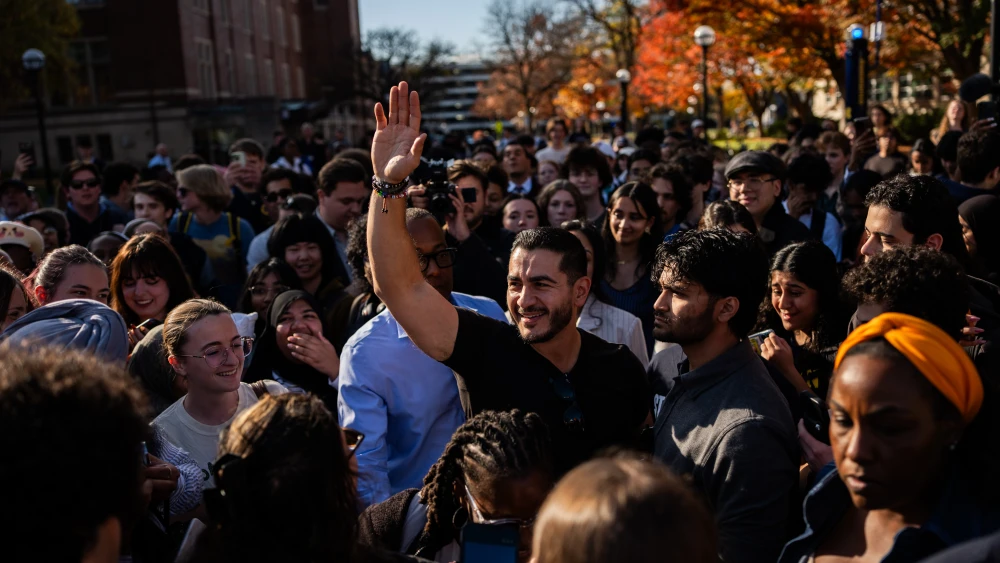
Dr. Abdul El-Sayed, the Democrat whom the Republican Jewish Coalition has called “the most antisemitic U.S. Senate candidate in America,” defeated former Republican congressman Mike Rogers early on Wednesday morning in one of the country’s most closely watched Senate races, particularly for Jews and Zionists.
The Associated Press called the race at 2:27 a.m. on Wednesday. With more than 95% of votes counted, El-Sayed routed Rogers by seven points, with 2,497,852 votes (52.5%) to the Republican’s 2,162,890, or 45.5%.
A former Detroit health director, El-Sayed will succeed retiring Sen. Gary Peters (D-Mich.), becoming the first Muslim elected to the Senate.
His victory follows a bitter campaign, in which he called Israel’s government “bloodthirsty” and “as evil as Hamas,” suggested that a terrorist who attacked a Michigan synagogue had been driven by Israeli military actions in Lebanon because “hurt people hurt people” and campaigned with antisemitic streamer Hasan Piker, who said that “America deserved 9/11.”
He has called Israeli Prime Minister Benjamin Netanyahu a war criminal, accused Israel of buying U.S. Jewish support and opposed the International Holocaust Remembrance Alliance’s working definition of antisemitism.
On Oct. 26, Rebellion PAC released an advertisement supporting El-Sayed that blamed rising grocery costs on U.S. military aid to Israel.
Jonathan Greenblatt, CEO and national director of the Anti-Defamation League, called the as “a case study in antisemitism.” El-Sayed’s campaign said it had no affiliation with the advertisement but initially stopped short of condemning its content.
On Nov. 1, Rep. Haley Stevens (D-Mich.), whom El-Sayed narrowly defeated in the Democratic primary in August, endorsed Rogers, citing El-Sayed’s rhetoric about Israel and his association with Piker.
Her endorsement drew criticism from Democratic leaders, including Senate Minority Leader Chuck Schumer (D-N.Y.), who called it “a despicable betrayal.”
Despite the controversies surrounding him, a survey commissioned by the Jewish Majority found that 57% of Jewish early voters in Michigan supported El-Sayed.
The survey of 482 Jewish voters, 75% of whom identified as Democrats or leaned Democratic, was conducted between Oct. 25 and 31, before Stevens endorsed Rogers. It had a large margin of error.
El-Sayed substantially underperformed among those surveyed compared with other Democrats on the ballot. Democratic gubernatorial nominee Jocelyn Benson received support from 78%.
Rogers received 36% of the Jewish early vote, according to the survey, while 4% supported other candidates.