


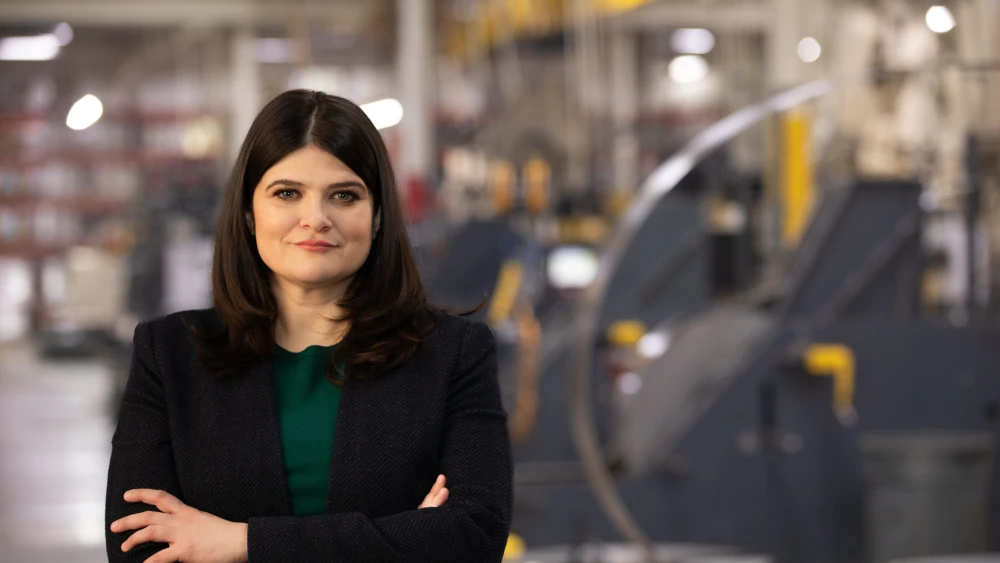
Rep. Haley Stevens (D-Mich.) was right to distance herself from Dr. Abdul El-Sayed, former Detroit health director, and his antisemitic statements and to endorse former Republican congressman Mike Rogers, even as she incurred the wrath of her party, according to Alyza Lewin, president of U.S. affairs for the Combat Antisemitism Movement.
“I think that the Democratic Party’s reaction demonstrates that they want to make an example of her,” Lewin told JNS. “They want to make it as public and as painful as possible in order to deter any other Democrat from even thinking about possibly raising concerns about antisemitism being expressed by any other Democratic candidate in the future.”
The Democratic Party “seems so determined to take the Senate that it doesn’t matter to them if the Jews are harmed in the process,” Lewin said. “I certainly felt that what she did was very brave and very principled.”
Stevens, who lost to El-Sayed in the primary, announced her endorsement of Rogers on Sunday, after El-Sayed refused to condemn an antisemitic political ad. Her Jewish fiancé, Jason Turkish, had said that he would vote for Rogers.
Since the endorsement, Stevens has been accused of betraying party values, changing her endorsement because she was bitter about being left out of the campaign and being manipulated and controlled by her fiancé.
Senate Minority Leader Chuck Schumer (D-N.Y.), the self-declared Jewish “guardian,” accused Stevens of a “despicable betrayal,” and House Minority Leader Hakeem Jeffries (D-N.Y.) told Politico on Monday that Stevens “made a terrible decision” and “blindsided everyone and isolated herself from the House Democratic caucus.”
There will be a “discussion about appropriate next steps upon our return,” Jeffries told Politico, and Curtis Hertel, chair of the Michigan Democratic Party, said that Stevens is “not a current member of the Michigan Democratic Party, nor will she be in the future.”
Stevens stated on Monday that “some critics have also dragged my fiancé into this, suggesting he or others must have made my decision for me.”
“Think about what that says. A woman can serve in Congress, run statewide and fight for her convictions and still be told that when she makes a choice people dislike, someone else must be pulling the strings,” the congresswoman said. “That is sexism dressed up as political analysis. My fiancé has his own views. I have mine. I made this decision, and I am proud of it. Do not question my independence simply because you disagree with my conclusion.”
“What has troubled me almost as much as this experience is my party’s reaction. Instead of asking why a lifelong Democrat reached this point, some leaders rushed to condemn me, question my motives and push me out,” she wrote. “That response reveals something deeply troubling about what is missing in today’s Democratic Party.”
Lewin told JNS that the Democratic Party’s response was intended to discourage other Democrats from challenging Jew-hatred in their ranks.
“They want to make it as public and as painful as possible in order to deter any other Democrat from even thinking about possibly raising concerns about antisemitism being expressed by any other Democratic candidate in the future,” she said.
“They want to make sure that nobody else dares to put principle ahead of party,” Lewin told JNS. “That’s why I think they’re being particularly nasty.”
Lewin has concerns about how she thinks that El-Sayed defines Jew-hatred.
“He’ll talk about how he understands what it is to be discriminated against because of the way he prays,” she told JNS. “But what he refuses to acknowledge or accept is the ethno part of Judaism and the idea that the Jews are people with a long ancient history rooted in the land of Israel.”
“There are folks today who are hostile to the very notion that the Jews consider themselves indigenous to Judea, that the Jews are a people indigenous to the land of Israel,” she said.
Lewin told JNS that El-Sayed has “spread antisemitic conspiracy theories.”
“If a candidate like that wins and gets ahead and succeeds with that kind of a campaign, then others will learn from that and follow,” she said. “This election, this specific race in Michigan, is a test of the Democratic Party.”
Jonathan Choe, a senior fellow with the Discovery Institute, was evicted on Sunday from an El-Sayed rally in Michigan, where he is talking to voters. Choe told JNS that Democratic Socialists of America merchandise was for sale at the rally and that no explanation was given for his removal.
“The Democratic Party is more concerned about power, control and messaging than actually representing the well-being of their constituents and the greater good,” Choe said. “When it comes to politics, when it comes to the Democratic machine here, anything that’s a threat will be ostracized, canceled and kicked to the curb.”
He told JNS that Democrats are “trying to discredit” Stevens “and cancel her like she never existed.”
“That’s what I’m seeing on the ground right now,” Choe said. “If you’re a Democrat, they’ll call her a sellout. If you’re a Republican and a conservative, they welcome it, of course, and it’s a breath of fresh air. Politics makes strange bedfellows.”
Choe didn’t expect “how nasty” Michigan politics would be.
“It’s so significant here, because it could have presidential implications,” he told JNS. “If Abdul El-Sayed wins, it means that a far-left progressive DSA member could potentially be in the White House and trigger AOC to run,” he added, of Rep. Alexandria Ocasio-Cortez (D-N.Y.).
‘Slow suicide march’
Joel Rubin, a Democratic operative who served in the Obama administration and directed Jewish outreach for the presidential campaign of Sen. Bernie Sanders (I-Vt.), told JNS that the response to Stevens endorsing Rogers “was the kickoff to the real battle over the next two years for the direction of the party on Israel and antisemitism.”
“I think this is just the beginning,” said the operative, who has warned about rising Jew-hatred on the left.
Rubin told JNS that he appreciates the “principled stand” that Stevens has taken but worries that “she may have diminished it” by endorsing across the aisle.
Julian Epstein, chief Democratic counsel on the House Judiciary Committee from 1995 to 2001 who now runs a Democratic consulting firm, told JNS that the incident is a “slow suicide march on behalf of the Democratic Party.”
“What you’re seeing with the Democrats is an embrace of a guy, who has trafficked in every kind of blood libel and every antisemitic trope that has been used over the centuries,” he said.
“The party is shrinking,” Epstein told JNS. “It’s losing its working class. It’s certainly losing Jewish voters. I think it’s losing centrists, and so it is rebuilding with this red-green alliance that we’ve seen in Europe that is now coming to the United States.”
Epstein fears that “if any of these candidates are successful, the lesson that the party will learn is that this red-green alliance, the socialist-Islamist alliance, is a winning strategy and therefore they should further normalize it.”
Stuart Smith, investigative analyst at the Manhattan Institute, told JNS that “ever since El-Sayed won the primary, there has been a wave of particularly harsh ‘get in line’ commentary from prominent figures across the Democratic coalition.”
“El-Sayed’s unofficial hype man, Hasan Piker, has even called for a kind of Marxist-Leninist discipline on this front, arguing that those who oppose El-Sayed should be punished,” he said.
“It’s no secret that the Democratic Party appears lost in the wilderness, struggling to define itself beyond past victories,” Smith told JNS. But from Rep. Nancy Pelosi (D-Calif.) to New York City Mayor Zohran Mamdani, “the attacks on Stevens were swift and relentless,” he said.
Smith thinks that a “third worldist current” is gaining influence in U.S. political discourse, and Stevens’ “refusal to endorse a candidate associated with anti-American, anti-Israel and anti-Western rhetoric is being viewed by many not as political disloyalty but as an act of honesty and patriotism.”
“In an era of hyper-partisan politics, I think that says quite a bit about where most Americans actually are politically,” he told JNS.
Democratic leadership deferred to the party’s far-left progressive wing, according to Matt Klink, a Republican political consultant in Los Angeles.
“Democrats picked punishment and decided to cater to the party’s most radical elements,” he told JNS. “Party leaders spent more energy on Rep. Stevens than on the racist ad.”
“Today’s Democratic Party is not the Democratic Party of times past,” he said. “In general, its members do not support Israel. Its leaders support Hamas and Palestine, and that’s a significant change.”
Democrats have broken from the party to support Rogers, as has a group called Democrats for Mike Rogers and leading Michigan rabbis who said that they plan to vote for the Republican.
Sam Markstein, national political director at the Republican Jewish Coalition, told JNS that Rogers is “bringing Michiganders together—Democrats, Republicans and Independents—into his campaign.”
“The contrast could not be clearer with the race run by Abdul El-Sayed, which has been based on hate and division,” he said. “The fact that Haley Stevens, a lifelong Democrat known for her bipartisan work, crossed the aisle to publicly endorse Mike Rogers for the U.S. Senate highlights the fact that Abdul El-Sayed is too extreme for Michigan and dangerous for America.”
“The shameless Democrats, like Chuck Schumer and Hakeem Jeffries, who are attacking Stevens for showing moral clarity and for putting country over party, should be ashamed of themselves,” Markstein told JNS.
Those, he said, are “the same pathetic Democrats, who had nothing to say when their party nominated a literal Nazi as their candidate in Maine and have said absolutely nothing as El-Sayed gleefully campaigns with antisemites, bigots and radical Islamists.”
Tyler Stapleton, senior director of government relations at FDD Action, a Foundation for Defense of Democracies affiliate, told JNS that the Democratic Party is set to have members who have “nuanced policy positions on supporting Israel” and others who “would like to downgrade the relationship significantly.”
El-Sayed’s campaign “has largely frozen out voices” that want him to support the Jewish community and recognize the U.S.-Israel relationship, according to Stapleton.
Jared Sclar, a Democratic consultant in San Diego, has a different view. Stevens was not taking a principled stance but reacted to El-Sayed shutting her out of his campaign, Sclar told JNS.
“The fact pattern and most of the insider reporting shows this endorsement was more about hurt feelings than some kind of country-over-party courage,” he said. “If it was the latter, she would have endorsed Rogers or stayed out from the outset. I’m not sure it moves the needle in the race.”
The Democratic Party’s response was “exactly as you would expect from any party defection two days before an election,” Sclar told JNS.
“It has more to do with protecting their very thin lead, if you believe the current polls, than anything to do with any issue,” he said.

