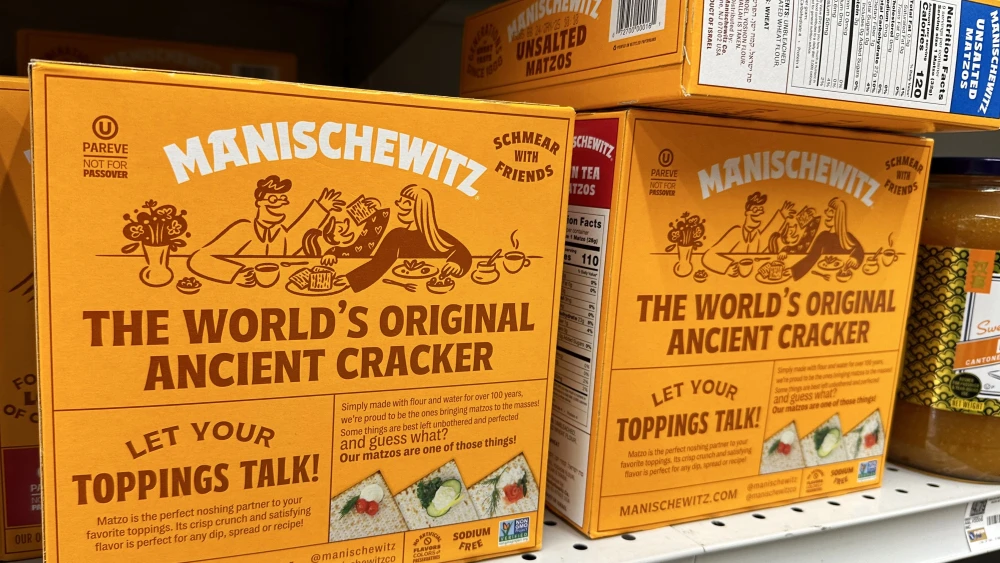
Manischewitz is reviewing its packaging as some have warned on social media that the brand’s packaging doesn’t adequately differentiate between products that are and are not kosher for Passover and that grocery stores often shelve them together.
“We’re aware of the conversation and appreciate the community bringing this to our attention, especially at a time as important and detail-oriented as Passover,” Mirit Shalvi, senior vice president of marketing and strategic partnerships at Manischewitz, told JNS.
“At Manischewitz, we take our role in helping families prepare for the holiday very seriously. We understand that kashrut during this time is deeply meaningful,” she added. “That said, we also recognize that in a busy retail environment, particularly during the high-volume Passover season, similar packaging across product lines can sometimes create confusion.”
Rabbi Moshe Elefant, chief operating officer and executive rabbinic coordinator at OU Kosher, told JNS that “over the past century, matzah has evolved from a food reserved for Passover into a year-round product found in many kitchen cabinets.”
“Today, some matzah is specifically produced for Passover, while other varieties are made for use throughout the rest of the year, a distinction that has existed for decades,” he said. “Matzah not intended for Passover is clearly labeled as such under the OU symbol.”
Those who keep kosher “must remain vigilant when shopping and always check the product labels, especially as Passover approaches,” he told JNS. “This is particularly important for products that may have different formulations designated specifically for Passover use.”
Shalvi told JNS that manufacturers, businesses and customers have a “shared responsibility” in purchasing the correct products for the holiday.
“This includes evaluating packaging differentiation and working with our retail partners to ensure clearer in-store separation and signage where needed,” she said. “Our goal at Manischewitz is always to make the Passover shopping experience as seamless and trustworthy as possible, and we remain committed to upholding that standard for our consumers.”
“Look before you buy,” advised Mordechai Lightstone, a Chabad rabbi and the founder of the Brooklyn, N.Y.-based group Tech Tribe, on social media. “Or you, too, might end up purchasing OU-certified Manischewitz brand bread.”
“Manischewitz sells a cracker with the kosher certification of OU Kosher that looks like matzah and says matzah, but it isn’t kosher for Passover,” he added.
Shais Taub, a Chassidic rabbi and author, shared a photo of similar-looking boxes on social media.
“It’s heartbreaking when someone thinks they are keeping Passover and is unknowingly eating chametz,” he wrote, of food that isn’t kosher on Passover. “It happens way more often than you might think. Look at these two products and tell me nobody would confuse them.”