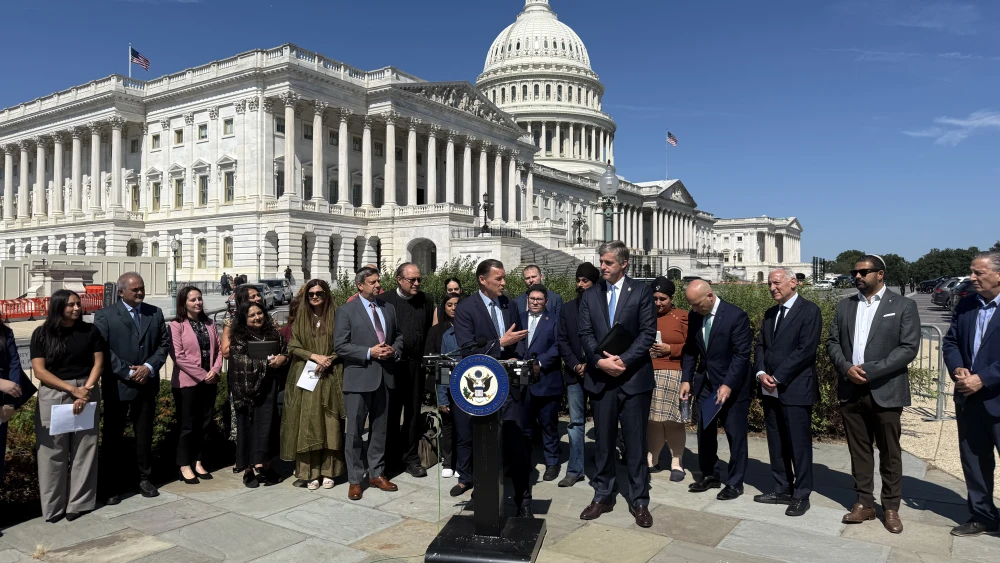
Leaders from more than 30 Jewish, Christian, Muslim, Sikh, Hindu and other faith groups gathered on Capitol Hill on Wednesday to urge passage of the Right to Worship Act, a bill designed to protect religious services from the interference of protesters.
Speaking to reporters in the autumn heat outside the Capitol, the bill’s House sponsors, Reps. Tom Suozzi (D-N.Y.) and Brad Knott (R-N.C.), said that the legislation is intended to weigh potentially conflicting elements of the First Amendment.
“This bill works very hard to balance our First Amendment constitutional rights between the right to free speech and the right to worship. These are two very fundamental parts of what makes America a fantastic place to live,” Suozzi said. “We have got to balance these two ideas together.”
The bill would make it unlawful, under penalty of a civil fine, for anyone to knowingly disrupt or impede a scheduled religious service by engaging “in a course of conduct that substantially affects interstate commerce” within 100 feet of the entrance of a house of worship.
The bill also creates a right for anyone whose religious service is so disrupted to sue in court.
“If there’s a civil action that can be brought, it will make the antagonizers, the harassers, the people who don’t want to peaceably protest think twice,” Knott told JNS.
Jewish groups have sought greater federal and local protections for houses of worship as a result of anti-Israel protests and attacks against synagogues in the wake of Oct. 7.
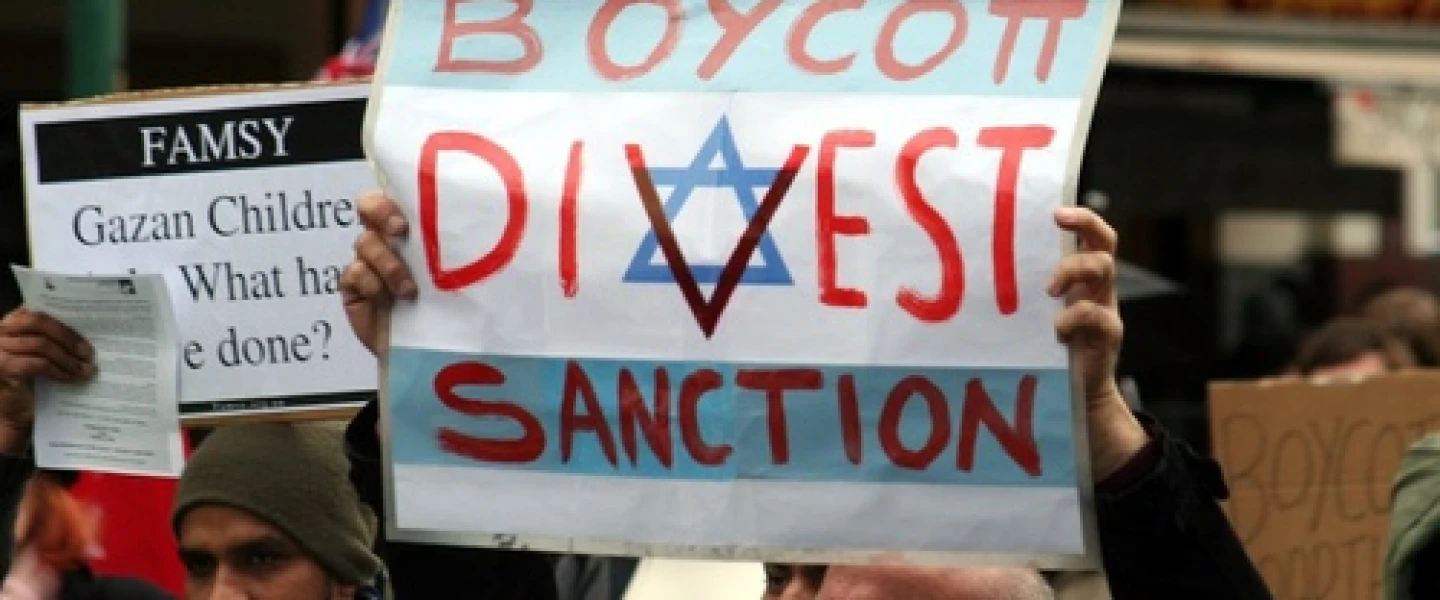
Anti-Israel protest groups frequently target synagogues hosting what the protest organizers describe as “real estate sales” events offering property in Israel, including in Judea and Samaria. Those events are frequently put on by groups like Nefesh B’nefesh, which promotes Jewish emigration to Israel.
For centuries, rabbinic law has regarded moving to Israel, or aliyah, as a religious obligation.
JNS asked Suozzi and Knott if Jewish organizations would have to ask courts to determine that making aliyah was a religious observance protected under the law or if those events fall outside the scope of a protected “scheduled religious service.”
Suozzi told JNS that he expects that there will be litigation around that issue and other areas where the bill seeks to balance the rights of protesters and worshippers.
“The bill really focuses heavily on religious services, so that’ll be a real question and a real challenge as to whether or not that will withstand the constitutional challenge,” Suozzi said. “That’s why we’ve spent so much time speaking to constitutional experts about this process.”
Some local officials have sent mixed messages about disruptive protests at synagogues.
New York City Mayor Zohran Mamdani said in January that pro-Hamas chants from protesters at a synagogue in Queens was “wrong.” But his spokeswoman also described a Nefesh B’nefesh event at Manhattan’s Park East Synagogue in November as a “violation of international law.”
Knott told JNS that one reason that he is backing the legislation is that there is currently no legal remedy for worshippers if local prosecutors decline to press charges against protesters who violate existing laws protecting houses of worship. He cited a recent case of protesters storming a church in St. Paul, Minn.
“In my opinion, it was a criminal disruption, whether it’s trespass, assault, just barnstorming that church during the service, and the progressive, far-left district attorney did not bring charges,” Knott said. “Those worshippers have no remedy.”
In regard to aliyah events, Knott told JNS that the bill is deliberately narrow.
“Within the buffer zone, if you hold a sign that says ‘Israel do better,’ that’s perfectly consistent with this law,” the North Carolina Republican said. “If I grabbed a worshiper by the lapel pin and said, ‘You’re committing whatever crime’ you allege, that is a disruption that’s not sanctioned with this bill.”
“The definition targets the focused, intentional disruption, not the benign and peaceful,” Knott told JNS. “We were not trying to cast a wide net. It’s a focused net where people use an organized, established house of worship to target specific people.”
The Jewish and other faith groups backing the legislation include the Jewish Federations of North America, Anti-Defamation League, American Jewish Committee, Agudath Israel of America, U.S. Conference of Catholic Bishops, National Association of Evangelicals, Hindu American Foundation, Islamic Society of North America and United Sikhs.
Eric Fingerhut, CEO of the Federation, described the $1 billion cost that American Jews now pay for security at their religious institutions.
“Over $250,000 per synagogue is being spent on average across the United States for physical security needs,” Fingerhut said at the press conference. “Our synagogues know and our worshippers know that they are under attack and that they have to be safe and secure.”
The House went into an early recess on Wednesday, meaning that the bill will not come up in the lower chamber before the midterm elections in November.
Suozzi told JNS that he hopes there may be more activity in the Senate, where Sens. Ted Cruz (R-Texas) and Elissa Slotkin (D-Mich.) have sponsored the bill’s companion version.
“I’m really hoping that we can convince the Senate, who’s going to be in session for another three weeks, to pay attention to this now,” Suozzi said. “I think that we can get the speaker to pay attention to this once we come back, because I think it’s something that he was paying attention to and asked Knott to work on this, specifically.”
“Now we’ve got to push him over the finish line to try and get this thing done,” Suozzi told JNS.