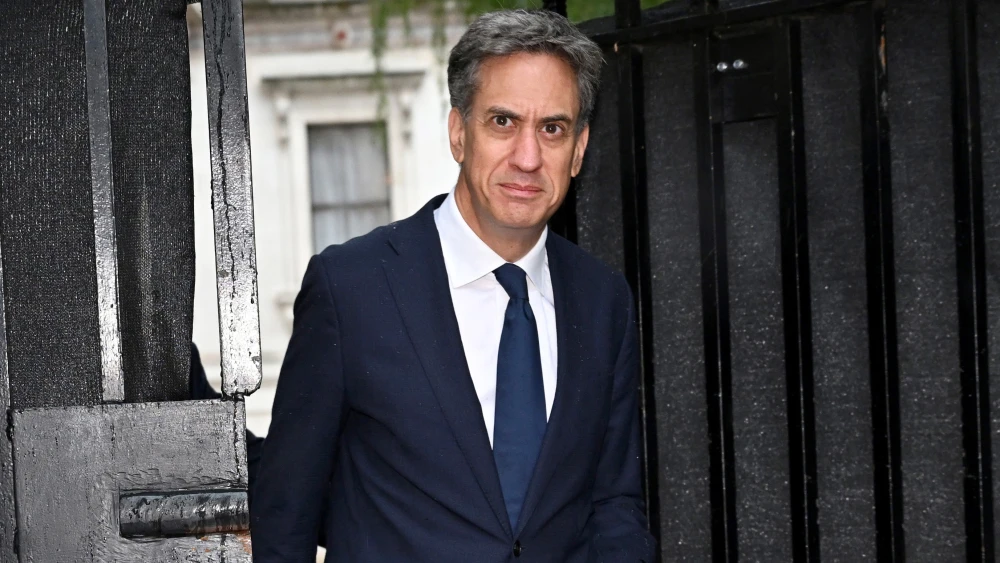

When U.K. Foreign Secretary Ed Miliband defended the British government’s latest measures against Israel in the House of Commons last week amid a barrage of inflammatory and baseless accusations against the Jewish state and its communities in Judea and Samaria, one exchange stood out.
Responding to shadow foreign secretary Tom Tugendhat, Miliband declared that “the voices that I listen to more than his on the Palestinian people are those of the prime minister of the Palestinian Authority and Palestine’s ambassador to the U.K.”
There’s nothing wrong with a British foreign secretary listening to Palestinian leaders. He should. But if particular voices carry such weight in foreign policy, then what they said and the institutions they represent should be examined. In this particular case, Miliband’s decision to elevate them becomes more troubling.
Later, when Democratic Unionist Party Sammy Wilson, a Member of Parliament, warned that the government’s measures could harm Palestinians, Miliband went further: “How dare he try to speak for the Palestinian people instead of the Palestinian prime minister or the Palestinian ambassador in the United Kingdom?”
So, who are these voices? One is Husam Zomlot, the Palestinian ambassador to the United Kingdom and a senior figure within the P.A.’s ruling Fatah Party.
In February 2023, days after a Palestinian gunman shot and killed seven people exiting a synagogue in Neve Ya’akov in Jerusalem, Sky News presenter Kay Burley repeatedly asked Zomlot whether he condemned the killings. “No,” he eventually replied. “I condemn the origin of this.”
Eight months later came Oct. 7.
Interviewed by CNN news anchor Christiane Amanpour while Hamas’s massacre was still unfolding, Zomlot said he did not support killing civilians. But when asked directly whether he condemned what Hamas had done, he turned instead to Palestinian deaths, Israel’s military response and decades of alleged Israeli oppression. He subsequently described the slaughter as “a matter of when, not if” within a narrative of “75 years” of Palestinian suffering.
More than a year later, Sir John Whittingdale asked Zomlot before the House of Commons Foreign Affairs Committee whether he “unequivocally” condemned the Oct. 7 attack. Zomlot said Palestinians rejected targeting civilians “wholeheartedly, fully and in absolute terms.” Again, he did not give the unequivocal condemnation of Oct. 7 he had been asked for.
Zomlot’s description of Israel itself is equally relevant. For years, he has framed the Israeli-Palestinian conflict through the language of colonialism, apartheid and ethnic cleansing, going far beyond criticism of Israeli Prime Minister Benjamin Netanyahu or particular Israeli policies.
He has described Israeli communities as “illegal colonial settlements” and referred to Israel’s “colonial enterprise.” In a Frontline interview, he spoke of Israel’s “colonial settlement project” and compared the Palestinian cause with the struggle against apartheid South Africa.
Before the Commons Foreign Affairs Committee in 2024, Zomlot described Palestinians as confronting “more than a century of settler colonialism,” together with “ethnic cleansing,” “military occupation, colonization, besiegement and apartheid.”
“More than a century” is revealing. It takes his indictment back not to the 1967 Six-Day War or even Israel’s establishment in 1948, but to the origins of the modern Zionist movement itself. It places the creation of the Jewish national home within a narrative of colonialism and dispossession. This is one of the voices Miliband described as “incredibly important in this debate.”
If particular voices carry such weight in British foreign policy, then we should examine what they have said and the institutions they represent.
The other is Mohammad Mustafa, prime minister of the Palestinian Authority. Mustafa is an economist and former World Bank official and should be judged on his record. Speaking at Davos about Oct. 7, he described what happened as “unfortunate for everybody” before characterizing it as a symptom of Palestinian suffering over “75 years non-stop.” So, his grievance begins not in 1967, but with Israel’s establishment.
Mustafa has also defended the P.A.’s prisoner and martyr payment system against its “pay for slay” moniker, presenting it as social support for families in need.
These men represent Palestinian political institutions with longstanding questions to answer over the involvement of their members and affiliated groups in terrorist attacks, incitement, the glorification of terrorists, prisoner and martyr payments and antisemitic rhetoric. P.A. leader Mahmoud Abbas, who will turn 91 in November, has himself repeatedly caused international outrage with statements concerning Jews and the Holocaust.
Here, the contrast in Miliband’s own language is striking. For Israel, he announced an import ban, a “new comprehensive sanctions regime,” action against companies and individuals, restrictions on advertising, further individual sanctions and additional controls on arms and other exports. Those who finance or facilitate the activity he condemned, he warned, would face “the full force of U.K. sanctions.”
And the P.A.? He said, “I urge the Palestinian Authority to accelerate reform.” He immediately followed that with another demand of Israel: to release revenues it was withholding from the P.A.
Later, Miliband’s language was softer still: “Yes, they need to keep reforming, but Israel needs to release the funds.” No comparable language of consequences. No “full force” of British action. There was only another exhortation to reform, followed by another demand of Israel.
Israel is a sovereign state and should not be placed on an equivalent footing with Palestinian political factions and institutions. And those institutions should not escape scrutiny or accountability.
Less than a week after Miliband’s statement, Labour MP Tahir Ali intervened in a House of Commons debate in which Liberal Democrat Richard Foord called for Hamas to be disarmed and disbanded.
Ali asked whether Israel should also be disarmed. Then he went further: “Is it not about time that military action was taken against Israel as well?”
A call to disarm Hamas, a proscribed terrorist organization responsible for the massacre of 1,200 people and the kidnapping of 251 others on Oct. 7, prompted a Labour MP to demand military action against the world’s only Jewish state. Miliband did not make those remarks and cannot be held responsible for another MP’s words. But ministers should not ignore how far the language surrounding Israel is going.
In the same debate, Jewish Labour MP Matthew Patrick recalled the terrorist attack on Manchester’s Heaton Park synagogue, during which the attacker reportedly declared: “This is what they get for killing our children.” Patrick warned that some cloak antisemitism in professed concern about Israel, dressing “murderous intent and racist ignorance” as a moral crusade.
Criticizing an Israeli government is not antisemitism, nor is opposing Israeli policies. It matters, however, when rhetoric moves beyond that and portrays Israel itself as uniquely illegitimate: a colonial enterprise, an apartheid system, an inherently criminal project whose very establishment is presented as a historical wrong.
This takes us back to Miliband. The question is not whether Britain should listen to Palestinian voices. It should. The question is which voices it privileges, how critically it listens, and why Palestinian leaders and institutions appear to receive such deference while the language and measures directed against Israel become ever harsher.
Ed Miliband has told Parliament whose voices he is listening to. Perhaps Westminster should listen more carefully to what those voices have actually been saying.
Because when condemnation of Israel grows harsher, accountability of Palestinian leadership grows softer and a British MP can move from discussing the disarmament of Hamas to contemplating military action against Israel, one question remains: Where does this end?