Representatives from the U.S.-led Board of Peace laid out plans to disarm Hamas and rebuild Gaza on Wednesday, with the head of the board’s transitional Palestinian government saying that it opposed the removal of the Strip’s inhabitants.
Speaking at a donor conference on the sidelines of the United Nations General Assembly in New York City, members of the board and its subsidiaries described plans for Gaza that they said are now ready to be implemented.
“We trained and prepared our advance force, the troop contingents of 500 troops from Kosovo and Morocco, to be ready to deploy,” said U.S. Maj. Gen. Jasper Jeffers, commander of the Gaza International Stabilization Force.
“For Gazan police, we’ve had over 250,000 applicants, and we vetted 19,000, and we started the initial training,” he said.
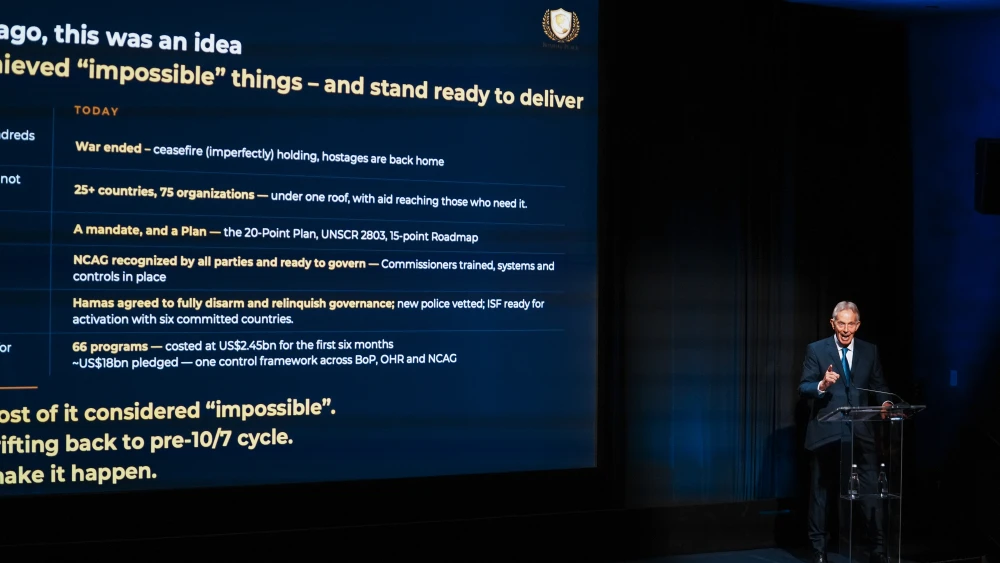
The hour-long session included a slide presentation with ambitious goals, like “Gaza rebuilt by Gazans,” but scant public details.
One of few concrete demands from the presenters was a request to donors for $2.45 billion to meet the “near-term capital requirement” for 66 recovery programs over the next six months. The same slide put the total reconstruction cost for Gaza at $71 billion.
“The first phase—make no mistake about it—is all about donations for us,” said Johannes Worsoe, the board’s chief financial officer. “We have $18 billion in commitments at this point to the Board of Peace. At this point, we have only called $280 million.”
“We’re going to call capital as we need it, and we do not need to put money in our bank account before we’re ready to actually have the impact,” Worsoe said. “At this point, we’re ready to call capital.”
Worsoe said that donors could see details about the 66 programs, which cover issues like public sanitation and winterization, after the session.
Many of the speakers, including former U.K. prime minister Tony Blair and U.S. Special Envoy for Peace Missions Jared Kushner, said that the plan from the board was the best chance for peace in Gaza, despite objections to some elements from figures in the Israeli government and from Gaza’s de facto ruler, Hamas.
“There is talk of ‘free Palestine,’ but for Palestinians living in Gaza, they don’t need a slogan. They need a solution,” Blair said. “To be free, Gaza must live in peace with its neighbors and with itself, and this cannot happen if it’s governed by those who use Gaza as a base for war against a neighbor it has no chance of defeating.”
“Hopefully, this will show the Israelis that there is hope for peace and coexistence,” Kushner said.
One of the sticking points in the potential reconstruction of Gaza is that some Israeli officials have pressed for Palestinians to be removed from the enclave, either temporarily or permanently.
Itamar Ben-Gvir, Israel’s national security minister, unveiled an “emigration” plan for Gaza earlier this month, and Israeli Defense Minister Israel Katz said on Sept. 2 that a plan for Gazans to depart the Strip was “frozen” but still under consideration.
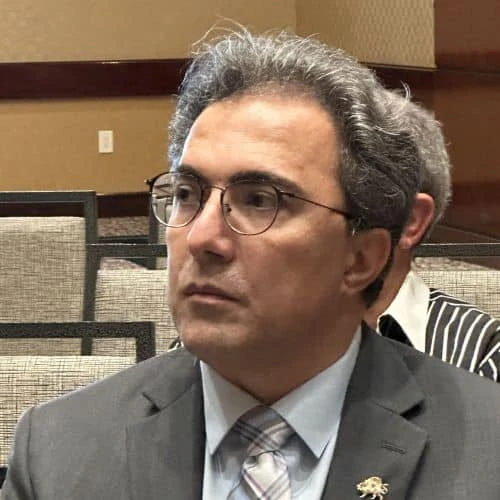
Ali Shaath, chief commissioner of the National Committee for the Administration of Gaza, which the board intends to be the transitional government of Gaza, said that the board was opposed to such plans.
“We are against the evacuation of Gazans out of Gaza,” Shaath said. “We want them to stay and live in Gaza with hope and prosperity.”
Nikolay Mladenov, the board’s high representative for Gaza, told reporters that the upcoming Israeli elections had made negotiations more difficult.
“Everything is a little bit more emotional, a little bit more politically sensitive,” Mladenov said.
He said that the stabilization force was moving ahead despite reports that Israel has barred Gazan police recruits vetted by the board from travelling to Egypt for training.
“Certainly, of course, this is taking time,” Mladenov said. “Many of us would have wished that it took less time, but given the complexities of what we’re dealing with, I think we’re making slow but steady progress.”