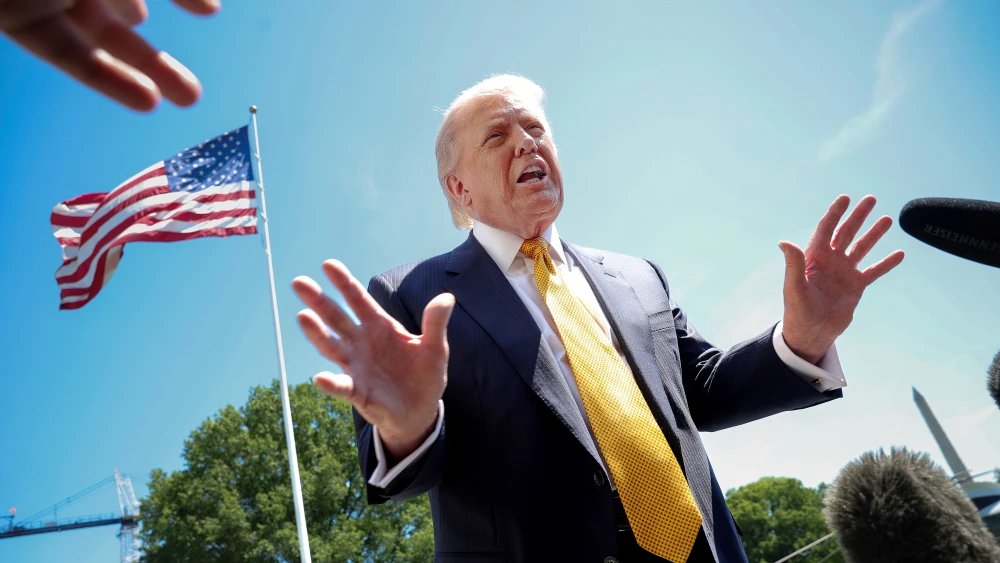
U.S. President Donald Trump warned on Tuesday that the Iranian regime would be “decimated” if it refused to agree to end the war, saying the United States would prevail “peacefully or otherwise.”
“We’ll win it one way or the other,” Trump told journalists at the White House before departing for China. “Their navy is gone, their air force is gone; every single element of their war machine is gone.”
The regime “killed 42,000 people at least over the last month and a half—we’re gonna... we’ll win,” the president continued.
The Islamic Republic “cannot have a nuclear weapon,” Trump stressed. “They will not have a nuclear weapon. They know that... we don’t play games.”
“We’re either going to make a deal or they’re going to be decimated—so one way or the other, we win,” Trump said.
He added that Iran would likely not be among the topics he planned to discuss with Chinese President Xi Jinping during his visit, saying Washington had Tehran “very much under control.”
Trump on Tuesday told Sid Rosenberg, host of “Sid & Friends in the Morning” on WABC radio, that the Islamic Republic had initially agreed to hand over its enriched uranium, “but then they changed their mind.”
“I call it the nuclear dust because it’s appropriate. It’s easier for people to understand. And we’re going to get it,” he reiterated.
“The problem is there’s only two countries in the world that can get it, us and China, because nobody has the equipment. Because when we bombed it, it was a total—that I was right—it was a total obliteration. The entire mountain collapsed on top of it,” said Trump.
On Saturday, the U.S. president warned that “Operation Project Freedom” in the Strait of Hormuz could be resumed and expanded if Tehran does not agree to a deal ending the war and dismantling its nuclear program.
Trump launched “Operation Project Freedom” on May 4 to safeguard merchant vessels following a series of Iranian attacks in the vital waterway. Tehran has largely blocked the strait since the start of the war, triggering a spike in global fuel prices and putting pressure on financial markets.
The operation was suspended two days after its launch at the request of Pakistan, which is mediating talks with Tehran.
Trump’s threat followed an exchange of fire between U.S. and Iranian forces in the Strait of Hormuz, adding to uncertainty over the temporary ceasefire that Washington says remains in effect.
Trump told journalists on Monday that the Islamabad-brokered truce with the Iranian regime was “unbelievably weak” and “on life support.”
“I would call it the weakest right now after reading the piece of garbage [proposal] they sent us. I said, ‘I’m not even going to waste my time reading it.’ I would say it’s one of the weakest. Right now, it’s on life support,” he declared.