When about 50 anti-Israel protesters targeted his house on Feb. 5, 2025, Jonathan (“Jay”) Sures, one of 26 members of the University of California Board of Regents, remembers light shining into his home.
“It was 6:30 in the morning. They were trying to blind us,” Sures, who is Jewish, told JNS. “There were antisemitic signs posted all over our house, bloody handprints, pictures of dead babies, people just screaming and yelling.”
Sures is one of 18 members of the Board of Regents, which governs the public school system, appointed by the California governor to 12-year terms.
The regents appoint a 19th member, a student, to one-year terms, and there are seven ex officio members: the governor, lieutenant governor, Assembly speaker, superintendent of public instruction, the president and vice president of the university’s alumni associations and the university system president.
His wife’s first thought was to leave the house and go to work, but when she tried to do so, a “mob” came and “surrounded her in her car and held her against her will,” Sures said. He called 911 and reported that his wife was in “immediate danger,” he said.
“Within two minutes, there were sirens blaring from everywhere, and they shut up and dealt with it pretty well,” he told JNS.
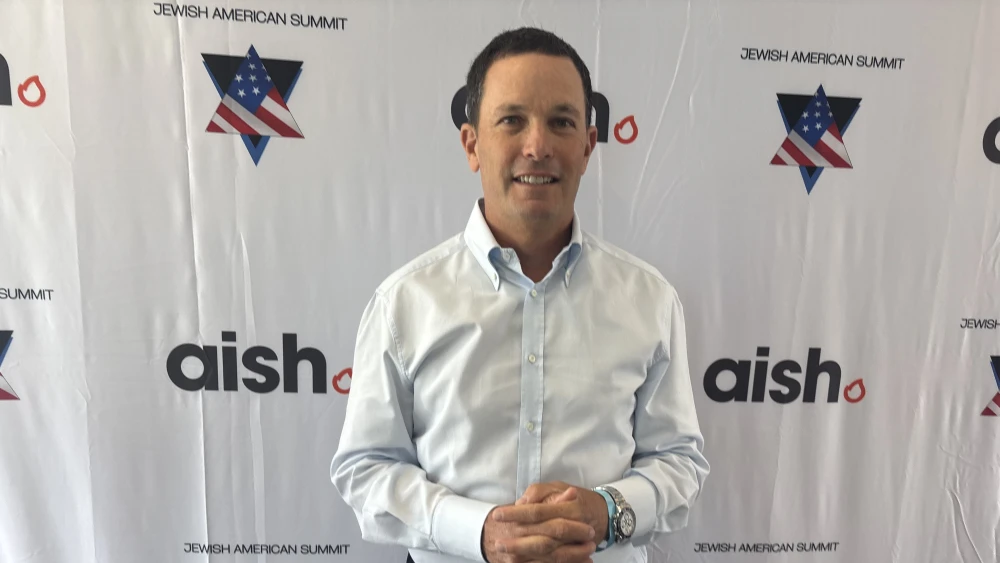
Erielle Reshef, of MS NOW, moderated a discussion with Sures at the Jewish American Summit in Los Angeles on Sunday morning. Sures, who is vice chairman and one of four managing directors of United Talent Agency, one of the world’s biggest such firms, spoke to JNS after his session.

Since the protest, “we’re very conscious about being followed home at night,” and he and his family “put a lot of security measures in place, both at our house and at my company, that are preventative,” Sures told JNS.
He filed for a restraining order against the graduate student, whom he identified as the protest leader. In May 2025, a judge denied that order and the following August, ordered Sures to pay the student’s legal fees.
The regent told JNS that he thought the case was “as solid as you get.”
“Win or lose, I don’t care. I just want to let them know that if you do this to me, I’m coming after you harder,” he said.
“You hit me with a fly swatter, I’m going to hit you with a baseball bat,” he said.
Sures thinks that Julio Frenk, chancellor of the University of California, Los Angeles, did the right thing by banning the Students for Justice in Palestine chapter from campus indefinitely in March 2025. Frenk did so after the group was involved in the protest at the regent’s house, but Sures said that he had nothing to do with the decision.
“I think the group is terrible,” Sures told JNS. “I think they are a group that incites violence. I think it’s a group that is wildly antisemitic, and I think that has no place on college campuses.”
Sures told JNS that the public university system has improved in its response to Jew-hatred since the early days after Oct. 7.
“We figured it out now,” he said. “I think there was just a real slowness in terms of dealing with it.”
“That was highly frustrating for me and a few of my UC regent colleagues,” he told JNS. “I think they allowed it to go on too long—the protests, everything.”
After the anti-Israel protest in front of his house, Sures said that regents, chancellors and trustees around the country contacted him to see how he was.
“There was a common theme when we were talking about it,” he told JNS. “The more Republican-leaning states tend not to have this problem, primarily because they empower their police to do their jobs.”
“One of the big issues I had is that the police across the University of California were really held back from doing their jobs, which was to enforce the time, place and manner rules that we had in place,” Sures said.
“Subsequently, that’s changed, and now they’re highly enforced,” he told JNS. “But at the time they weren’t, and that was troubling.”
A “big bureaucracy” in the University of California system “amongst the chancellors and the office of the president” and other departments was holding the police back, he said.
Sures believes that the university system now does a “pretty good job” putting measures into place to address Jew-hatred.
That includes changing “website rules about posting discretionary statements” and dealing with “student and faculty discipline,” he said. There were “much fewer antisemitic issues on campus” last year, he told JNS.
Sures said he couldn’t talk about the Trump administration’s actions against the university system due to pending litigation. But he said of the federal government’s efforts, broadly in higher education, that “if the intent is to cut funding because schools are not enforcing their time, place and manner rules and allowing rampant antisemitism, I understand it.”
“My sense of it is, the universities, in general, have done a much better job, and in some cases, an incredible job, curbing this,” he told JNS. “I think it was just a slow process.”