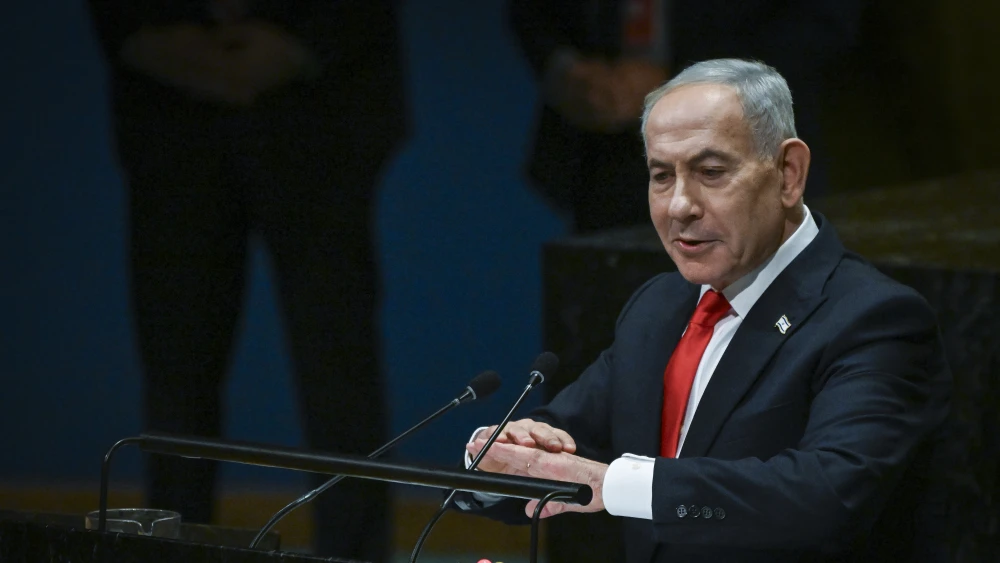
Ending the Iranian threat ultimately will require toppling the regime in Tehran, Israeli Prime Minister Benjamin Netanyahu said, in an interview with Fox News‘s Mark Levin that aired on Saturday.
“Let’s complete the job and have the people of Iran seize their own future,” Netanyahu said, praising U.S. President Donald Trump’s military and economic pressure on Tehran.
“The only way you can deal with it is to basically get rid of this regime,” the prime minister said, describing this as a long process involving military and economic measures.
Netanyahu told Levin that his goals for the last two years of Trump’s term are to eliminate the Iranian threat, expand the Abraham Accords and harness the power of artificial intelligence.
The first goal is to “achieve the complete elimination of the Iranian threat to Israel, to America and to the world,” Netanyahu said.
“This is a regime that chants ‘Death to Israel, death to America'—you’re the real target,” the premier said.
Crediting Trump’s “brilliant leadership,” Netanyahu said the military campaign and economic blockade against the Islamic Republic had been “very effective,” adding, “Let’s complete the job.”
Also on Saturday, Defense Minister Israel Katz warned that Jerusalem is prepared to launch powerful strikes against Iran in a possible future confrontation.
“We are prepared to strike Iran with full force, and this time all energy targets as well,” Katz told Israel’s Channel 14, adding that such attacks could set the Islamic Republic back decades.
He insisted that the Iranian regime was close to collapse.
השר כ"ץ נשאל אם הוא מרוצה מהרמטכ"ל זמיר - והשיב: "לחלוטין כן"#הפטריוטים@YinonMagal @Israel_katz pic.twitter.com/kudiDvPvRi
— C14 (@C14_news) October 17, 2026
CENTCOM: IRGC not paying troops due to US economic pressure on Iran
The “compounding” effect of America’s economic suffocation campaign against Iran is being felt across all sectors of its economy, including its military and the Islamic Revolutionary Guard Corps, commander of the U.S. Central Command Adm. Brad Cooper said in a recorded message on Friday.
“The financial strain on Iran’s military has become so significant that there are reports of Iran-aligned militia groups across the region withholding payments to their soldiers in order to funnel money back to the IRGC, which also is not paying its troops,” Cooper stated.
The Islamic regime is feeling “economic pain” and the IRGC is “increasingly showing signs of greater desperation as a result,” the admiral continued.
Payments, including pensions, are being withheld by the Iranian regime from workers in industries such as oil and energy, manufacturing, steel and heavy industry, he said.
Meanwhile, the IRGC continues to attack commercial vessels in the Strait of Hormuz, having killed 20 civilian mariners since the war began on Feb. 28, Cooper said, citing data from the U.N.’s International Maritime Organization.
Despite these attacks, the commander continued, the strategic waterway “remains open for business.”
Over the past week, approximately 400 merchant ships and 100 million barrels of crude oil have transited the strait, in addition to the 1.3 billion barrels that were transported in recent months, Cooper said.
American forces initially launched a naval blockade on Iranian ports on April 13. It was temporarily lifted on June 18, when an interim U.S.-Iran agreement took effect, only to be re-imposed on July 14.
On Aug. 24, Washington initiated “Operation Economic Outcast,” also known as “Economic D-Day,” which added more sanctions and financial measures against Iran.
U.S. forces have thus far prevented Iran from exporting at least $25 billion worth of crude oil, Cooper said.