
The United Kingdom has banned the activist group Palestine Action under terrorism legislation. This might seem like a win for law and order, and in many respects, it is. But outlawing a group with strong support exposes the fragility of its legal system, the limits of state authority and the deep divisions undermining social cohesion.
Through direct action and intimidation, Palestine Action targeted U.K. arms manufacturers linked to Israel and, in some cases, successfully shut them down. Its members vandalized banks, attacked Jewish-owned businesses, and, most infamously, stormed the U.K.’s primary military airbase—an escalation that ultimately led to its classification as a terrorist group.
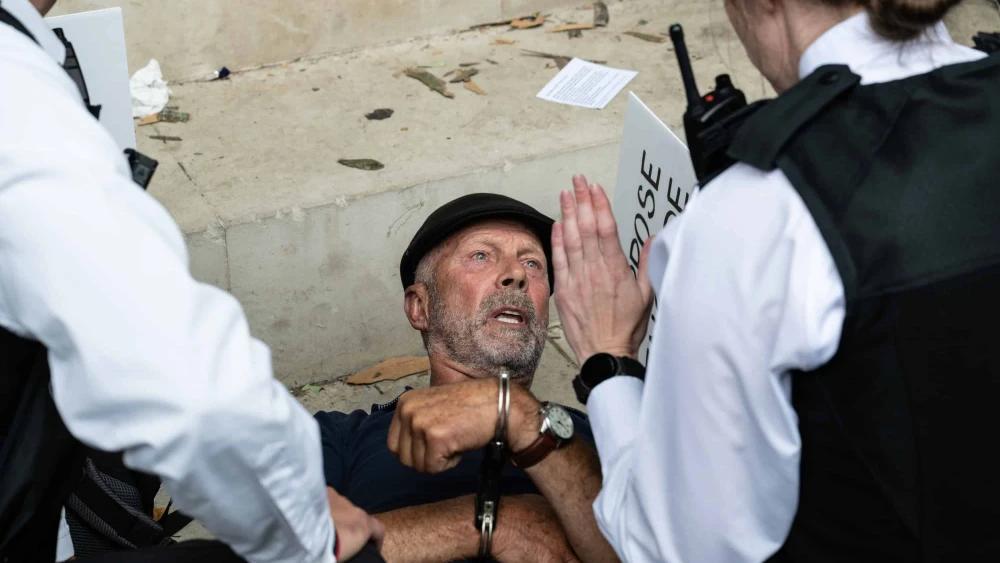
The state will move to target its organizers, freeze its funds and seize its assets. But the situation extends far beyond the group itself. On the day the ban took effect, July 5, police arrested nearly 30 protesters in London, galvanizing resistance.
Estimates suggest that Palestine Action has tens of thousands of supporters in the United Kingdom. Parliament member Richard Burgon said the legislation risked “criminalizing thousands of volunteers and supporters,” including “students, nurses, retirees and professionals,” highlighting the diverse coalition backing the group and the potential for perceived overreach.
If these protests continue to grow, will the police attempt mass arrests of supporters? Politically and practically, that seems unthinkable. The challenge now is not just about suppressing the group, but about navigating the broader consequences of public dissent.
We’re entering dangerous territory with a law that exists on paper but is unevenly applied. Supporting the group carries a prison sentence of up to 14 years. But selective enforcement—applied for some, absent for others—undermines counter-terrorism laws and the principle of equal justice. It also breeds cynicism and resentment.
The double standard is even starker when it comes to public figures. Multiple government officials voiced support before the ban, and Parliament member Zarah Sultana even declared, “We are all Palestine Action.” If they repeat their endorsements today, would they face prosecution like members of the public might? It’s hard to imagine.
One public figure has already tested the boundary. In a video released after the group was declared a terrorist organisation, Pink Floyd’s Roger Waters called them “great” and voiced his support. Comfortably numb to what that now means under terrorism law, he revealed the dark side of the ban: no investigation, no prosecution. The only pressure so far has come from pro-Israel U.K. lawyers and the activist group Campaign Against Antisemitism, which have raised the alarm themselves and have said that they will pursue private legal action if the authorities do not. As of now, there is no public information showing that law enforcement has taken any action.
Such an enforcement gap emboldens the supporters of this group, encouraging them to view the conduct not as criminal but as justified resistance. For many in Palestine Action, this mindset frames tactics like vandalism as part of a moral struggle against what they perceive as a complicit or genocidal state.
Extremists and terrorists always believe that their cause is just. Yet there is an uncomfortable reality: The sense of righteousness motivating Palestine Action is no longer fringe. The narrative that the State of Israel is committing genocide has gained traction in the mainstream. This belief fuels public debate and motivates direct action with real consequences for social cohesion and public order.
Against this backdrop, the government’s ban targeted Palestine Action’s illegal tactics, not free speech or the right to protest. It failed, however, to influence how this distinction was portrayed in the media and by other activist groups. As a result, many people who oppose the tactics of vandalism, harassment and intimidation ended up conflating the group’s illegal methods with legitimate protest. This weakens public trust and complicates enforcement efforts.
When the shared legitimacy of law breaks down, and when large parts of society reject who is labeled an actual criminal, the government’s power to govern is weakened. This signals a deep political and cultural fracture that can’t be patched over with legislation. It forces a reckoning: What kind of society do we want to be, and whose values define the law?
The ban was justified, but in a deeply divided country, the government faces a choice: Enforce the law selectively and lose authority, or enforce it strictly and risk unrest? There’s no easy answer, and every step risks deepening the very divisions that threaten public order.