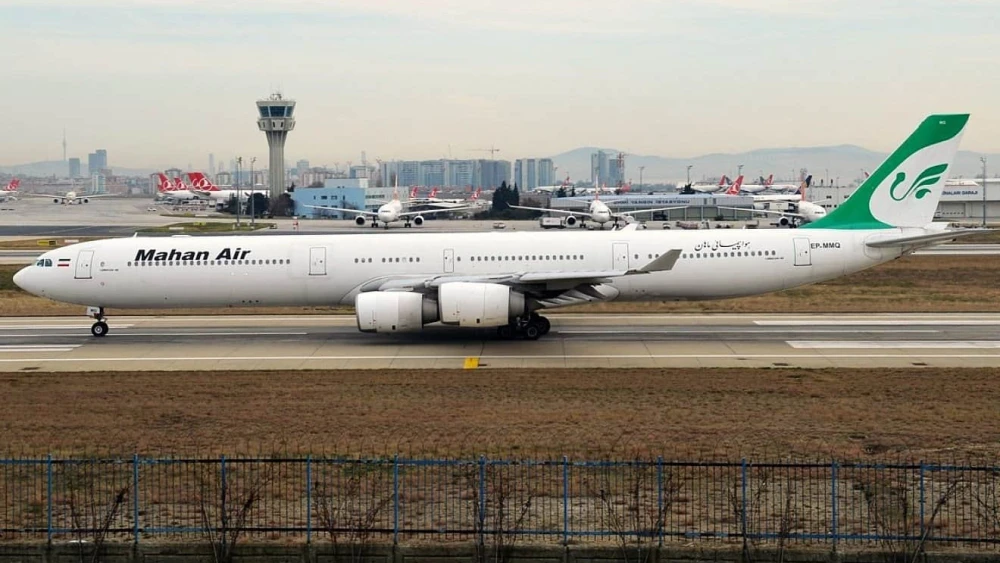
Under the barrage of precise Israeli attacks and amid the collapse of internal security, Mahan Airlines, a so-called “private” airline in Iran, has once again surfaced as a crucial tool of the regime. Long known as the flight arm of Iran’s Islamic Revolutionary Guard Corps, Mahan plays a central role in transporting key security figures, their families and critical military equipment.
Since June 13, as Israeli airstrikes have intensified across more than 23 provinces, and approximately 100 cities and military centers, suspicious activity involving Mahan Airlines has notably increased.
Although it presents itself as a civilian airline, Mahan Air has operated as an unofficial fleet of the IRGC for years. Its activities include:
- Secret flights to Syria, Lebanon, Iraq and Yemen.
- The transport of military advisors, drones, and missile components.
- The evacuation of commanders’ families during periods of crisis.
- Inclusion on the U.S. sanctions list due to its material support of terrorist activities.
Mahan Air is no longer an ordinary airline. It has become an extension of the regime’s military-security apparatus—a lifeline for extracting key players, and continuing regional terror and suppression operations.
Unofficial sources now report that some Mahan flights are being carried out without public registration, using “security codes” to depart from Imam Khomeini International Airport to destinations such as Muscat in Oman, Damascus, Beirut, Bangkok and China. These are widely seen as emergency evacuation flights for elite regime figures and their families.
Images show groups of people preparing to board planes, accompanied by multiple bulletproof escort vehicles. Both Mahan Air and Iran Air aircraft are visible. These movements coincide with reports that family members of regime officials and IRGC commanders have been secretly fleeing the country.
In videos online, people are describing how three or four flights take off, one after another, within a five-minute time span, even though Iran’s airspace is closed.
The Flightradar24 website confirmed the exodus, publishing time-lapse images that show several passenger planes taking off from Tehran airports, despite Iran’s officially closed airspace, heading toward undisclosed destinations.
While the Iranian people endure crushing economic hardship and escalating insecurity, the regime diverts its national air fleet to protect the corrupt and traitorous individuals responsible for years of repression and bloodshed.