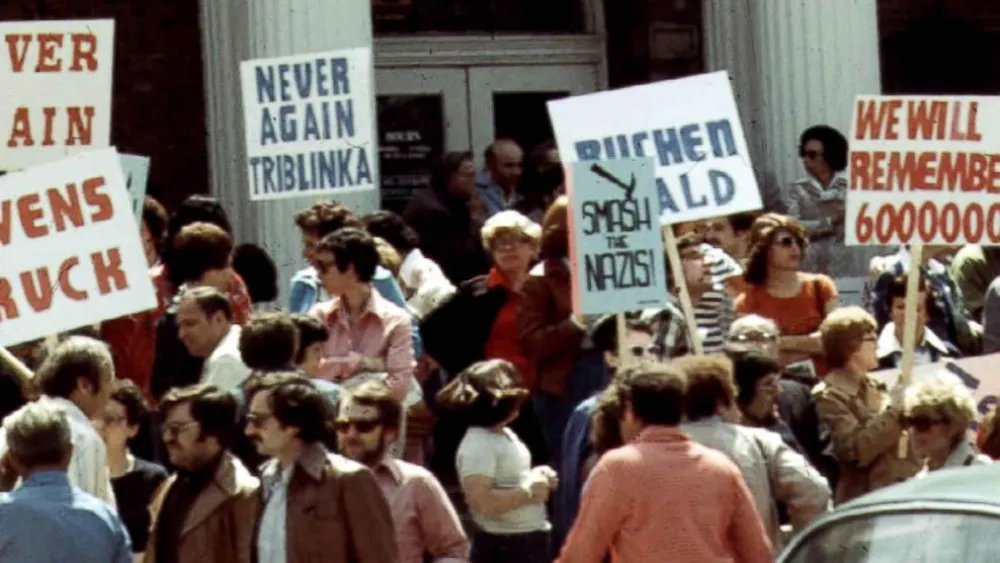

The question of how a democratic society balances free expression with public safety becomes especially urgent when protests begin to escalate. The landmark National Socialist Party of America v. Village of Skokie case (1977) is often cited as a defining moment in which the United States reaffirmed its commitment to protecting even deeply offensive speech.
The concern behind that protection was that the government should not be trusted to decide too easily which movements are legitimate and which are hateful. For that reason, the law generally gives different groups the same starting protection: the right to assemble, speak, hold signs, chant slogans and advocate political views, even when those views are offensive.
But this legal protection creates a practical problem. The law may begin by treating different movements similarly, but it’s not designed to anticipate or manage how protests actually unfold in real time.
In practice, hostility, emotional intensity and confrontation between groups can emerge across different movements as similar risks. These risks are often recognized only after they become evident on the ground. The law is structured to react after specific thresholds are crossed, yet escalation produces risks before that moment, often in ways that remain unaddressed until harm has already begun. Once escalation takes hold, it becomes difficult not only to control but at times even to contain or prevent violence.
Examining motives and goals in advance can help anticipate how group behavior may develop. Motives—whether rooted in justice, hatred, solidarity or anger—and the goals of a movement, such as policy change, protest or opposition, shape the conditions under which risk emerges. They influence crowd dynamics, emotional intensity and the likelihood of confrontation between groups. Under these conditions, escalation can occur rapidly, and control can be lost even when a gathering initially appears contained by its stated purpose.
The implication is not only that enforcement is reactive, but that prevention requires a different kind of attention. Social-science research on crowd behavior has long analyzed how gatherings evolve under pressure—how emotional intensity, group identity and proximity can shift a situation from expression to confrontation. These studies suggest that escalation is not entirely unpredictable; it often follows recognizable patterns. In that sense, escalation is not simply a matter of surprise, but of conditions that can, in part, be anticipated.
The legal framework itself is structurally limited: It is designed to react only after escalation, even though escalation follows recognizable patterns that can, at least in part, be anticipated. As a result, the current framework is not equipped to manage escalation in real time. This is not an argument against the right to protest itself, but a recognition that the conditions under which protest unfolds are not neutral, and that protest can, under certain conditions, produce predictable patterns of escalation that shape outcomes in ways the current framework does not adequately address.
This also does not mean abandoning free-speech protections but recognizing that prevention can be guided by objective indicators, such as patterns of crowd behavior, prior incidents, and conditions of proximity and intensity, rather than by viewpoint or political content.
If that is the case, then institutions are not without guidance. They can draw on this body of research to identify conditions under which escalation is more likely and to take preventative measures before those dynamics take hold.
The gap between theory and practice becomes most visible here. In principle, institutions are expected to allow protest while enforcing clear boundaries when conduct crosses into intimidation or disruption. In theory, this approach is sound. In practice, however, the challenge is not that escalation cannot be anticipated, but that existing frameworks are not designed to act on what is already known. Once a protest reaches a certain level of intensity, the shift from expression to intimidation can occur rapidly, and enforcement often comes too late—after disruption or harm has already occurred.
Once escalation takes hold, it becomes difficult not only to control but at times even to contain or prevent violence.
So, I return to the question: How do we recognize when protest shifts into intimidation? Experience does matter here. When we repeatedly see similar patterns—where certain types of demonstrations escalate, create hostility, and deepen antagonism between groups—that experience should inform how institutions set boundaries in advance, not only how they respond afterward.
I experienced this firsthand at Duke University, where a lecture by a visiting Israeli dignitary, part of an academic program, was interrupted by loud protests outside. The shouting carried into the room, and the lecture was effectively disrupted. Yet it was not stopped. That experience stayed with me. A university, at its core, is meant to be a place for learning, inquiry and the ability to engage without disruption. When that environment is compromised, it raises a broader question about the role of protest in academic settings.
We do not have to look far for examples. Even at the local level, protests have at times escalated into violence and individuals have been physically harmed. That is not abstract. It shows how quickly what begins as expression can become something else entirely: violence.
Looking more broadly, recent protests across parts of Europe—particularly, in the United Kingdom, France, Italy and Germany—raise similar concerns. In several cases, demonstrations have not remained peaceful, and the potential for escalation has been real. This raises a more difficult question: How should governments respond when there is a credible risk to public safety, even if the immediate threat appears limited and even if it concerns a single individual? The potential loss of even one human life should not be treated as negligible.
It also raises concerns about those who may be more vulnerable when situations become uncontrolled. In environments where tensions escalate, individuals, especially women, may face increased exposure to harassment or abuse, as seen in events such as Cologne, Germany, in 2015-16, where large gatherings created conditions in which such harms became possible once order broke down.
Taken together, these examples suggest that the problem is not isolated but patterned. When similar forms of escalation occur repeatedly across different contexts, experience itself becomes a source of knowledge.
Applying this knowledge does not mean preventing protest altogether, but rather distinguishing between the right to assemble and the responsibility to prevent predictable conditions in which that right becomes a vehicle for intimidation or harm. Applying this knowledge also requires clear and limited criteria—focused on behavior, context and risk of escalation—so that preventative measures remain consistent, transparent and not subject to arbitrary enforcement.
The response cannot rely on enforcement alone; it requires anticipation and prevention. There are situations in which repeated experience—demonstrating a high likelihood of escalation and growing antagonism—should be sufficient to justify stricter preventative measures. Otherwise, the same patterns will continue to recur with similar harmful consequences.
This leads back to the central question: not whether protest should be permitted in principle, but how to apply what we have already learned in ways that reduce the likelihood of escalation, limit intimidation and better protect those affected.