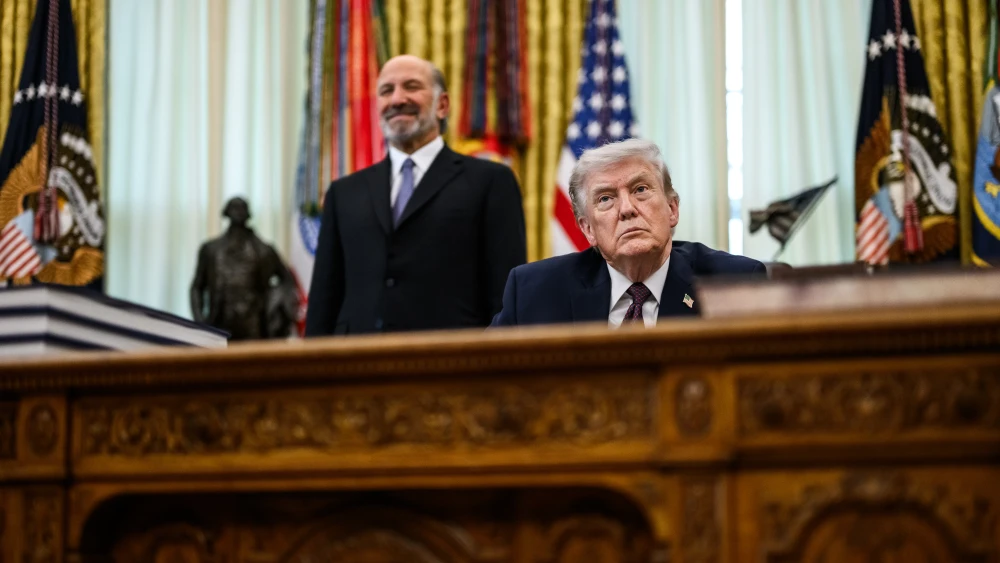
U.S. President Donald Trump told press on Monday at the White House that the ceasefire deal with Iran is “unbelievably weak” and is “on life support.”
“I would call it the weakest right now after reading the piece of garbage they sent us. I said, ‘I’m not even going to waste my time reading it.’ I would say it’s one of the weakest. Right now, it’s on life support. They understand. These are all medical people. Dr. Oz, life support is not a good thing,” he said, turning to Dr. Mehmet Oz, administrator of the Centers for Medicare & Medicaid Services, during a meeting on maternal healthcare.
“I would say the ceasefire is on massive life support where the doctor walks in and says, ‘Sir, your loved one has approximately a 1% chance of living,’” said Trump.
The president said he had a plan for Iran, “a very simple plan. I don’t know why you don’t say it like it is. Iran cannot have a nuclear weapon. They’re very dangerous. They’re very volatile.”
On Sunday, Trump accused the Iranians of “playing games with the United States,” warning the mullahs they would be “laughing no longer.”
“For 47 years the Iranians have been ‘tapping’ us along, keeping us waiting, killing our people with their roadside bombs, destroying protests, and recently wiping out 42,000 innocent, unarmed protestors, and laughing at our now great again country,” Trump wrote on his Truth Social platform.
The Islamic Republic “has been playing games with the United States, and the rest of the world, for 47 years (delay, delay, delay!),” he charged.
According to Trump, the regime “finally hit pay dirt” when Barack Obama became president in 2009 and pushed through the Joint Comprehensive Plan of Action (JCPOA), which lifted sanctions in return for limitations on Tehran’s nuclear program.
“He was not only good to them, he was great, actually going to their side, jettisoning Israel, and all other allies, and giving Iran a major and very powerful new lease on life. Hundreds of billions of dollars, and 1.7 billion dollars in green cash, flown into Tehran, was handed to them on a silver platter,” he said. Trump withdrew from the deal in May 2018.
The mullahs “had never seen money like this, and never will again,” the president vowed.