
For decades, planet Earth has been undergoing a rapid process of desertification. While deserts have always existed due to climatic or geological factors, since the 20th century, they have increasingly been created by humans. Desertification is caused by factors like soil degradation and subsequent erosion, overgrazing, deforestation of rainforests and the flight of impoverished populations—whether northward, such as to Europe, or to the megacities within their own countries, which emerge alongside abandoned land.
According to statistics compiled by the United Nations, a billion people already live in desert regions—many of them former agricultural areas devastated by desertification, and around one-third of global agricultural land has been degraded by soil erosion. The U.N. Food and Agriculture Organization claims that this figure could exceed 80% by 2050.
To see how far desertification can go, one need only look to Europe. In Spain, for example, as the London newspaper The Guardian noted back in 2005, “a third of the country is threatened with being turned into desert. … If things continue this way, we won’t have to travel to Africa to enjoy the peace and quiet of the desert anymore; we can simply go to the Canary Islands or Valencia.”
Against this backdrop, the revitalization of desert regions is gaining ever greater importance. One of the most successful countries at reclaiming desert areas is Israel. The small country consists predominantly of desert, so its inhabitants had to adapt to this landscape for the sake of survival. Israel’s economic boom, its remarkable demographics and its still-rising standard of living prove that desert regions can be transformed into comfortable places to live for people in a relatively short time.
I have lived in the Negev Desert in southern Israel for almost 30 years and have witnessed an almost unbelievable revival of once-deserted areas. David Ben-Gurion, Israel’s founding father and first prime minister, saw the settlement of the Negev Desert as the litmus test for Israel’s future. He himself moved from comfortable Tel Aviv to the desert kibbutz of Sde Boker, where he initiated the establishment of a Beersheva University desert research campus.
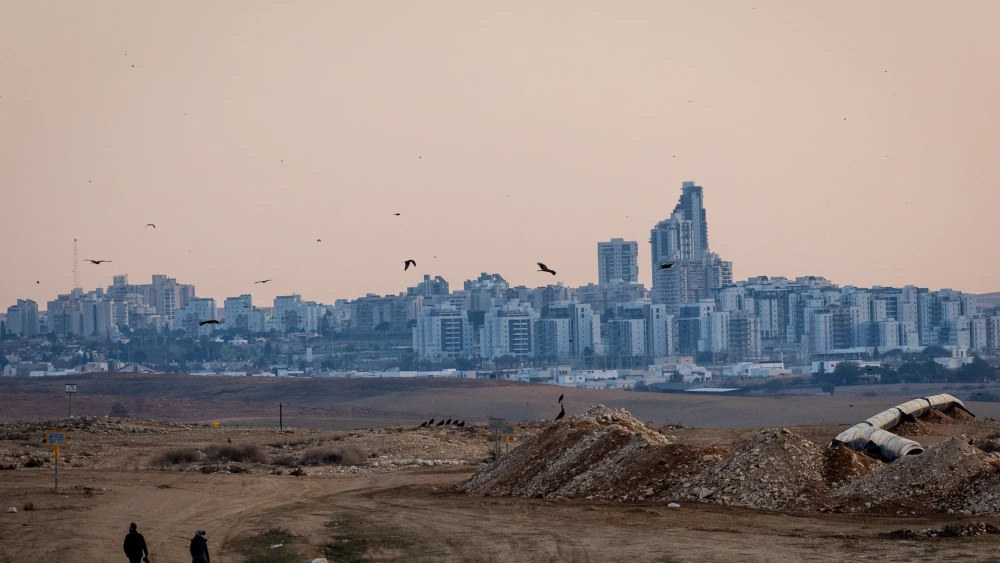
The ancient desert town of Beersheva, mentioned early in the Torah, was for centuries a sleepy caravanserai under Ottoman Muslim rule. It has been transformed within a few decades into a modern metropolis and an internationally renowned high-tech center. In the time since I have lived here, the city’s population has more than doubled.
Since Israel’s overall population is growing rapidly—from five million to 10 million in the 30 years since my arrival—the government and the Jewish National Fund plan to settle another million people in the Negev Desert by 2040, creating jobs and environmentally sustainable communities.
In Israel, I have witnessed an almost unbelievable revival of once-deserted areas.
It reads like a fairy tale, but I can assure you that here, in the heart of what Mark Twain (in his famous travel book The Innocents Abroad) described as “hopeless,” I live surrounded by greenery and harvest baskets full of lemons, pomegranates and figs from my garden. My children have found well-paid jobs here, at universities and high-tech companies, and my grandchildren are receiving the best possible education. Our quality of life is high, even by Western standards.
To avoid monstrous cities, uncontrolled sprawl of concrete and slum structures, the focus is on developing self-sufficient small towns with detached houses. Already, enticed by the construction of a railway and a new highway, tens of thousands of families from Israel’s center are building new homes in this green setting.
The use of the desert as a habitat and agricultural area is a concern for desert researchers in wealthy, developed Arab states such as Dubai, Abu Dhabi, Saudi Arabia and Kuwait. The oil-rich metropolis of Abu Dhabi on the Persian Gulf is planning a gradual phase-out of its dependence on oil with the help of algae farms and other crops, starting with a desert city, Masdar, powered entirely by renewable energy—a model for a post-oil future.
Larger countries can benefit from such pilot projects. In Egypt, the overwhelming majority of the population is crammed into a few monstrous urban agglomerations (the megacity of Cairo alone has around 20 million inhabitants), while some 90% of the country’s land remains largely unused.
Saudi Arabia is attempting to establish a series of large settlements in the middle of the desert with its Neom project, including the port city of Oxagon, conceived as an environmentally sustainable community, and the seemingly utopian desert metropolis “The Line,” also an eco-project, whose location on the Gulf of Aqaba already reveals the larger geostrategic concept: a new trade route between India and the Mediterranean, which is intended to lead via Eilat and Israeli highways to the Mediterranean ports of Ashdod, Ashkelon and Haifa.
For decades, Israeli and Arab scientists have cooperated in the field of desert research. Behind this cooperation lie tangible political and business interests. For all countries in the Middle East, regardless of religion or form of government, the future is at stake. This is a matter of survival under extreme conditions.
The development of Middle Eastern deserts into human settlement areas requires peace. No country in the region can afford to leave these landscapes fallow indefinitely. “The Gulf States know what deserts are,” wrote Neue Zürcher Zeitung in 2022. “The Arabs have money and the Israelis ideas they are happy to sell.”
This long-standing cooperation was formalized in 2020 by the Abraham Accords, which are proving resilient even during the ongoing war with Iran. Desert researchers from Arab countries and Israel have never ceased collaborating.
“We hardly concern ourselves with the conflicts in the region,” professor Amit Gross, director of the Blaustein Institute for Desert Research at the University of Beersheva, recently explained to me. “Our projects think in terms of timescales beyond politics and war.”