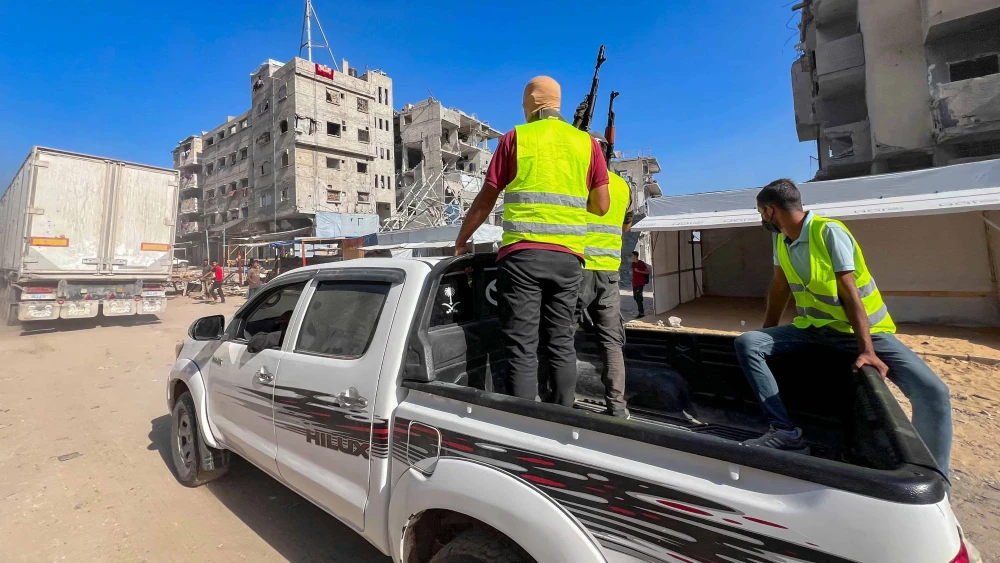

The announcement on Oct. 13 that Hamas has received American approval to conduct security operations in the Gaza Strip represents a catastrophic strategic error that undermines the long-term objective of excising the terrorist organization from Gaza’s governance.
U.S. President Donald Trump’s statement that “we gave them approval for a period of time” to address lawlessness fundamentally contradicts his own 20-point peace plan’s core principle: Hamas must have no role—direct, indirect or in any form—in Gaza’s future governance. While the remaining 19 points of the framework continue to be negotiated and implemented, this premature legitimization of Hamas’s security role virtually guarantees its complete reconstitution.
The strategic imperative remains unchanged: empowering Gaza’s clan structures, which represent 72% of the coastal enclave’s 2.3 million residents through 608 registered mukhtars and six major Bedouin confederations, to fill the governance vacuum as Hamas is systematically removed.
Fatal miscalculation of Hamas’s security role
The partial destruction of Hamas’s military infrastructure has created what should represent an opportunity for fundamental governance restructuring. Yet as the U.S.-brokered ceasefire demonstrates, Hamas has survived as an organizational entity despite military degradation, retaining approximately 10% to 15% of its rocket arsenal, maintaining its external leadership in Doha and preserving its military command structure under Izz al-Din al-Haddad. The organization’s recruitment of 15,000 new fighters during the war, according to U.S. intelligence assessments, means that it enters this transition period with renewed human resources eager to demonstrate commitment to the cause.
The Hamas Interior Ministry’s Oct. 13 offer of amnesty to gang members who join its security forces reveals the organization’s strategy for rapid reconstitution. Every individual accepting this amnesty becomes a Hamas operative, expanding the organization’s intelligence network and territorial control under the legitimate cover of maintaining public order. The ongoing clashes in Sabra and Shuja’iyya neighborhoods between Hamas forces and independent actors demonstrate that Hamas is not preventing lawlessness, but systematically eliminating alternatives to its authority.
Trump’s justification that “close to 2 million people going back to buildings that have been demolished” requires immediate security fundamentally misdiagnoses the problem. The security vacuum exists precisely because Hamas’s totalitarian control prevented alternative power structures from developing over 18 years of rule. Filling this vacuum with the same organization that created it, even temporarily, while other framework elements are negotiated, guarantees the perpetuation of the underlying pathology that led to Oct. 7.
Proven capacity of clan forces
The October 2023 Hamas attack on Israel exposed a fundamental truth about Gaza’s social architecture: Hamas’s control masked but never eliminated deeper tribal loyalties. When Israeli forces offered partnership opportunities to 12 major clans in early 2024, 11 rejected collaboration not from an ideological commitment to Hamas but from calculated self-preservation against an uncertain future. It demonstrates both the clans’ strategic autonomy and their potential as rational actors capable of pragmatic decision-making based on shifting incentives.
The emergence of effective clan-based security forces during the conflict provides concrete evidence of their capability. Yasser Abu Shabab’s Popular Forces, with 400 fighters, successfully secured humanitarian corridors for six consecutive months. Hossam al-Astal’s Counter-Terrorism Strike Force demonstrated the ability to clear neighborhoods of Hamas cells while maintaining civilian protection. When Hamas’s Arrow Unit attempted to reassert control earlier this month, al-Mujaida clan fighters, supported by al-Astal’s forces and Israeli air cover, successfully repelled the attack. These achievements occurred despite minimal resources and constant Hamas intimidation, proving what becomes possible with proper support.
The March 2025 success of clan forces in securing World Food Programme convoys to Gaza City warehouses, ending months of systematic looting, demonstrates their ability to provide the practical security that Gaza’s population desperately needs. Unlike Hamas, whose security provision always served military objectives, clan forces focus on protecting economic activity and humanitarian operations that directly benefit their constituent populations.
Economic foundations
The clans’ control of Gaza’s economic activity through established commercial networks, agricultural holdings and trade relationships positions them as indispensable stakeholders in reconstruction. The Tarabin confederation’s members across Gaza, Egypt and Jordan provide cross-border commercial networks essential for economic recovery. The Tayaha confederation’s clans controlling eastern territories offer agricultural expertise crucial for food security. The Barbakh clan’s members engaged in commerce represent an entrepreneurial capacity no technocratic committee could replicate.
These economic networks evolved through seven centuries of external rule—Ottoman, British, Egyptian, Israeli, Palestinian Authority and Hamas—by adapting to each regime while preserving core commercial functions. Unlike ideologically driven movements that subordinate economic rationality to political objectives, clans operate on pragmatic calculations where prosperity trumps ideology. When reconstruction funds flow, clan leaders will prioritize projects that employ their members and develop their territories rather than preparing for the next military confrontation.
The pre-2023 reality where Dughmush-controlled tunnels supplied goods distributed by Tarabin networks demonstrates that economic incentives can overcome traditional rivalries when mutual benefit exists. This pragmatic cooperation, which was impossible under Hamas’s ideological framework, becomes the foundation for sustainable economic development that serves civilian needs rather than resistance narratives.
Administrative capacity
The period from 2007 to 2011 demonstrated the effectiveness of integrating clan structures into formal governance. Hamas’s General Administration for Clan Affairs successfully incorporated 608 mukhtars and established 41 reconciliation committees processing over 19,000 disputes through 2010. This proves that clan structures can function within modern administrative frameworks when properly organized. The critical difference now lies in orienting these structures toward constructive governance rather than supporting terrorist infrastructure.
The 320 registered mukhtars as of 2011, organized through family, tribal and area-based jurisdictions, maintained detailed knowledge of their communities’ political affiliations, economic activities and social dynamics. This granular intelligence capability, developed over generations, exceeds anything an external technocratic committee could develop in years. The mukhtars’ traditional role in handling dispute resolution allowed them to manage 70% to 90% of disputes outside the formal courts’ infrastructure during the transition period.
Historical precedent supports clan administrative capability. Sa’id al-Shawwa’s successful administration of the Gaza municipality from 1906 to 1916 combined traditional authority with modern governance, building hospitals, schools and infrastructure while maintaining public order through clan networks. Gaza’s notable families like the Abd al-Shafi and Rayyes, despite wartime losses, retain networks of professionals—doctors, lawyers, engineers, educators—who can staff technical positions while maintaining clan legitimacy that foreign technocrats could never achieve.
Preventing fragmentation
Critics correctly warn that empowering clans risks creating competing warlords and fragmenting Gaza into hostile fiefdoms. This concern requires serious engagement, but should not paralyze action when the alternative is Hamas reconstitution. The key lies in creating institutional mechanisms that channel clan competition constructively while preventing destructive fragmentation.
The framework should mandate joint clan operations for all major security and reconstruction initiatives, preventing any single clan from achieving dominance. Major families, including Astal, Sikik and Abu Warda in Khan Yunis, must collaborate on the governorate administration. Gaza City’s various clan territories require coordinated management. This forced cooperation, initially maintained through Israeli military oversight, creates habits of collaboration that will persist as external supervision decreases.
Economic integration provides the strongest bulwark against fragmentation. Every reconstruction project should require workers from multiple clan territories. Supply chains must deliberately cross traditional boundaries, while commercial licenses should mandate multi-clan partnerships. The reconstruction budget’s magnitude, likely exceeding $50 billion, provides sufficient resources to make cooperation more lucrative than conflict. Hamas’s Palestine Scholars’ League demonstrated how institutional frameworks can channel competitive energies, growing from 20 members processing 1,000 cases in 2004 to 500 members handling 13,408 cases in 2010.
The Israeli military, as the current security guarantor, must maintain clear hierarchical control during the transition period. Clan militias operate under Israeli oversight, preventing autonomous action while building coordination capabilities. This temporary arrangement, though imperfect, provides the stability necessary for institutional development while preventing both Hamas’s reconstitution and clan warfare.
The failure of alternative models
The Palestinian Authority’s comprehensive inadequacy makes it irrelevant to Gaza’s immediate needs. Its security forces failed to prevent Hamas’s 2007 coup, despite international training and equipment. Its administrative apparatus remains thoroughly corrupted with aid routinely diverted to personal enrichment rather than public service. Palestinian leader Mahmoud Abbas, at 89 years old and serving the 20th year of his four-year term, commands no legitimacy in Gaza.
International administration without local partners would require a massive military deployment that no country will provide. The technocratic committee envisioned in the Trump plan, while theoretically appealing, lacks enforcement capacity without armed forces loyal to its authority. Technocrats can advise and plan, but they cannot compel compliance from a population that views them as foreign impositions lacking legitimate authority.
The Israeli experience with the Village Leagues in the 1980s failed because it attempted to create artificial leadership structures rather than working with existing social organizations. The current opportunity differs fundamentally: Clans are not being asked to collaborate against a popular resistance movement but to replace a terrorist organization that brought unprecedented destruction upon Gaza. The distinction changes both the moral and practical calculations that clan leaders must make.
Transition period
The current period, while the framework’s remaining 19 points undergo negotiation, represents maximum vulnerability for Hamas’s reconstitution. The organization will exploit its temporary security role to rebuild capabilities that required two years of warfare to degrade. Success requires acknowledging that excising Hamas is a gradual process demanding sustained pressure rather than premature accommodation that enables reconstitution.
Israeli military operations must continue targeting Hamas infrastructure and leadership despite ceasefire restrictions. While large-scale military operations have ceased, precision strikes against Hamas commanders organizing security forces, weapons specialists rebuilding capabilities and political operatives re-establishing governance networks must persist. The message must be unambiguous: Hamas members conducting “security” operations remain legitimate military targets regardless of American statements about temporary approval.
Clan forces require immediate capacity building even as Hamas conducts parallel security operations. Israeli military advisors should embed with clan militias, providing training, intelligence and operational planning support. Communication equipment, vehicles and defensive weapons must be provided immediately. Most critically, regular salary payments to clan fighters must exceed anything Hamas can offer, creating economic incentives for clan loyalty that persist regardless of political developments.
The 84% of Gazans who trust customary law over formal courts demonstrate a deep preference for familiar authority structures over foreign impositions. This social reality means clan governance enjoys inherent legitimacy that neither Hamas’s extremism nor international technocracy can match. The sulha reconciliation process, with its established procedures for truce negotiations, compensation agreements and public accountability, provides conflict resolution mechanisms that maintain social cohesion while addressing grievances.
The path forward
The long-term objective of completely excising Hamas from Gaza remains achievable despite current setbacks; however, it requires strategic discipline and methodical implementation over years rather than months. Hamas’s temporary security role, while profoundly problematic, need not become permanent if clan alternatives are carefully developed during the framework’s implementation period. The key lies in recognizing that Hamas’s removal is a process requiring sustained pressure across military, economic, political and social dimensions.
The immediate priority must be preventing Hamas from translating its security role into permanent authority. Every day that Hamas operates checkpoints and patrols streets, it rebuilds the legitimacy that two years of war were meant to destroy. The framework negotiations must establish clear, enforceable timelines for transferring security responsibilities from Hamas to clan structures with specific benchmarks and consequences for non-compliance. Vague language about “transition periods” provides Hamas with the ambiguity it needs to transform tactical accommodation into strategic victory.
Gaza’s clan architecture represents the only viable Palestinian alternative capable of providing immediate security, administrative capacity and economic management without ideological extremism. Their deep roots in Gaza’s social fabric, proven operational capability during the conflict, and pragmatic orientation toward prosperity rather than perpetual resistance make them indispensable partners in preventing Hamas’s resurgence. The international community must overcome its discomfort with traditional authority structures and recognize that in Gaza’s current reality, the choice is not between ideal and compromised solutions, but between manageable challenges with clan governance and guaranteed catastrophe with Hamas’s reconstitution.
The cost of failure extends beyond Gaza’s borders. If Hamas successfully transforms its temporary security role into permanent authority, the precedent validates terrorism as a successful long-term strategy for any organization capable of surviving military pressure. The framework’s success requires recognizing that peace in Gaza will be built not with the partners we wish existed, but with the traditional structures that command loyalty, control territory and possess the pragmatic orientation necessary to choose prosperity over perpetual conflict. The clans offer that path—if the international community demonstrates the strategic patience and moral clarity to empower them while systematically excising the terrorist organization that brought nothing but destruction to Gaza’s long-suffering population.
Originally published by the Middle East Forum.