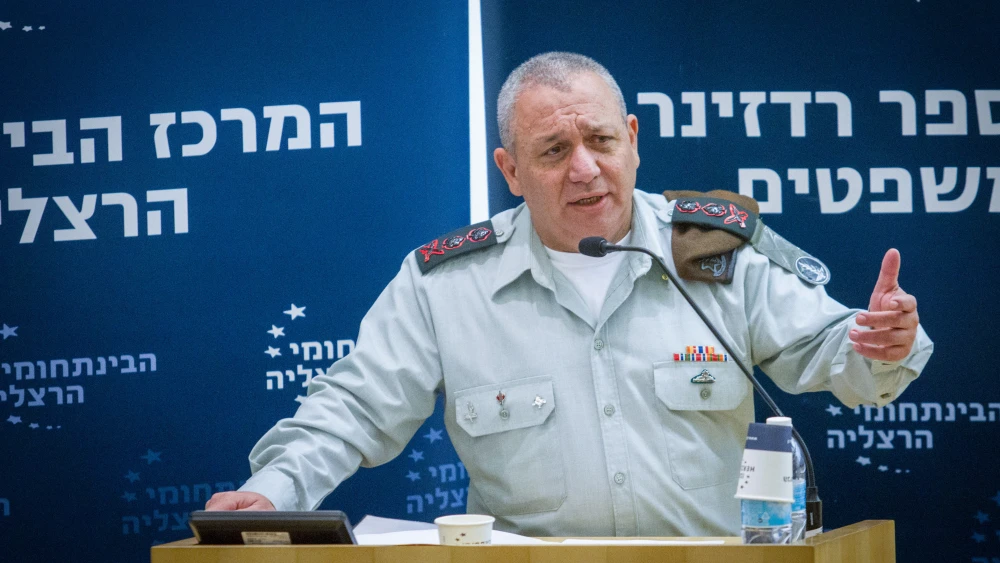
The scent of a coming election is once again in the air, and with it, talk of potential candidates new to politics. First among them is former IDF Chief of Staff Lt. Gen. (res.) Gadi Eizenkot. Seen as a moral and modest man, Eizenkot is remembered for declining the first offer to become chief of staff because he did not yet feel ready for the role.
This was also the case in the previous round of elections, during which Eizenkot did not feel ready to dive into the murky waters of Israeli politics. Now, however, he is reportedly prepared to do so. According to these reports, he is once again conducting himself with modesty and hinting that he has no plans to serve as the head of any party—not that anyone has asked him to do so—and is interested in serving as a number two while he learns the trade.
Politics is not for everyone, and certainly not for all former generals. There is a huge disparity between how one conducts oneself in the military compared to politics.
In the army, a squad commander issues an order and doesn’t look back. The order is simply carried out. This is especially true of high-ranking commanders, and necessarily true for the chief of staff.
In politics, by contrast, there are no orders and there is no automatic obedience. The one who yells the loudest is the one the people remember. There is no room for humility. Just look at Ra’am Knesset member Mazen Ghnaim, Meretz MK Ghaida Rinawie Zoabi and Yamina MKs Idit Silman and Amichai Chikli and the trouble they have caused the current governing coalition. They aren’t interested in their parties or the government. Their only concern is their personal interests.
Eizenkot would be wise to take a glance at the list of generals that have entered politics. A majority of them made little impact and ended their political careers battered and bruised, including Haim Bar-Lev, Mordechai Gur, Amnon Lipkin-Shahak, Amram Mitzna, Gabi Ashkenazi and Shaul Mofaz, among others. In their military career, they were supreme leaders. In politics, they were—how can we put it gently?—failures. Professional politicians wiped the floor with them.
The generals who succeeded are few and far between. Defense Minister Benny Gantz is still hanging on and trying to learn the necessary lessons. Time will tell if he succeeds. Former Prime Minister Ehud Barak, who is both Israel’s most decorated soldier and its shortest-serving prime minister, pulled the IDF out of Lebanon but failed in the political field. Of course, the late Prime Minister Ariel Sharon, after decades in the field, was a beloved premier. Eizenkot would, therefore, be wise to make sure he has thick enough skin before embarking on a political career.
Nechama Duek is a journalist and political commentator.
This article was originally published by Israel Hayom.