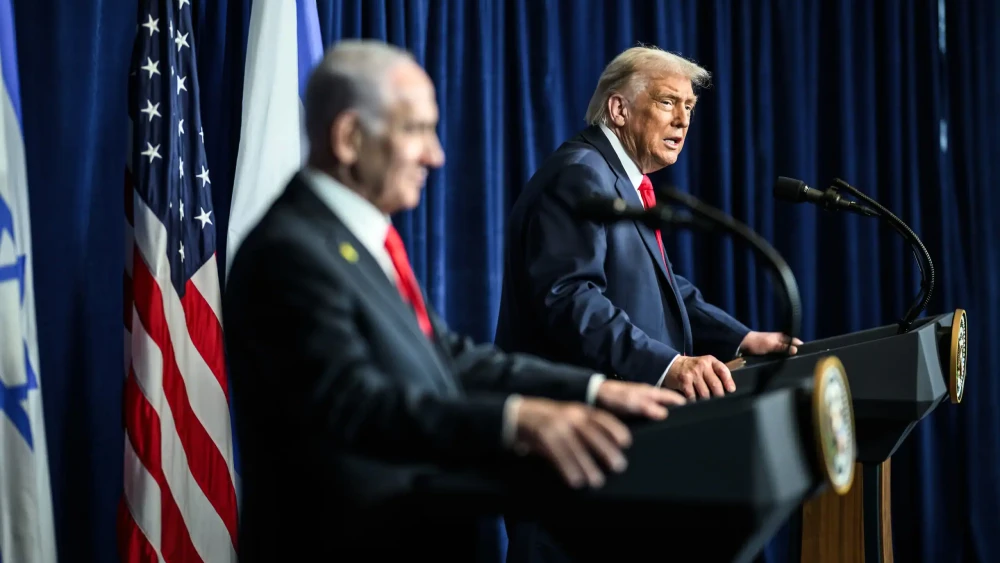

Recent elections in Israel and the United States have underscored growing strains between the two countries.
Their strategic partnership, built over decades, once enjoyed broad political support in America. That consensus is eroding: Israel has become controversial, even toxic, among growing constituencies in American politics. Criticism is pronounced among Democrats and gaining ground among isolationist Republicans. By several measures, American support for Israel has fallen to historic lows.
This crisis reflects a deeper trend, not a temporary dispute.
Israel and the United States are increasingly focused on problems at home. In the case of the latter, this makes it harder to persuade Americans of the value of strategic partnerships in the world. The challenge is especially acute when the partner is a distant Middle Eastern country embroiled in wars that seem endless.
Thus, in an “America First” climate, the alliance’s story must be told anew: not as charity from a superpower to a small country, but as a partnership that serves American interests. In Israel’s case, that story is easy to tell because it is true.
Yet public debate focuses heavily on U.S. security assistance to Israel, which represents only one part of the relationship and largely goes to U.S. defense firms.
The reciprocity between the two countries is clearest in defense and intelligence. Few U.S. allies are both willing and able to confront shared threats directly. Israel is one of them, defending itself against adversaries that often threaten American interests as well.
The merits of the two campaigns against Iran are debatable. But once Washington chose to act, Israel had the determination and capabilities to fight alongside it. Several Gulf states favored action against Iran’s nuclear program, but Israel possessed capabilities few regional partners could match.
Less visibly, Israeli intelligence helps protect American lives and prevent attacks, including on U.S. soil.
For example, on Nov. 23, 2025, it killed Hezbollah Chief of Staff Haytham Ali Tabatabai, who had a $7 million State Department bounty on his head for his role in American deaths. On June 12 of this year, Israel killed Ali Musa Daqduq, a Hezbollah operative involved in the murder of Americans in Iraq.
Critics who call for ending assistance should also reckon with the alternative: accepting greater regional risk or relying more heavily on U.S. forces.
Israel’s small permanent U.S. troop presence, compared with the 28,000 stationed in South Korea, reflects the extent to which Israel confronts threats by itself.
Israel also offers U.S. forces a highly secure operating environment in the Middle East, protected by advanced air-defense systems and the deterrence Israel has established against Iran.
Critics who call for ending assistance should also reckon with the alternative: accepting greater regional risk or relying more heavily on U.S. forces.
Israel’s value extends beyond defense. Its high-tech sector is among the world’s largest, supported by an innovation ecosystem that has drawn more than 250 American companies to establish research and development centers there. Their presence brings investment and jobs to Israel while giving U.S. companies intellectual property, products, patents and capabilities they can use in markets around the world.
These ties matter all the more as Washington competes with China for leadership in future technologies. Israeli work in defense technology, AI, quantum computing, medical technology, robotics, advanced agriculture and food research gives the United States access to critical capabilities that strengthen its economy and provide distinctive competitive advantages that would be difficult to replicate elsewhere.
These contributions touch Americans’ daily lives. Israeli company IDE Technologies helped build a desalination plant using Israeli technology that supplies water to about 400,000 people in San Diego County, California. Teva, an Israeli company, is the largest generic drug manufacturer in the United States, helping to increase competition and lower prices.
Israeli systems designed to counter anti-tank missiles are installed on American Abrams tanks. Israeli cybersecurity companies such as Wiz and CyberArk—acquired in deals worth a combined $57 billion—help defend Americans online.
Israel is not a superpower, but its strengths and deep U.S. ties make America safer, wealthier, more innovative and better prepared for future challenges.
The partnership also rests on political and economic affinities.
According to two leading democracy rankings, Israel rates highest in the Middle East for political freedom. Its economy is built on free markets, private initiative and open trade. The Heritage Foundation ranks it 41st worldwide and fourth in its region for economic freedom. In 2024, under a Democratic administration, Israel’s U.N. votes aligned with U.S. positions 89% of the time—more than any other country.
Israel is not without flaws, but in a turbulent and strategically important region, it remains closely aligned with the United States in its political institutions, economic system and international orientation.
The two countries have overcome crises before by recognizing that they achieve more together. Israel’s comparative advantages in military capability, intelligence and economic innovation have become even more valuable to the United States in recent years.
At a time when many Americans view Israel negatively, the case for the alliance should be made on “America First” grounds.
Criticism that reduces the relationship to U.S. aid and the controversies surrounding Israel’s wars obscures a broader reality: Israel makes the average American richer, safer, more innovative and more resilient.
The alliance’s mechanics merit debate, but it is clear that Israel remains one of America’s most valuable strategic investments.