


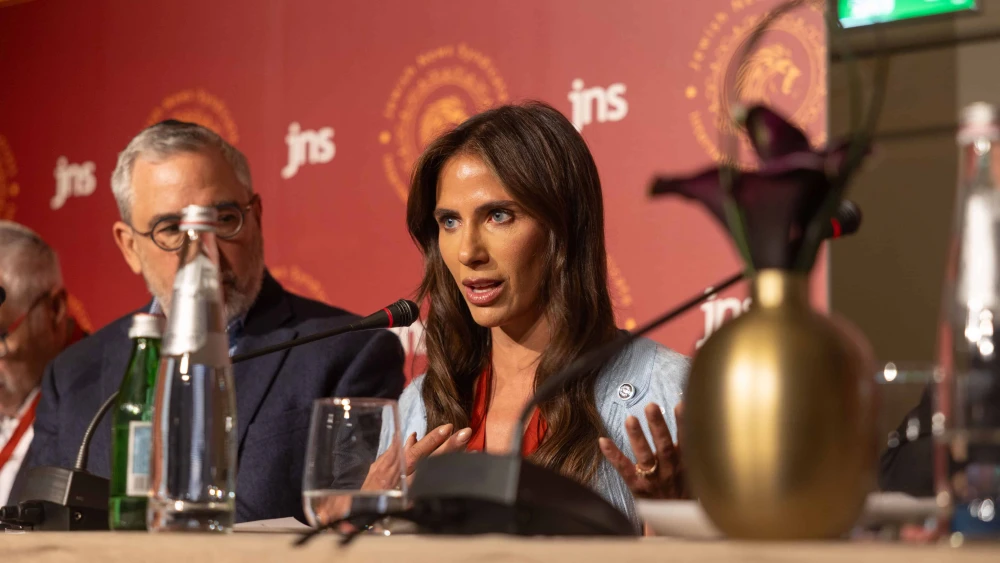
An American influencer who receives daily death threats challenged a Meta executive at a gathering in Poland on Monday over the company’s handling of antisemitic harassment, prompting a discussion on AI tools to counter Jew-hatred online.
Lizzy Savesky, a New York-based content creator with hundreds of thousands of followers on Instagram, which is owned by Meta, interrupted Edo Haveman, that company’s director of public policy for the Benelux region, as he described the firm’s policies against hateful content.
“I just filed a harassment report five minutes ago,” she told him.
Haveman said he hoped that her complaint would be addressed promptly, and acknowledged that Meta’s moderation systems weren’t always effective.
The exchange took place during a panel discussion organized by the European Jewish Association on the anniversary of the Kristallnacht pogroms ahead of a delegation visit to the Auschwitz-Birkenau former German death camp. Haveman and Jeff Bullwinkel, Microsoft’s vice president for Europe, the Middle East and Africa, both attended the event and are scheduled to visit Auschwitz with the delegation.
On Kristallnacht in 1938, Nazis and their supporters burned down hundreds of synagogues throughout Central Europe. The event is widely viewed as the opening shot in the campaign of violence against European Jews that culminated in the Holocaust.
Savetsky, who is Jewish, said she had been receiving death threats since publicly expressing support for Israel in 2021, when she lost 30,000 followers in 24 hours and was dropped by her management company.
“I’m pretty disappointed, I have to say, in the policing of the hate and the threats [online],” she said, adding that she reports threats to the New York Police Department and has been in contact with the FBI.
A World Jewish Congress study published earlier this year found that reporting content to platforms had little effect on whether it was removed. More than 80% of antisemitic social-media posts reported by Jewish community members across Europe remained online, according to the study, which examined 754 posts reported between February 2025 and April 2026. Of those, 613 (81.2%) were still accessible when researchers checked them in May.
Another report published this year by the StopAntisemitism group showed the Chinese-owned TikTok platform had a better removal rate of antisemitic content than Meta’s Instagram: TikTok removed nearly half of about 50 reported accounts and took action against 48% of 324 flagged posts, while Meta removed 33% of 36 reported Instagram accounts and took action against 40% of 175 flagged posts.
Oct. 7, 2023
The Hamas-led massacres in Israel on Oct. 7, 2023, triggered an increase in the volume of antisemitic content online that has not subsided back to pre-Oct. 7 levels, the Online Hate Prevention Institute (OHPI) said in an overview last year based on almost 10,000 items of online antisemitic content.
Haveman said Meta was preparing to use large language models to accelerate the identification and removal of hateful content from Facebook and Instagram. “AI and specifically LLMs [machine learning models] are gonna help us a lot to act even quicker,” he said.
He also expressed willingness to explore a mechanism in which Jewish organizations and prominent Jewish social media personalities could escalate serious complaints.
Bullwinkel outlined Microsoft’s Azure AI Content Safety system, launched in 2023, which allows organizations to configure filters against harmful content. He invited the European Jewish Association to participate in an upcoming roundtable in Israel on combating AI-generated hatred and using artificial intelligence to preserve Holocaust memory.
Bullwinkel also described an updated AI-powered digital classroom tool released last month, tailored to help young people identify hateful messages.
Rabbi Menachem Margolin, chairman of the European Jewish Association, said that hate speech “now travels faster than ever, and what begins as a conspiracy theory online can reach the street within days.” He argued there is a link between the rhetoric and the thousands of antisemitic attacks documented annually across Europe. “The Holocaust did not begin with the gas chambers. It began with words,” he noted. Margolin urged European governments to take stronger action against antisemitism.

The keynote guest at the conference was Iranian Crown Prince Reza Pahlavi, who received this year’s King Solomon Award from the European Jewish Association. He addressed Iran’s role in promoting antisemitic discourse as part of its war on Israel.
“The regime that denies the Holocaust and sponsors terrorism is not Iran. The Iranian people are its first victims. Our fight for freedom is also a fight against the forces spreading antisemitism, hatred and terror across the world,” Pahlavi told reporters at the event. “The time for condemnations is over. European governments must shut down the regime’s embassies, expel its diplomats and target its illicit funds.”
Savesky argued that the problem of antisemitism on social networks went beyond individual moderation failures.
“This is a system that algorithm favors extremism,” she said, adding, “I am most concerned that my children know who they are and that they stand strong as proud Jews.”
She recalled how her advocacy for Israel began in 2021, as Israel came under attack from Hamas, which fired rockets into its territory, and from hundreds of Arab rioters within Israel.
Savetsky, who was primarily a fashion, lifestyle and family influencer then, borrowed an Israeli flag from an Israeli neighbor “and made a post about why I stand with Israel and how Israel is just constantly forced to defend itself,” she said. “And within 24 hours, I had lost 30,000 followers. I had dropped by my management company because they said I was no longer marketable.”
That moment was “when everything changed when I stepped into my purpose,” said Savetsky, whose has interviewed Israeli hostages’ families and published hundreds of explainers about Israel as well as reports on campus antisemitism in the U.S.


