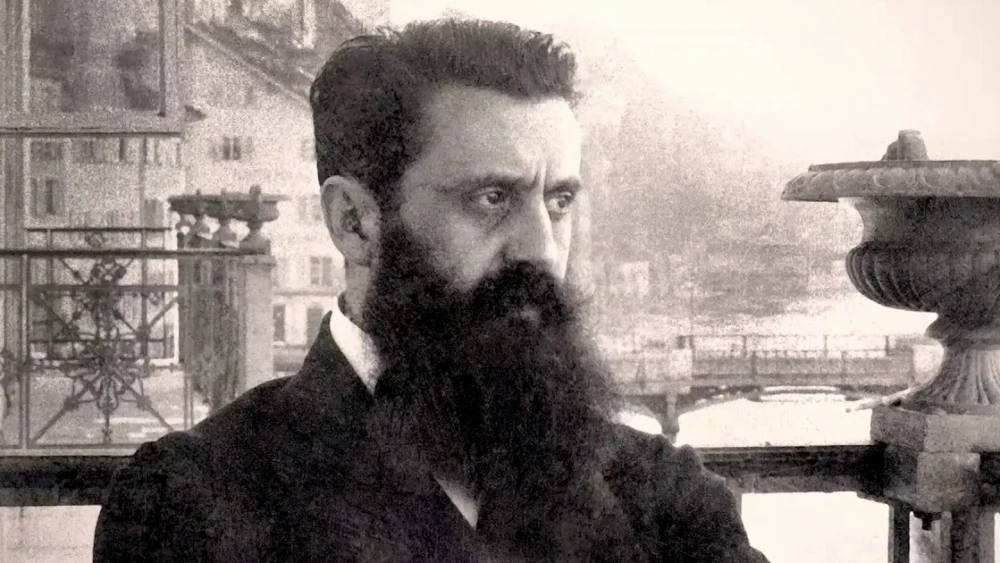

In a recent essay at Jewish Priorities, Israeli intellectual and politician Einat Wilf wrote about Theodor Herzl’s life and thought.
She noted ominously, “In places like the United States and Britain, we see the same phenomenon taking place as in Herzl’s day. Despite the immense success of those Jewish communities, antisemitism is rising to unprecedented heights of venom and violence and threatening to become a hegemonic force in politics and culture.”
“Herzl’s legacy therefore sounds a warning and presents an ominous question: Should Jews heed his warnings again, while there is still time, and make aliyah to the Jewish state he created?” Wilf concluded.
This is not, to say the least, a pleasant question. It has been asked for more than 20 years in Europe, and many European Jews have answered in the affirmative and made their way to Israel. Others have stayed. But the question, as I know from personal experience, remains perpetually on their minds.
Until three years ago in the United States, that question would have been unthinkable. But the rise of an antisemitic mass movement in the form of an alliance between radical progressives and radical Muslims, its conquest and colonization of the Democratic Party, and its recent massive midterm victory after a campaign driven by Jew-hatred has changed the equation.
Few American Jews, however, are asking it outright.
This is, it must be said, unusual. In the last 2,000 years, the Jews have never really felt secure enough to forgo all thought of flight. There was always at least one suitcase packed; portable wealth was always at hand; and important religious and sentimental objects were kept small and easily transported—just in case. The Jews always knew there might come the moment when it was time to run, and prepared accordingly.
This sense of the essential precariousness of Jewish life in any non-Jewish society was universal until, perhaps, the last century, and only among the Jews of the United States.
Certainly, Israel has established itself as an armed Jewish citadel, but it has its own sense of precariousness due to its geopolitical and military vulnerability. It is in the United States alone that the Jews came to believe—and most still believe—that they are safe.
Yet this sense of perpetual security is a delusion. There is no doubt that the Jews have met with immense success and accumulated considerable political, social and cultural power in America. But in any non-Jewish society, the Jews are only as successful as they are allowed to be. What they have earned can be taken at any time and it can happen overnight.
There are ominous signs that this time has arrived.
As we speak, Jews are being pushed out of the institutions, political offices, and social and cultural spaces where they have previously thrived.
As we speak, Jews are being pushed out of the institutions, political offices, and social and cultural spaces where they have previously thrived. They have seen some of their most powerful organizations demonized and marginalized, especially on the political left. Their synagogues are haunted by hate rallies defended by major politicians; their children harassed, intimidated and attacked; and members of their community murdered by fanatics to little public outrage or retribution.
Worst of all, as we saw in the recent elections, antisemitism is rising swiftly to the heights of political power. It has already seized control of the Democratic Party and is bidding for control of the Republican Party, threatening the Jews with a pincer movement that would see them completely ghettoized in American politics and society as a whole.
Things, in other words, are not looking good.
Many would likely reply that American Jews do not appear to agree. They voted overwhelmingly for the Democrats in the last elections, including for openly antisemitic candidates like Dr. Abdul El-Sayed, and clearly feel that their status in America is neither precarious nor threatened.
I have heard from some who ought to know that the methodology behind this analysis of the Jewish vote is problematic, but let us grant it for the sake of argument.
In response, we can only say: The Jews of Herzl’s time felt the same way. When he came to them with his prophecies of doom and his recommendations of flight to then-Palestine and the creation of a Jewish state, they either laughed or thought him insane.
But Herzl was right, and they were wrong. Perhaps he is still right, and American Jews are wrong.
At the very least, they ought to consider the possibility. After all, the entirety of Jewish history indicates that it is a plausible scenario.
American Jews ought to wonder whether they are living in the same dream palace of the middle class that Herzl’s contemporaries inhabited, a palace that history proved was made of glass. They ought to remember that, while the Jews have had 247 good years in America, perhaps this is the best that can be hoped for from any host society.
In saying this, I do not wish to counsel despair. The Jews largely retain their place in American society for now; they enjoy their constitutional rights; and they have many genuine allies to call upon. They can and should fight for their right to remain both Jews and Americans.
There is nothing certain about history, and to stand athwart it yelling “stop!” has often been the destiny of the Jewish people. It is, after all, the fate of the Jews to rebel against the world, and it always will be.
What is certain, however, is that American Jews now face an ordeal of the most grievous kind. They can overcome their enemies if they choose to do so. If they do not, they will unquestionably lose.
At that point, religious and more strongly identified secular Jews will make aliyah, and the rest will assimilate out of existence. One of the greatest Diaspora communities in Jewish history will come to an end.
If American Jews wish to avoid this fate, then they must face Herzl’s challenge and finally acknowledge the inevitable precariousness of Jewish life in any non-Jewish society.
They must do so not for the sake of despair, but to forgo their delusions. They must face the horrors of life as they are, because without doing so, there can be no victory.