


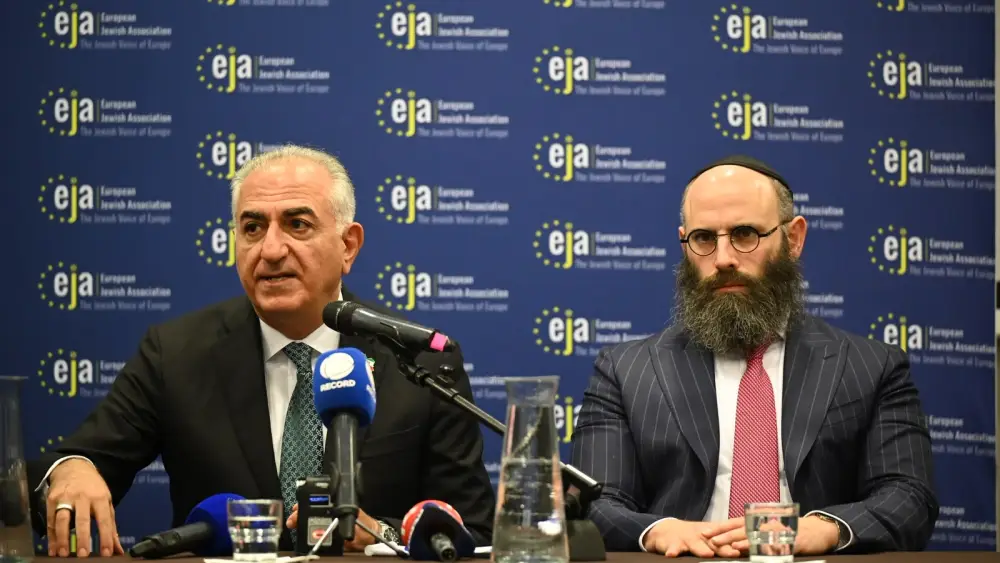
In a speech that evoked 25 centuries of shared history, Iran’s exiled crown prince Reza Pahlavi on Monday predicted the resumption of an Iranian-Jewish alliance, as he prepared to visit Auschwitz-Birkenau for the first time.
“The bond between Iranians and the Jewish people is not a matter of sentiment and is not a matter of political convenience, it is older,” Pahlavi said at a ceremony in Krakow, where he received the King Solomon Award from Rabbi Menachem Margolin, chairman of the European Jewish Association (EJA). He said the bond would resume when the regime of the Islamic Republic is toppled.
The group honored Pahlavi for his support for Israel and opposition to antisemitism, Margolin said. Pahlavi called for greater international pressure on the Islamic Republic. He advocated military intervention against Iran’s security apparatus to help protesters overthrow the regime.
In his acceptance speech, Pahlavi, who lives in the United States, invoked the biblical account of Cyrus the Great. The Persian king permitted Jews to return from exile in Babylon and rebuild the Temple in Jerusalem. Pahlavi also noted the biblical story of Esther and Mordechai, and nearly 3,000 years of Jewish life in Iran.
“It is a fundamental part of Iranian history that we are truly proud of,” he said.
Pahlavi contrasted this historical record with the antisemitism of the Islamic Republic, whose revolution in 1979 had forced Iran’s last shah, Reza Pahlavi’s father, into exile.
“In 1942 and prior to the Islamic Revolution, Tehran was a name that meant life. I want Tehran to be a name that means life again,” Pahlavi said.
The EJA ceremony took place on the anniversary of the Kristallnacht pogroms of November 1938, ahead of a visit by an EJA delegation to the former Nazi death camp of Auschwitz-Birkenau on Tuesday.
Pahlavi noted that his late father, Shah Mohammad Reza Pahlavi, had visited Auschwitz in 1966 with Reza Pahlavi’s mother, who wrote about the visit’s emotional impact on her in her memoirs.
At a press conference before the award ceremony, Pahlavi described the Islamic Republic as an “existential threat to Iranians” and Israelis alike. He accused Iran’s leaders, whom he described as an “occupation force,” of embracing an ideology reminiscent of Nazi Germany.
“When you hear ‘never again,’ this regime, in its virulent sense, wants to finish what Hitler had started, which is why we need to fight this evil,” he said.
Pahlavi argued that weakening the Iranian regime’s capacity to suppress demonstrations could create conditions for a popular uprising. “They can’t do that when the regime is willing to kill them by the thousand,” he added.
Western diplomatic efforts to change the Islamic Republic’s behavior had failed, Pahlavi said.
“For the most part, particularly in the Western free world, they were focused on a policy of appeasement with an expectation of behavior change,” he said. “Rather than wait for this regime to ever change its behavior, invest in the solution, which is the people of Iran themselves.”
“Those people did not die to keep the Strait of Hormuz open or for nuclear deals,” he said, referencing some 40,000 people whom opposition sources estimate were killed during an attempted uprising in January. “They are fighting for liberty, and they deserve your support.”
He urged European governments to adopt tougher measures against Tehran, including closing Iranian embassies, expelling diplomats and targeting illicit funds associated with regime-linked figures.
“We are beyond resolutions. We are beyond condemnations. This is a matter of action,” he said.
Restoring internet connectivity inside Iran was key to facilitating resistance, Pahlavi said, adding that an 88-day blackout had allowed the authorities to suppress dissent without international scrutiny.
The prospect of a new Israeli government would change little in Israel’s basic position vis-à-vis Iran, Pahlavi said, arguing that Tehran remains a major security concern for any Israeli government.
“Iran continues to be a threat regionally. It continues to be a direct existential threat to Israel, and it goes beyond Israel. It is now a direct threat to Europe’s security,” he said, urging further sanctions on Iran’s Islamic Revolutionary Guard Corps.
Rabbi Margolin condemned what he called the “hypocrisy” of “some countries in Europe that lately started legislation to boycott products produced in Israel, while their level of trade with Iran is growing.”
He referenced the Netherlands specifically, where “they can sentence to jail a Jew who consumes wine coming from Judea and Samaria, and at the same time support a regime that tortures its own people and spreads hatred across the Middle East and beyond.”
During the press conference at the Holiday Inn hotel, Pahlavi recalled his 2023 visit to Israel, where locals approached him during a visit to a Tel Aviv cafe.
“Ordinary Israeli citizens recognized me, and they came to me literally with tears in their eyes, hugging me and saying, ‘What a different world it would be once you’re able to liberate your country,’” he said.
Under a post-Islamist regime, Israel’s Abraham Accords would expand into what Pahlavi called the “Cyrus Accords,” he said. A future democratic Iran could become a central partner in regional cooperation, he added. “We look at Israel as a very important strategic partner,” he said.
“My position has been that anyone who doesn’t have blood on their hands should be part of regime change and part of the solution,” he said, when asked about who would be allowed to join the coalition of a post-Islamist regime. Officials responsible for crimes would face trial, he added. He envisioned a temporary role for himself in power. “I’m not the destination, but a bridge to it,” he said.
His proposed political framework would “preserve Iran’s territorial integrity,” he said, as well as guarantee equality before the law, separate religion from government and allow Iranians to determine their future political system through democratic elections.
At the award ceremony, Pahlavi recalled Iran’s role in sheltering Jewish and Polish refugees during World War II. Among them were thousands of Jews and nearly 1,000 Jewish children, many of them orphans, he noted.
“And those Jewish orphans went on to the land of Israel, where they now build a nation. History remembers them as the Tehran children.”
Pahlavi highlighted the actions of Abdol Hossein Sardari, an Iranian diplomat in Nazi-occupied Paris who helped Jews escape persecution by issuing them visas. “He viewed himself as a man who simply did his duty, both as an Iranian and as a human being,” Pahlavi said.
Presenting the King Solomon Award, Margolin praised Pahlavi’s leadership and his opposition to the Islamic Republic.
“You are fighting not only for the Iranian people, you are fighting also for the Jewish people, and for Europe, and we appreciate and respect that,” Margolin said.
Accepting the award, Pahlavi said he did so on behalf of millions of Iranians seeking a future of peace and coexistence. “I say without hesitation now, the people of Iran are with you,” he said.


