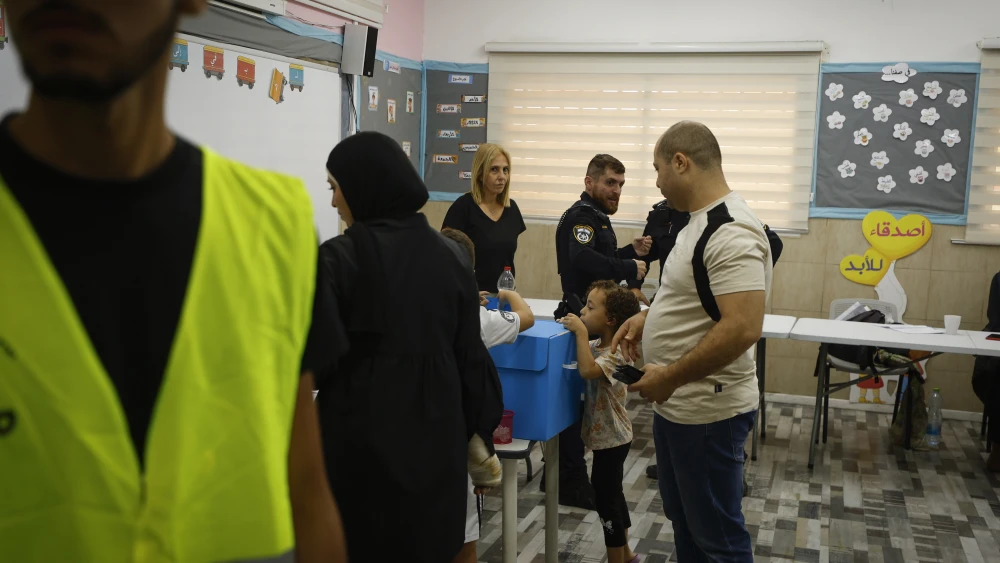

Israel’s Oct. 27 election produced a historic political shift, with Arab parties securing unprecedented parliamentary representation and potentially gaining decisive influence over the formation of the next government.
The Joint List and Ra’am captured a combined 19 Knesset seats, compared with 53 for Prime Minister Benjamin Netanyahu’s bloc and 48 for the Jewish-led opposition. Neither camp secured the 61 seats necessary for a governing majority.
The result immediately ignited two distinct controversies. On Election Day, Netanyahu warned, “They are trying to steal the election from us,” as allegations of vote-buying emerged. Likud subsequently accused Arab parties of widespread electoral fraud, prompting demands for criminal and security investigations.
Yet beyond the integrity of the ballots lies a deeper political dispute: whether parties whose leaders have challenged Israel’s Jewish character or refused to designate Hamas a terrorist organization can legitimately become partners in determining the country’s next government.
Election fraud
An unprecedented surge in voter participation drove a dramatic increase in Arab parliamentary representation. According to the Israel Democracy Institute, turnout in Arab and Druze localities reached approximately 77%, compared with 53.2% in 2022, an increase of nearly 24 percentage points and one of the highest levels recorded in three decades.
The increase was particularly pronounced among Negev Bedouin communities, where turnout approached 80%, compared with approximately 51% in the previous election. In unrecognized Bedouin villages, participation nearly doubled from 38% to 74%. Similar increases were recorded throughout the Galilee and Triangle regions.
Dr. Arik Rudnitzky of the Israel Democracy Institute described the results as reflecting “extraordinary electoral mobilization among Israel’s Arab minority.”
Researchers have attributed the surge to several factors, including dissatisfaction with government policies, concerns about violent crime and campaigns emphasizing the Arab parties’ potential influence over the next government.
The resulting expansion of Arab representation, from 10 to 19 seats, fundamentally altered the parliamentary balance. However, the extraordinary scale of the increase also became central to Likud’s allegations of electoral misconduct, raising questions about whether the surge reflected legitimate political mobilization alone or was accompanied by unlawful interference.
The allegations of election fraud encompass two major areas: suspected manipulation and bribery at polling stations, and a separate Shin Bet investigation into possible foreign efforts to influence the Arab vote. Likud’s Oct. 28 complaint alleged intimidation, forgery, illegal voter tracking and vote-buying, and called for police and security-service investigations.
According to Israel Hayom, Likud submitted approximately 1,000 complaints relating to 463 polling stations. The party alleged improper use of the Elector voter-management application, inadequate identity checks and questionable staffing arrangements, including hundreds of stations staffed by two Arab secretaries. JNS subsequently reported firsthand accounts from Majd al-Krum, where a supervisor described intimidation and an unauthorized individual recording voters’ arrival and serial numbers, and from Rahat, where Likud MK Amit Halevi alleged voter tracking and efforts to bribe election personnel.
The investigative organization Ad Kan separately reported hundreds of accounts involving cash payments, fuel vouchers, intimidation and requests for photographs verifying votes. It suggested that as many as 200,000 votes might have been affected. Police arrested three Bedouin men on Election Day after reportedly finding cash envelopes alongside Ra’am party ballots; four more suspects were later detained. The original three denied bribery and were released unconditionally by November 4, due to warrantless searches and limited investigative progress.
The parallel Shin Bet investigation concerns a potentially more consequential question: whether foreign actors used covert funding to influence Israeli political participation. On Oct. 29, Central Elections Committee chairman Justice Noam Sohlberg instructed Shin Bet director David Zini to investigate intelligence indicating that foreign entities acting against Israeli interests may have financed improper election activity. Unlike the polling-station complaints, the inquiry concerns the origin, routing and purpose of funding allegedly introduced from abroad.
Israeli media reports implicated Qatar and Turkey, with reports indicating that as much as 100 million shekels ($31.5 million) may have been channeled toward mobilizing Arab voters. Both countries denied involvement, and the Shin Bet has not publicly identified any responsible state or organization. In a Nov. 4 submission to the Central Elections Committee, the agency said intelligence indicated foreign-financed influence activity potentially involving thousands of people, perhaps more, while stressing that additional investigative work was necessary to establish its true scale.
The investigation has also focused attention on Arab political leaders. Former Joint List chairman Ayman Odeh was identified in media reports as suspected of receiving hundreds of thousands of shekels from a foreign source, an allegation he rejected. Reports that Zini sought to expand questioning produced clashes over evidentiary thresholds and investigative authority. Zini has allegedly complained legal advisers were obstructing the inquiry.
Despite the mounting allegations, Israel’s Central Elections Committee certified the election results on Nov. 4, following an extensive review of voting records.
The committee examined protocols from 9,069 polling stations, approximately 75% of the national total, with 350 undergoing additional scrutiny of ballots, voter registers and other election materials. Officials also reviewed 3,691 complaints and requests submitted by political parties and members of the public, ultimately reporting no evidence that electoral irregularities had compromised the results.
Committee chairman Justice Noam Sohlberg subsequently presented the certified results to President Isaac Herzog, declaring, “It is the voters, through their ballots, who determine the election results.”
However, certification does not preclude further investigations or legal challenges. The Shin Bet’s inquiry into suspected foreign financing remains ongoing, while Likud is considering appealing the results through the Jerusalem District Court.
Under Israeli election law, challenges must generally be submitted within 14 days of publication, with courts empowered to correct results or order repeat voting if sufficiently consequential violations are established.
The distinction is consequential: proving bribery or unlawful foreign financing would not automatically invalidate the election, but could provide grounds for further legal proceedings if the violations affected the results.
The Arab vote
Yet even if the electoral outcome remains unchanged, a separate controversy persists over the political character of the Arab parties whose unprecedented parliamentary gains have placed them at the center of Israel’s coalition negotiations.
The controversy surrounding the Arab parties extends beyond their electoral success to their ideological foundations and the positions of their leaders regarding Hamas and Israel’s existence as a Jewish state.
Balad party (part of the Joint List) founder Azmi Bishara left Israel in 2007 amid suspicions that he had passed intelligence to Hezbollah during the 2006 Second Lebanon War. He denied wrongdoing and was never convicted. Former Balad MK Basel Ghattas received a two-year prison sentence in 2017 for smuggling cellphones to imprisoned terrorists, including a convict linked to the murder of IDF soldier Moshe Tamam. Another former party lawmaker, Haneen Zoabi, was convicted in 2021 alongside 12 others of fraud and forgery involving party financial records.
Balad’s Heba Yazbak also shared posts praising terrorists Samir Kuntar and Dalal Mughrabi, participants in attacks that killed Israeli civilians. The Supreme Court nevertheless permitted her to run for Knesset in 2020. More recently, Balad chairman Sami Abu Shehadeh described the Oct. 7, 2023, Hamas assault as militarily and strategically significant, suggesting others could learn from Hamas’s ability to surprise Israel. State prosecutors backed his disqualification, and he withdrew after judges indicated a majority favored barring him. He denied endorsing violence.
Joint List chairman Yousef Jabareen repeatedly refused to designate Hamas a terrorist organization during an Oct. 31 interview. Pressed for a direct answer, he replied, “My dear, I am not in an interrogation room.”
Ra’am has faced separate questions over its connections to the Islamic Movement in Israel Southern Branch’s charitable organizations. In 2024, a Tel Aviv court upheld the freezing of accounts belonging to Aid 48, associated with Ra’am’s parent movement, after a bank presented evidence of suspected terrorist financing. In 2025, the Justice Ministry reported transfers or cooperation involving organizations proscribed for terrorism links in Judea and Samaria. Separate reports implicate Aid 48 in the transfer of up to 400,000 shekels ($125,000) to a Turkey-based Hamas-linked group. Ra’am and Aid 48 denied wrongdoing.
A June 2026 Knesset committee also examined allegations that Ra’am chairman Mansour Abbas participated in conferences alongside Hamas and Palestinian Islamic Jihad representatives in Turkey in 2018; those allegations did not establish operational cooperation. Abbas has also declined to directly label Hamas a terrorist organization, telling an interviewer, “I don’t want to give you a straight answer.”
Although the Supreme Court reinstated both Arab lists in October, their legal eligibility remains distinct from the political controversy surrounding their record.
The electoral success of parties with documented controversies involving terrorism and Palestinian nationalism raises a broader question about the political attitudes of the Arab citizens who support them. According to data from the Central Elections Committee, 94.8% of votes cast in Arab localities in the recent election went to Ra’am or the Joint List. Public-opinion research reveals a prevalent ideological foundation for this support among the electorate, including troubling attitudes toward the Oct. 7 massacre and Israel’s Jewish national identity.
A July 2024 joint survey by Tel Aviv University and the Palestinian Center for Policy and Survey Research found that 28% of Arab Israelis believed Palestinian suffering under the Gaza blockade justified Hamas’s Oct. 7 attack. Separately, a December 2023 Tel Aviv University survey found that 32% did not believe Hamas terrorists had intentionally targeted civilians, including women and children, during the massacre.
An Israel Democracy Institute survey conducted shortly afterward found that 56% agreed with Mansour Abbas’s assertion that Oct. 7 did not reflect Arab or Islamic values. However, significant differences emerged between political constituencies: while 66% of Ra’am voters and 65% of Hadash-Ta’al (part of the Joint List) voters agreed, only 39% of Balad voters shared that position.
A separate April 2024 Jewish People Policy Institute (JPPI) survey found that 40% of Arab respondents opposed disciplinary sanctions against university students expressing support for Hamas on social media.
The ideological divisions extend to Israel’s Jewish identity. A December 2025 JPPI survey found that 68% of Arab respondents considered Zionism either inherently racist or containing racist elements. Just 4% identified themselves as Zionists, compared with 15% identifying as anti-Zionists and 39% as non-Zionists.
Jewish historical and religious claims also remain contested. The April JPPI survey found that only 10% of respondents recognized that a Jewish Temple had existed on the Temple Mount, while 55% supported prohibiting Jews from visiting the site altogether.
Despite these widely prevalent positions, political integration remains a widely supported objective. A May 2026 Tel Aviv University survey found that 77.2% supported Arab-party participation in government.
These findings reveal a significant distinction between seeking greater influence within Israeli institutions and accepting the country’s Jewish-national character
These divisions have acquired immediate political significance as opposition leaders consider forming a minority government dependent on Arab parliamentary support.
Yashar party leader Gadi Eisenkot’s Jewish-led opposition holds 48 seats, but cooperation with the Joint List and Ra’am could provide a 67-seat parliamentary majority. Both Arab parties have indicated willingness to facilitate a change of government, although their preferred arrangements differ.
Eisenkot has demanded that prospective coalition partners recognize Israel as a Jewish and democratic state, support universal national service and designate Hamas a terrorist organization. Joint List and Ra’am leaders have resisted applying these requirements to themselves or their supporters.
For opponents of such an arrangement, the concern extends beyond coalition arithmetic. The Arab parties’ documented histories, controversial positions regarding Hamas, and the widespread rejection of Zionism reflected in public-opinion surveys raise fundamental questions about their influence over Israel’s national security and political leadership.
The fraud investigations may ultimately determine whether electoral laws were violated. Yet even if the results remain unchanged, the underlying political dilemma persists.
The right of Arab citizens to parliamentary representation is legally established. Whether parties whose positions challenge Israel’s Jewish-national character should exercise decisive influence over its government remains a separate and deeply contentious question.