If exit polls are to be believed, about 68% of American Jews got what they voted for on Tuesday when Democrats won sweeping, nationwide victories in the House and Senate.
As Americans across the country reckon with the political landslide, JNS spoke with the leaders of non-partisan, American Jewish groups about how they and their organizations are taking stock of the election.
“I’ve been on the phone with a lot of unhappy Jewish people from across the country this morning,” Evan Bernstein, CEO of B’nai B’rith International, told JNS on Friday. “I think people are scared. They’re nervous.”
“In a lot of the campaigns around the country, Jews and antisemitism and Israel were intertwined into so many of the conversations and the rhetoric that led up to the election,” Bernstein said.
“There’s now a real feeling that Israel has been singled out so badly throughout this whole election season, where no other country is being singled out in that same way, and how close that all comes on a regular basis to being basically antisemitic,” he told JNS.
Throughout the election season, many Jewish groups raised concerns that the way that some candidates, predominantly on the progressive left, talked about Israel and its supporters in the United States had ventured into Jew-hatred.
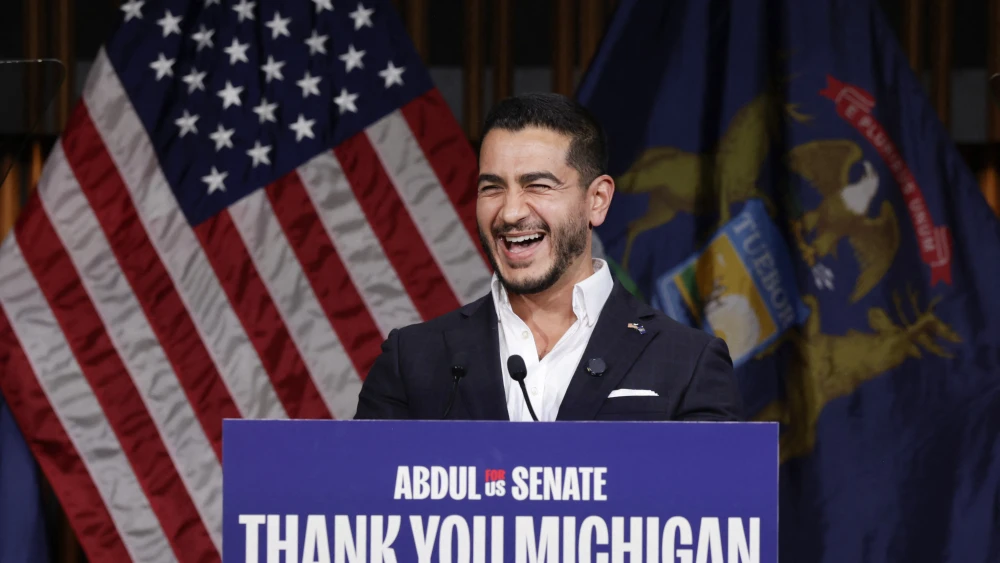
In one of the most closely watched races in the country, the Anti-Defamation League said that Michigan senator-elect Dr. Abdul El-Sayed’s decision to campaign with the antisemitic influencer Hasan Piker was “absolutely shocking” and reflects “the dangerous normalization of antisemitism in our politics.”
The Republican Jewish Coalition called El-Sayed “the most antisemitic U.S. Senate candidate in America.”
Despite those warnings, a poll of Jewish voters in Michigan suggested that a majority of Jews in the state who voted early opted for El-Sayed, albeit by a much narrower margin than supported the Democratic nominee for governor or compared to the number of Jews who voted for Democrats nationwide.
Ron Halber, CEO of the Jewish Community Relations Council of Greater Washington, told JNS that Jews in Michigan had to balance issues like support for Israel against wanting to send a rejoinder to U.S. President Donald Trump in deciding whether to back El-Sayed.
“They knew what he stood for,” Halber said. “If they still voted for him, they obviously calculated that.”
“They believed that his influence on stopping Trump would be greater than his ability to do any damage to the U.S.-Israel relationship,” he said. “That allowed Jewish Democrats to cast their vote.”
Halber also pointed to the unpopularity of Israeli Prime Minister Benjamin Netanyahu among American Jews.
“American Jews are struggling with Israel’s reputation,” he told JNS. “A candidate’s position on Israel may have been a little less important than it was in the past, because they are so upset with Israel and the current government.”
Vehemently anti-Israel voices like El-Sayed’s will be a small, albeit larger, minority of the Democrats who were swept into power in the House and Senate on Tuesday.
AIPAC noted on Thursday that 245 of the candidates that it backed had won their elections in response to a story in Politico that claimed the group’s allies were “dwindling” in Congress.
“AIPAC members support Democrats and Republicans,” the group wrote. “So yes, unfortunately, 10% of the candidates they backed lost in a wave election.”
The pro-Israel group announced in October that it would cease making direct candidate endorsements and instead support candidates via the donations of its members, as it did prior to 2021, and through its United Democracy super PAC.
Over the course of the campaign season, the group faced a backlash from many Democrats, who accused it of having a nefarious influence on U.S. elections and the Democratic Party, even as the group had long backed Democratic leaders like Rep. Hakeem Jeffries (D-N.Y.) and Sen. Chuck Schumer (D-N.Y.).
Israel played a larger role in intra-Democratic politics this year than it did in the GOP, but Republicans may soon have to deal with growing anti-Israel sentiments on the right after U.S. Vice President JD Vance, who is widely expected to run for president in 2028, blamed the U.S.-Israel relationship in part for his party’s losses on Tuesday.
Bernstein told JNS that he does not think that either the Israeli election in October or the results of the midterm in the United States would change the trajectory of discourse about Jews and Israel in America.
“Even if Bibi Netanyahu was no longer the prime minister, I don’t think that that stops anything,” he said.
The train of Jew-hatred and opposition to Israel “has left the station,” the B’na B’rith leader told JNS.
“It’s, to me, unbelievable what’s gone on over the last three or four or five years and how fast this is all moving against the Jewish communities across the globe,” Bernstein said. “It’s shocking how fast this is moving.”
One challenge that Jewish groups will face in the next Congress is the sheer number of new faces in Congress after Democrats unseated Republicans in both swing districts and in longtime GOP strongholds.
Republicans who lost on Tuesday included some of the most prominent voices on Jewish issues in Congress, like Rep. Brian Fitzpatrick (R-Pa.), who co-chaired the House bipartisan task forces for combating antisemitism, and Rep. Mike Lawler (R-N.Y.), who helped introduce the Jewish American Security Act to increase funding for the nonprofit security grant program.
Josh Nason, senior director of political affairs at the Jewish Federations of North America, told JNS that the “biggest story” of election night was how many new members of Congress “weren’t even on the radar.”
“There’s going to be a big education challenge,” Nason said. “Our first priority is establishing that connection point and helping them understand, especially on the security front, the acute threat that the community is facing and the importance of working on this issue.”
“There are a lot of members, who were really big champions of the issues we care about, who aren’t coming back,” he said. “That’s a huge challenge.”
Nason told JNS that maintaining bipartisan relationships will help ensure that the priorities of Jewish groups, like getting increased security funding for houses of worship, remain on the Congressional agenda.
“The players are changing,” Nason said. “Democrats are going to control the House and Senate floor, which means they’re going to get to decide which bills come up, which means our conversations are going to have to be with Hakeem Jeffries and his team and with Chuck Schumer and his team.”
The same will also be true at the state level, with Democrats flipping control of legislative chambers in nine states and five governor’s mansions on Tuesday, including in states like Texas, where Jews make up less than 1% of the population.
“We saw a huge blue wave election, and it’s a ton of new legislators, many of whom have no history or background on the issues that we care about,” Nason told JNS.
“We’re starting this process from the standpoint of an opportunity,” he said. “How do we make sure that we build those relationships? How do we make sure that we help legislators understand what their local Jewish community cares about and build that into policy successes?”