Coming to the annual Kinus gathering of thousands of Chabad-Lubavitch emissaries, who travel to New York City from some 110 countries, is “when the lone trees come back to the forest,” according to Rabbi Zvi Drizin, director of the Chabad at Southern Methodist University, in Dallas.
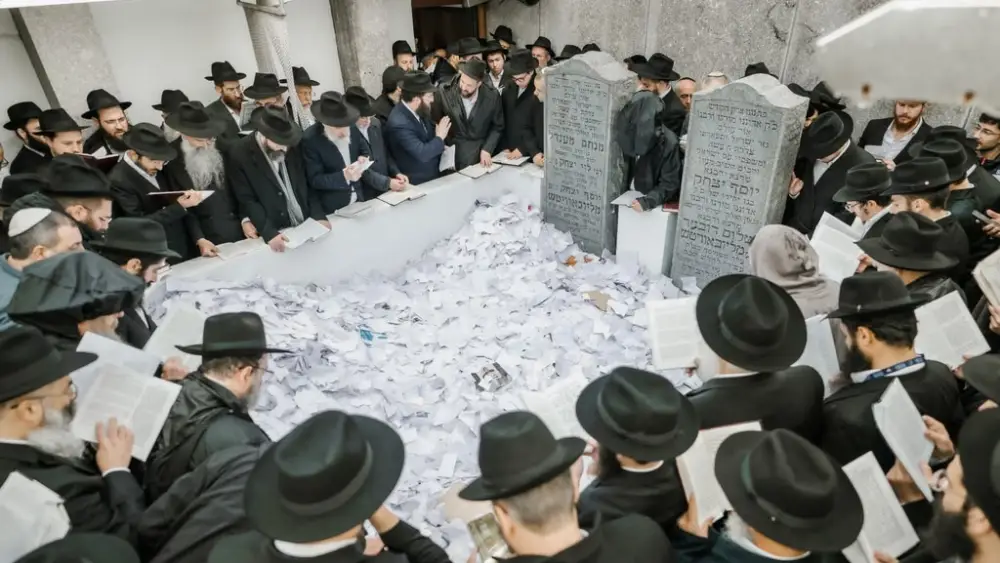
Drizin talked to JNS on Friday at the Ohel, the burial place of Rabbi Menachem Mendel Schneerson, known as the Lubavitcher Rebbe. He was one of 6,500 emissaries, or shluchim, who came that day to the site in Queens, where people greeted each other with “Mazal tov,” embraced and wished each other a forthcoming “Shabbat shalom.”
Many stopped to pray and study, and one attendee, whom JNS overheard, entrusted a stranger with the name of a sick newborn and asked him to pray for the child.

“The shluchim are carrying the weight of the Jewish people. From facing terrorism, war-torn countries and natural disasters to everyday human struggles, they absorb it all,” stated Rabbi Mendy Kotlarsky, director of the International Conference of Chabad Emissaries.
“But here, at the Rebbe’s resting place, they draw the strength they need to keep going, to return home and be the ones who uplift, who rebuild, and give hope to millions of Jews across the globe,” he stated.
For Drizin, Kinus is a chance for emissaries, who spend much of the year working independently, to remember that they are part of something much larger.
“The lone trees come back,” he said, of the support and “nourishment” that they require to continue their work.
The visit to the Ohel is central to that process. Rabbi Mendel Shmotkin, executive vice president and CEO of Lubavitch of Wisconsin, told JNS that “for so many of us, it’s coming back home.”

Rabbi Mendy Dubrowski, a Chabad emissary in Tampa, Fla., whose father the Rebbe dispatched to the city in 1983, told JNS that the Ohel visit is both personal and collective.
After years away studying and receiving rabbinic ordination, Dubrowski returned to Tampa to expand his father’s work. The family now operates in multiple centers across the city.
At the Ohel, he said, emissaries bring their individual challenges together and seek strength to continue. He compared the gathering to soldiers of different ranks standing together before their commander.
“The atmosphere for those that are lucky enough to be here is one of hope,” Dubrowski told JNS. “When we are strengthening and reinforcing each other, there’s nothing we can’t accomplish and overcome.”
Their mission, rooted in the Rebbe’s teachings, has taken Chabad emissaries to communities across the world, where they establish synagogues, schools, campus programs and other institutions designed to make Jewish life accessible to people regardless of their backgrounds or levels of observance.

Shmotkin told JNS that Rabbi Jonathan Sacks, the late former chief rabbi of the United Hebrew Congregations of the Commonwealth, described the Rebbe sending emissaries to search for every Jew with love in response to many who were hunting for Jews with hatred.
That approach resonates particularly today, as Jews navigate rising antisemitism, according to Shmotkin.
Rather than letting hatred define Jewish life, Chabad stresses strengthening Jews’ understanding of and connection to their own heritage, according to the rabbi.
“When I am comfortable with my Judaism, when I know exactly what it is and somebody out there doesn’t like it, well, what a shame, how ignorant somebody out there is,” he told JNS.
In Wisconsin, he has seen more parents seek Jewish education for their children, increased synagogue attendance and more people taking on Jewish ritual commandments since Oct.7, he said.

Rabbi Chaim Greisman, a Chabad emissary in Stockholm, Sweden, told JNS that he has seen a similar reconnection among Jews in his community since Oct. 7.
Many had assumed that they could live like anyone else and be accepted, but the Oct. 7 attacks and their aftermath prompted some to reconsider where they belonged and reconnect with Jewish life, the Swedish rabbi said.
Greisman said that Chabad focuses on Jewish identity rather than making opposition to antisemitism the center of communal life.
“We’re not supposed to be anti-antisemites,” he told JNS. “We’re supposed to be Jews, and live as proud Jews.”
That approach is reflected in the everyday work of his community, including helping people take on Jewish practices that they may never have considered. A 90-year-old Hungarian Holocaust survivor recently donned tefillin for the first time on his birthday, Greisman told JNS.
He also recalled an 85-year-old Jewish man, who had never had a bar mitzvah, asked him to conduct one.
“Every mitzvah is eternal,” he said.
Drizin, the Dallas rabbi, told JNS that “we, as Jews, don’t have an antisemitism problem. People who are antisemites have that problem.”
He compared Jew-hatred to racism. Responsibility lies with those who harbor prejudice, not with the people targeted by it, he said. Chabad empowers Jews to be courageous and confident in their Judaism, regardless of how much antisemitism they encounter, he added.
“Our world, as Jews, has to be to make sure there are Jews that are embodying what it means to be Jewish,” Drizin told JNS.
At Southern Methodist University, a private school with United Methodist heritage that is nonsectarian in its teaching, the Jewish student population is growing, and the rabbi estimates about 2% of the senior class is Jewish, compared with at least 8% of the freshman class.
SMU is a particularly welcoming campus for Jewish students, Drizin said.
For Dubrowski, the Tampa rabbi, Kinus is a reminder that the challenges emissaries face in their communities are not theirs alone.
“Seeing this incredible army of love reminds us that we will succeed,” he told JNS.