U.S. Marines on Sunday intercepted an Iranian cargo ship that attempted to break through Washington’s naval blockade of the Islamic Republic, U.S. President Donald Trump announced ahead of expected peace talks in Pakistan.
“Today, an Iranian-flagged cargo ship named Touska, nearly 900 feet long and weighing almost as much as an aircraft carrier, tried to get past our naval blockade, and it did not go well for them,” Trump wrote in a post on his Truth Social platform.
“The U.S. Navy guided missile destroyer USS Spruance intercepted the Touska in the Gulf of Oman, and gave them fair warning to stop. The Iranian crew refused to listen, so our Navy ship stopped them right in their tracks by blowing a hole in the engineroom,” continued the post.
The president said U.S. Marines took “full custody of the ship” and were checking its cargo. He noted the Touska had been under U.S. sanctions “because of prior history of illegal activity” on behalf of the Islamic regime.
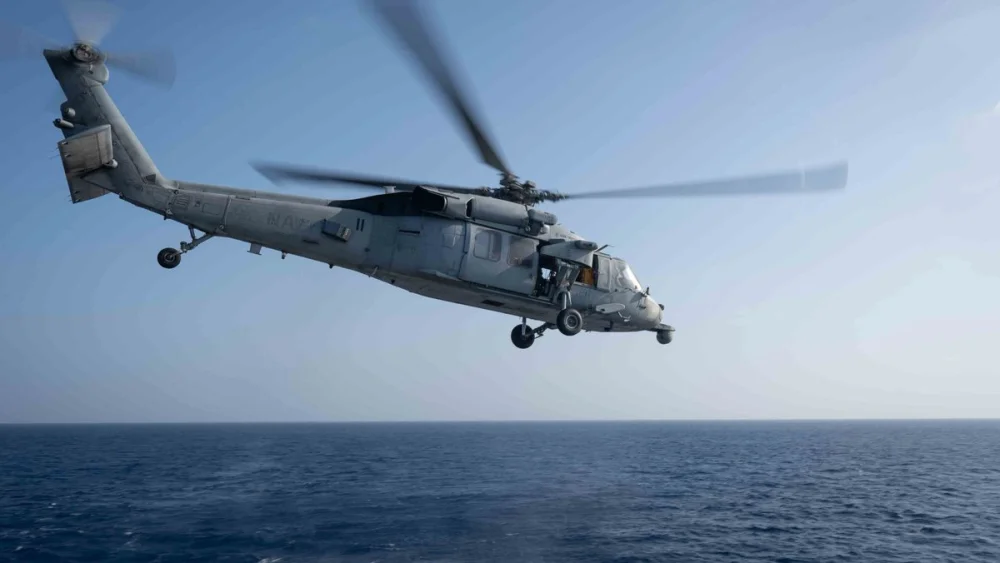
United States Central Command shared footage of the Marines departing amphibious assault ship USS Tripoli by helicopter and boarding the Touska.
U.S. Marines depart amphibious assault ship USS Tripoli (LHA 7) by helicopter and transit over the Arabian Sea to board and seize M/V Touska. The Marines rappelled onto the Iranian-flagged vessel, April 19, after guided-missile destroyer USS Spruance (DDG 111) disabled Touska’s… pic.twitter.com/mFxI5RzYCS
— U.S. Central Command (@CENTCOM) April 20, 2026
The Pentagon in an X post said the Iranian vessel was intercepted “as it transited the north Arabian Sea at 17 knots enroute to Bandar Abbas, Iran.”
After the vessel’s crew ignored repeated warnings over a six-hour period, U.S. forces warned the Touska to vacate its engine room, the Defense Department noted.
The Spruance then “disabled Touska‘s propulsion by firing several rounds from the destroyer’s 5-inch MK 45 Gun into Touska‘s engine room,” it stated. “U.S. Marines from the 31st Marine Expeditionary Unit later boarded the non-compliant vessel, which remains in U.S. custody.”
Since the blockade went into effect on April 13, U.S. forces have ordered 25 ships to turn around or return to an Iranian port, the post added.
U.S. forces operating in the Arabian Sea enforced naval blockade measures against an Iranian-flagged cargo vessel attempting to sail toward an Iranian port, April 19.
— DOW Rapid Response (@DOWResponse) April 19, 2026
Guided-missile destroyer USS Spruance (DDG 111) intercepted M/V Touska as it transited the north Arabian Sea at… https://t.co/iyzOQd93C3 pic.twitter.com/HwU4XS48Oq
U.S. negotiators will be going to talk with Tehran despite the IRGC Navy’s violations of the ceasefire, Trump said earlier on Sunday, while threatening to target Iranian civilian infrastructure if talks fail.
Iranian state media had reported on Sunday night that the Islamic Republic was not planning to take part in renewed talks.
“I hope they take it,” Trump wrote on Sunday on Truth Social, referencing the U.S. offer for a deal, which he said was “very fair and reasonable.” If the Iranian regime does not take the deal, “the United States is going to knock out every single power plant, and every single bridge, in Iran,” the president wrote.
“Iran decided to fire bullets yesterday in the Strait of Hormuz—a total violation of our ceasefire agreement! Many of them were aimed at a French ship, and a freighter from the United Kingdom. That wasn’t nice, was it?” Trump wrote in the beginning of his post.
“My representatives are going to Islamabad, Pakistan—they will be there tomorrow evening, for negotiations,” he wrote. He suggested the Iranian decision to close the strait was inconsequential since the U.S. is imposing its own blockade, meant to prevent the Islamic Republic from receiving vital goods and products.
Iran’s government said on Saturday that it had reimposed “strict control” over the Strait of Hormuz as gunboats of the Islamic Revolutionary Guard Corps fired on three commercial vessels, according to maritime security reports. This ended a brief period of calm in the maritime route following the declaration on April 8 of a two-weak ceasefire in the hostilities between Tehran and Washington.
Traffic through the strait, a bottleneck along a major shipping route, is a key element of the ceasefire and any future deal.