


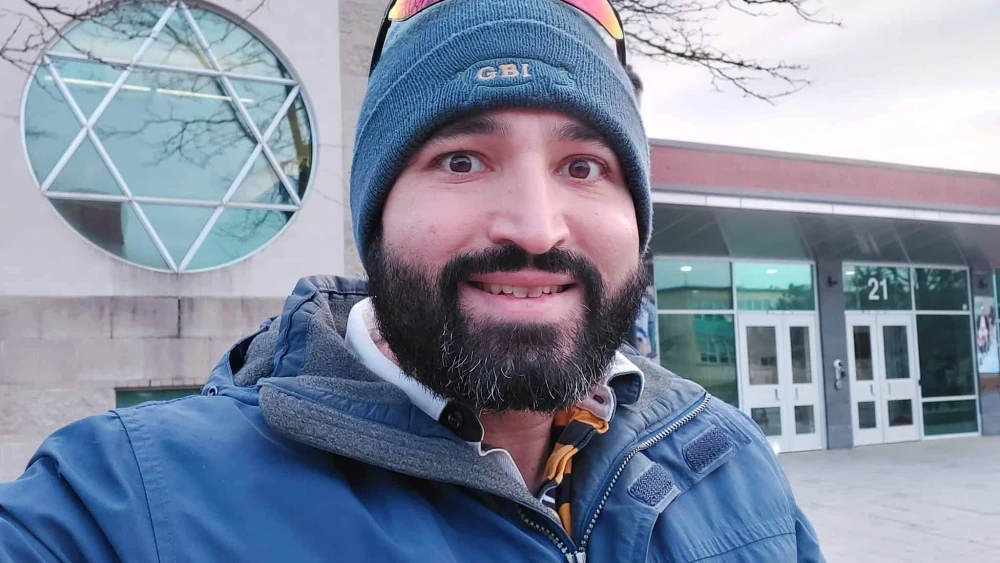
Having read the Torah during Shabbat services in each U.S. state, Michael Segal, 41, figured doing the same in Canada’s 10 provinces ought to be comparatively easy. That has not been the case.
“Focusing on the Canadian provinces has proved more challenging than I would have expected, having done all 50 states,” the veterinarian from Teaneck, N.J., told JNS, the week after he checked the seventh province off the list.
Segal spoke with JNS after having layened, or chanted the Torah portion, at Congregation Tifereth Beth David Jerusalem, an Orthodox congregation in Montreal. He has already read in Alberta, Manitoba, New Brunswick, Nova Scotia, Ontario, Quebec and Saskatchewan. The three that remain are Newfoundland and Labrador, Prince Edward Island and British Columbia.
He does not intend to chant the Torah in Canada’s three territories—Nunavut, Yukon and the Northwest Territories—a geographic area that spans approximately 2.5 million square miles and has about 200 self-identified Jews, according to 2011 data. But he will still have difficulty in Prince Edward Island, where there is no synagogue.
The largest crowd that the community attracts is on Rosh Hashanah—not Yom Kippur, “because they can’t have a kiddush afterwards to entice a crowd”—and even on the Jewish new year, there tends to be eight people, shy of the 10 men necessary for an Orthodox quorum to read the Torah. The “tiny” Chabad in Newfoundland also has difficulty corralling a minyan, he said.
“When I set out on the quest, I wasn’t even positive if it was possible, or how long it would take me,” Segal told JNS of what became a 10-year mission.
As his unusual quest has attracted attention, some congregations have marshalled congregants to form minyanim that would only otherwise do so on holidays or for funerals.
“Michael is on a wild mission,” Rabbi Raphael Kats, of the Chabad-Lubavitch of Saskatoon, told JNS. “We were lucky to help him check Saskatchewan off his list. With a last-minute minyan pulled together, we got to hear not just his beautiful Torah reading but also incredible stories from his cross-continental Torah journey.”
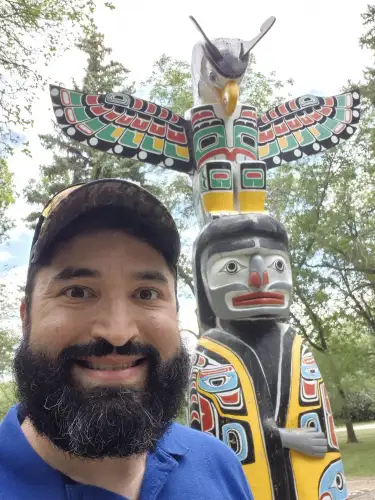
“Our community was uplifted, inspired and reminded of the power of one Jew on a mission,” the rabbi told JNS.
Segal told JNS that being in the Canadian Prairies, which includes Saskatchewan, was the first time he walked between wheat and soybean fields to get to synagogue.
“Part of it is spending Shabbos in 50 states, and 50 communities around the country, and really experiencing Shabbos with them, and having a mutually enriching experience,” he told JNS of the experience. “In Saskatoon, they really appreciated it. It definitely enriched the whole community.”
Energizing communities
After finishing ninth grade at Katz Yeshiva High School in Boca Raton, Fla., Segal began reading full Torah portions on Shabbat. He continued doing so after his family moved to Paramus, N.J., and after finishing high school, he read the Torah at Yeshivat Har Etzion during his gap year in Israel.
He returned to the United States to earn a bachelor’s degree in animal sciences from Cornell University and a doctorate in veterinary medicine from the University of Pennsylvania. He pledged in vet school to read every Torah portion on Shabbat before he turned 30.
For the past five years, he has read the Torah regularly at Congregation Rinat Yisrael, an Orthodox congregation in Teaneck, and at times, he has read the Torah portion at three different services in the same Shabbat.
When he realized the number of weekly Torah portions in the annual cycle corresponds to the number of U.S. states and territories, he decided to read in each one.
Among his memorable experiences stateside was driving a car full of prayer books and a Torah scroll on loan from an Omaha, Neb., synagogue to Fargo, N.D., while he was on a business trip to Nebraska in August 2015.
Rabbi Yonah Grossman, of the Chabad Jewish Center of North Dakota, had agreed to assemble a minyan, and he came through an hour before sunset, when the 10th man arrived, completing the quorum.
South Dakota was much harder. At the time, Grossman served both Dakotas, and there was no permanent rabbi nor Orthodox synagogue in the Mount Rushmore State. With some schedule coordination, Segal drove to Sioux Falls, but there was an unexpected challenge when two Israeli business owners and rivals, who were both necessary for the minyan, refused to participate together.
With some 11th-hour negotiations, Segal secured 12 men, and he was able to chant the Torah portion.
“Among the things I learned from my travels is that Chabad doesn’t mean there’s a minyan or a Torah. It just means there’s a rabbi,” he told JNS. (The tiny community in Newfoundland happens to have a Torah, he said.)
Segal is often asked why he doesn’t arrange for a bus with 10 men to come from place to place to complete a minyan. “That’s not what it’s about,” he told JNS.

The way he sees it, his quest has helped congregations with dwindling numbers and shifting demographics by being a catalyst for higher attendance.
Some 22 people showed up the week he read the Torah at Beth Israel Congregation, an Orthodox congregation in Halifax, Nova Scotia, compared to 12 to 15 who typically come on a Shabbat. (The first in the Maritime provinces, the congregation dates to 1890 and its current building to 1957.)
Tiferes Israel Synagogue, an Orthodox congregation in Moncton, New Brunswick, tends to attract 15 people on a Shabbat, and 31 came when he read, Segal told JNS.
“They were really happy to have me there and hear stories,” he said.
Segal told JNS that he isn’t sure whether he’ll add an asterisk to provinces where he tried to read but couldn’t, or whether he will return for a second attempt.
On Sept. 13, he plans to read the Torah for the first time in Toronto, at Beit Zion, a Modern Orthodox congregation that meets in a senior’s home.
Segal told JNS that he has mostly paid for his trips out of pocket, though some cities have coincided with work trips, including veterinary research that he conducts on—of all things for an itinerant Torah reader—pigs.


