Newsletter
Newsletter Support JNS

ICJ shows ‘predilection’ for Jew-hatred, says ranking Senate Foreign Relations Committee member

“The so-called ‘court’ has this all backwards,” said Sen. Jim Risch (R-Idaho).

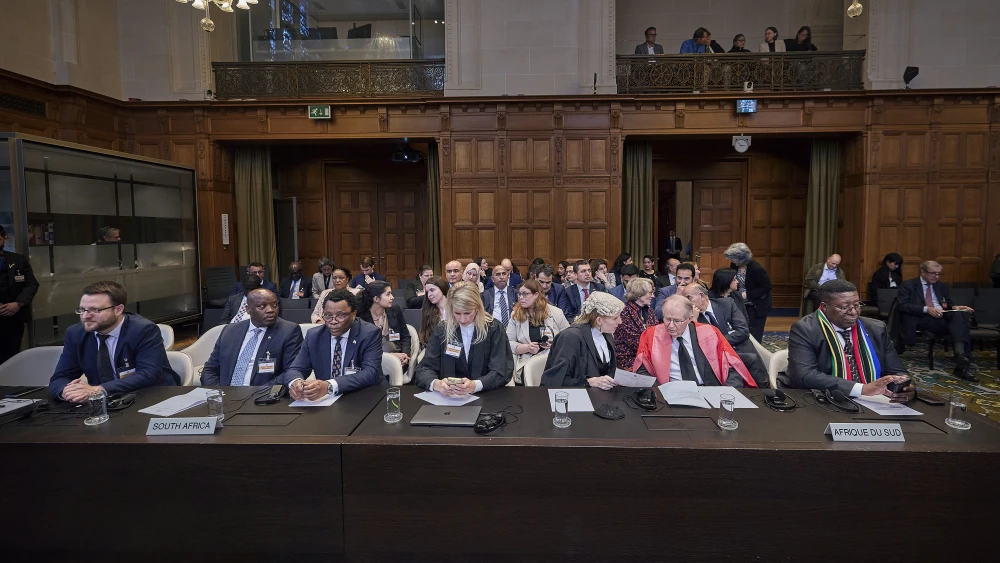
South Africa ICJ
Members of the South Africa delegation at the International Court of Justice on May 24, 2024. Credit: Bastiaan Musscher/U.N. Photo/ICJ-CIJ.

The principal judicial arm of the United Nations in The Hague, the International Court of Justice, “has shown its hate, bias and its predilection for antisemitism” in its Friday ruling that Israel must stop its military campaign against the Hamas terror group in Rafah, according to Sen. Jim Risch (R-Idaho).

“The so-called ‘court’ has this all backwards—those on the court would do well to make a ruling against Hamas demanding that Hamas release the hostages, cease fire, and lay down their weapons and stop this war,” said Risch, ranking member of the Senate Foreign Relations Committee.

“In particular, I am disgusted to learn an American judge voted for this ruling,” the senator said. “The ICJ is both morally and structurally bankrupt, and the United States should immediately cut off its funding to this prejudiced organization.”

“The U.N. has chosen to support terrorists who use hostages as weapons rather than support a sovereign nation that seeks to defend its citizens,” he added. “Israel has the right to defend itself and do all it can to eliminate Hamas terrorists who have plainly stated they wish to wipe Israel and the Jewish people off the map.”

Israeli forces later killed six Hezbollah terrorists in separate engagements as troops continued operations inside the Security Zone.
The Israeli airline said it would review its decision next week following an assessment of the situation.
The Israeli leader said the Jewish state turned the table on its enemies after Oct. 7, breaking through “the barrier of fear.”
The newly released State Archives trace the Israeli response from the Air France hijacking to the successful hostage rescue in Uganda.
Panelists at the JNS Summit argued that Israel must expand its domestic military capabilities while continuing strategic cooperation with the United States.
“Anti-Zionism can be a framework for justifying anti-Jewish hostility,” Rafaela Dancygier, of Princeton University, told the N.J. Advisory Committee to the U.S. Commission on Civil Rights.
Benny Gantz, JNS editor-in-chief Jonathan S. Tobin, Gilad Erdan, Mosab Hassan Yousef, Nissim Black and leading voices in security, diplomacy, media, law and Jewish communal affairs headline the summit’s third day in Jerusalem.
