


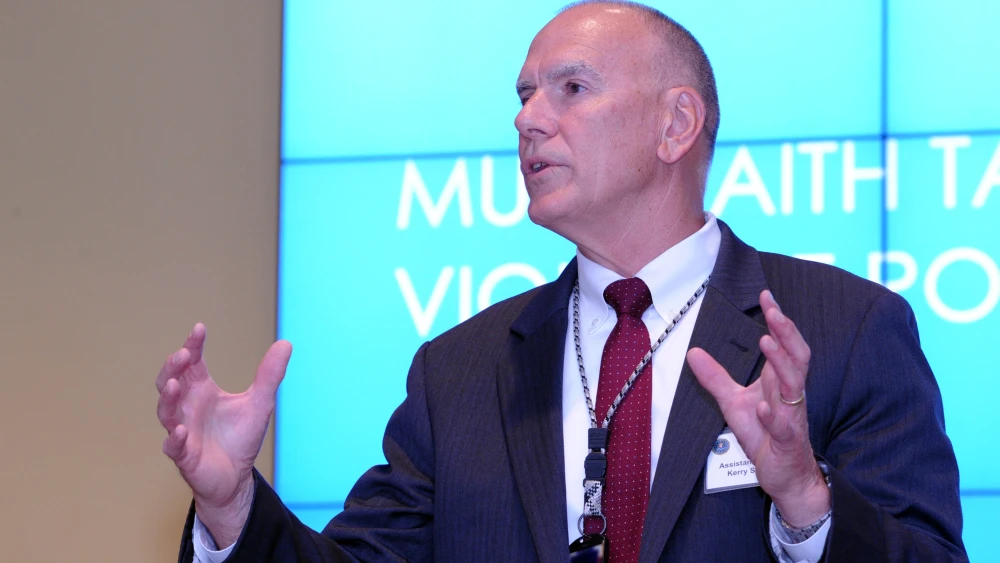
Representatives of Jewish, Christian, Muslim and other religious groups gathered together recently at FBI headquarters in Washington, D.C., for a discussion on security issues facing faith communities.
The timing couldn’t be more apt, as one FBI source noted that this is the most “complex and dynamic threat environment we have ever been in.”
Every day, said the source, foreign governments are researching and identifying ways that they can “exploit” and “sow discord,” and turn people against their own communities. He added that faith communities need to think about the consequences of what happens if the United States and Iran have a deeper conflict, and Hezbollah responds by attacking local communities.
“You need to be thinking about that now,” stressed the source.
The FBI’s advice in a shooter situation? Run, hide, fight.
During the June 18 program, faith leaders heard from officials from the Department of Justice, Department of Homeland Security and others, including assistant director of the FBI’s Office of Partner Engagement Kerry Sleeper. Speakers highlighted the changing and growing threats facing faith communities, and listened as the community leaders discussed concerns of their members, as well as how to move forward and ensure that everyone—federal officials, local law enforcement and faith members—has the tools necessary to prevent future attack.
One discussion led by a specialist in the FBI focused on the preattack behaviors of active shooters. Noting that the agency had studied 63 active shooters, the agent sought to debunk some myths and highlight common threads among attackers.
For instance, the FBI agent said, while many say that these people are loners, in fact, all either lived with someone or had “significant” in person or online interactions. The attackers had, on average, 3.6 separate stressors in the year prior to the attack, and 73 percent had a known connection with their attack site. Where attackers had no connection, they often did surveillance prior to attacking.
Discussions were also held around concrete steps that faith leaders can take to prepare congregants if an attacker strike their house of worship. Noting that it can take several minutes for law enforcement to arrive during an active shooter situation, one official suggested that congregants be taught the importance of the FBI’s advice: run, hide, fight.
“It’s human nature to freeze if you don’t have a plan in place,” he said, adding that people should know where all the exits are and how they would escape. The advice to hide “really means to disappear”—not be hidden halfway or in view of the attacker. The other option is to fight.
“How will you defend yourself? You don’t need weapons; you don’t need jiu-jitsu,” but people do need a plan, the official advised, adding that “there are ways to prepare people mentally, without scaring them.”
‘We are all feeling vulnerable’
Eric Fusfield, deputy director of the International Center for Human Rights and Public Policy at B’nai B’rith International, appreciated the details and analysis, as well as the chance to hear from leaders in other faith communities.
“Our ability to build coalitions is always our greatest strength, and it’s always important that communities that face similar and overlapping threats to come together and identify ways to respond,” he continued. “We need the help and support of our neighbors, and they need ours, so it’s only natural we come together in times like this when we are all feeling vulnerable and want to secure our communities”
Other sessions included an address by Elizabeth Neumann, assistant secretary for threat prevention and policy at the Department of Homeland Security, who said that the last few years have seen a rise in domestic terrorism from those who are “borrowing” from the ISIS handbook in planning and implementing attacks; and a talk by an FBI agent who recounted his experiences during a shooting in 2012 at a Sikh temple in Oak Creek, Wisc.
The daylong program was spearheaded by the Secure Communities Network, the Christian Emergency Network and Muslim Public Affairs Committee.
It is believed to be the first gathering of its kind hosted by the FBI and with such a “broad and diverse group” of participants, according to Michael Masters, national director and CEO of the Secure Community Network, which was founded in 2004 auspices of the Jewish Federations of North America and the Conference of Presidents of Major American Jewish Organizations.



