


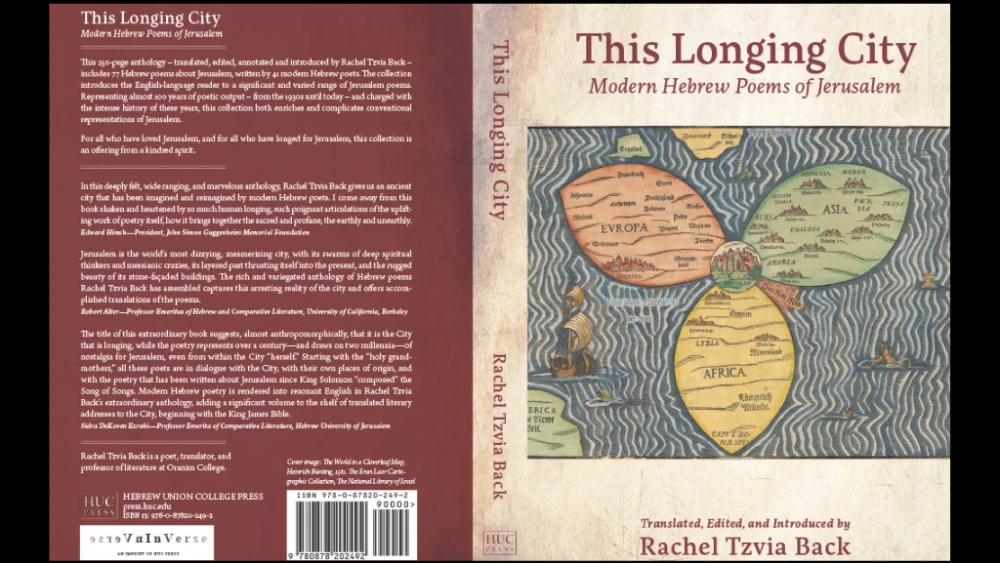
A new poetry collection, This Longing City: Modern Hebrew Poems of Jerusalem, translated, introduced and annotated by Rachel Tzvia Back, offers English-language readers an expansive and nuanced portrait of Jerusalem through the voices of modern Hebrew poets. This singular anthology is the first of its kind.
Published by Hebrew Union Press, this bilingual compilation features 77 poems by 41 poets, spanning nearly a century of literary expression, from the 1930s to the present. Presented in a bilingual format, the Hebrew originals appear alongside Back’s English translations, making the collection accessible to both scholars and general readers.

Moving beyond familiar names while still including canonical voices, the book introduces a broad spectrum of poetic perspectives that reflect Jerusalem’s layered identity-historical, spiritual, political and deeply personal. The collection captures the evolution of modern Hebrew poetry while illuminating the enduring power of Jerusalem as both a real and imagined city.
Back’s translations aim to preserve the texture, rhythm and emotional resonance of the original Hebrew, offering readers an authentic encounter with the poems. Her introduction and annotations provide literary and historical context, guiding readers through a body of work shaped by nearly a century of cultural and political change.
Early praise for This Longing City underscores its literary significance:
“In this deeply felt, wide-ranging and marvelous anthology, Rachel Tzvia Back gives us an ancient city imagined and reimagined by modern Hebrew poets. I come away from this book shaken and heartened by so much human longing, by the uplifting work of poetry itself,” said Edward Hirsch.
“The rich and variegated anthology of Hebrew poems Rachel Tzvia Back has assembled captures the arresting reality of Jerusalem and offers accomplished translations of the poems,” said Robert Alter.
“Modern Hebrew poetry is rendered into resonant English in Rachel Tzvia Back’s anthology,” said Sidra DeKoven Ezrahi.
With its scope, scholarly framing and literary depth, This Longing City is positioned to become an essential resource for readers of poetry, Jewish studies and Middle Eastern literature, as well as a significant contribution to the growing body of literature in translation.
Link to purchase:
https://www.amazon.com/This-Longing-City-Modern-Jerusalem/dp/0878202498
For review copies, interviews or more information, contact: Vicki@vickigjpr.com; 973-519-8926.



