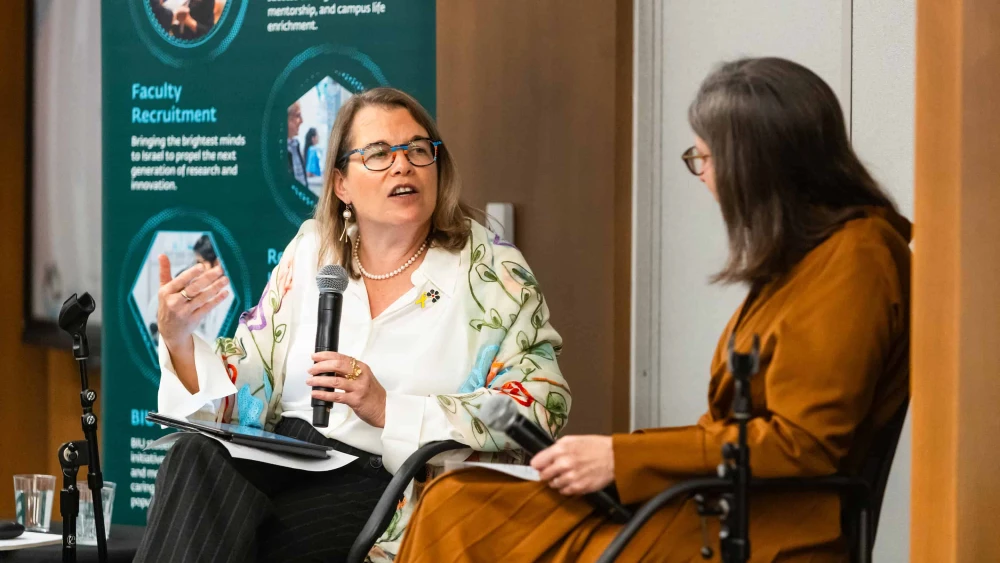
In an age of growing cynicism toward global institutions, two influential Jewish voices—Ruth Halperin-Kaddari, Ph.D., and Rabbi Joanna Samuels—delivered a shared message of conviction on Tuesday night: Giving up is not an option.
Speaking at an event hosted by the American Friends of Bar-Ilan University (AFBIU) on Manhattan’s Upper West Side, the women reflected on the erosion of faith in international human rights bodies following the atrocities of Oct. 7 and the muted response that followed. Yet both insisted that the only way to honor truth and justice is to continue working within imperfect systems to bring about change.
Halperin-Kaddari, a renowned women’s rights advocate and founder of the Rackman Center for the Advancement of the Status of Women at Bar-Ilan University, acknowledged her own disillusionment after witnessing denial and disbelief from global institutions—including the United Nations—regarding Hamas’s use of sexual violence on Oct. 7.
“The failure of the international human rights community is actually a failure of all humanity,” she said. “I’m more cynical and skeptical than ever before—and at the same time, more determined to create change from within. Giving up on these institutions is wrong.”
Her organization’s persistence eventually yielded a watershed moment when the U.N. Secretary-General’s annual report officially blacklisted Hamas for using sexual violence as a weapon of war—an outcome she described as both vindication and responsibility. Through The Dinah Project, which she co-founded under the auspices of the Rackman Center, Halperin-Kaddari helped put into motion the steps that led to this landmark designation of Hamas at the world body.
Rabbi Samuels—CEO of the Marlene Meyerson JCC Manhattan, where the event was held—echoed Halperin-Kaddari’s tension between outrage and obligation. She cited the struggle many Jewish women face as some progressive and feminist organizations—long aligned with their values—have failed to condemn antisemitism or the sexual violence committed against Israeli women.
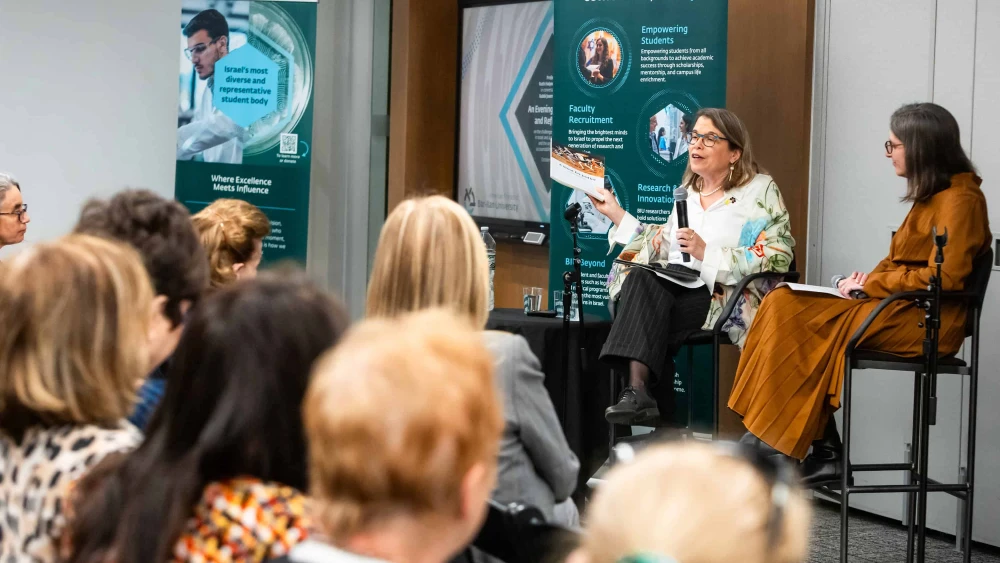
“As a liberal woman, I have to reckon with that inherent antisemitism,” she said. “It makes me feel extremely cynical about who is running and funding these organizations. But when I think of the people who are served by them, I have to get over it.”
Quoting Rabbi Abraham Joshua Heschel, Samuels added, “Against my better nature, I’m an optimist.” Her words underscored a central theme of the night: optimism not as naïveté, but as moral resistance.
Halperin-Kaddari reflected on the moral responsibility of engagement, even amid disillusionment. “You cannot really give up on what’s dear to you—on what’s part of your identity,” she said. “You have to work to maneuver and bring change as much as you can.”
Opening the evening, Jessica Feldan, CEO of AFBIU, reminded attendees that resilience is a defining characteristic of Bar-Ilan University—and of Israel itself. “People are just starting to feel like they can breathe again,” she said, describing how optimism has re-emerged in Israel and Jewish communities worldwide after two years of grief and uncertainty, with the release of the 20 remaining living hostages who were held by Hamas in Gaza.
When it comes to the relationship between Israel and the Diaspora, Feldan noted the broader significance of Bar-Ilan University’s efforts to ensure that no student-reservist fell behind academically during the war.
“They knew that we here in America had their backs,” she said.
The discussion left attendees with a clear message: that amid skepticism and loss, faith in justice and human agency—however strained—must endure.